Feeds:
Posts
Comments

iBag!

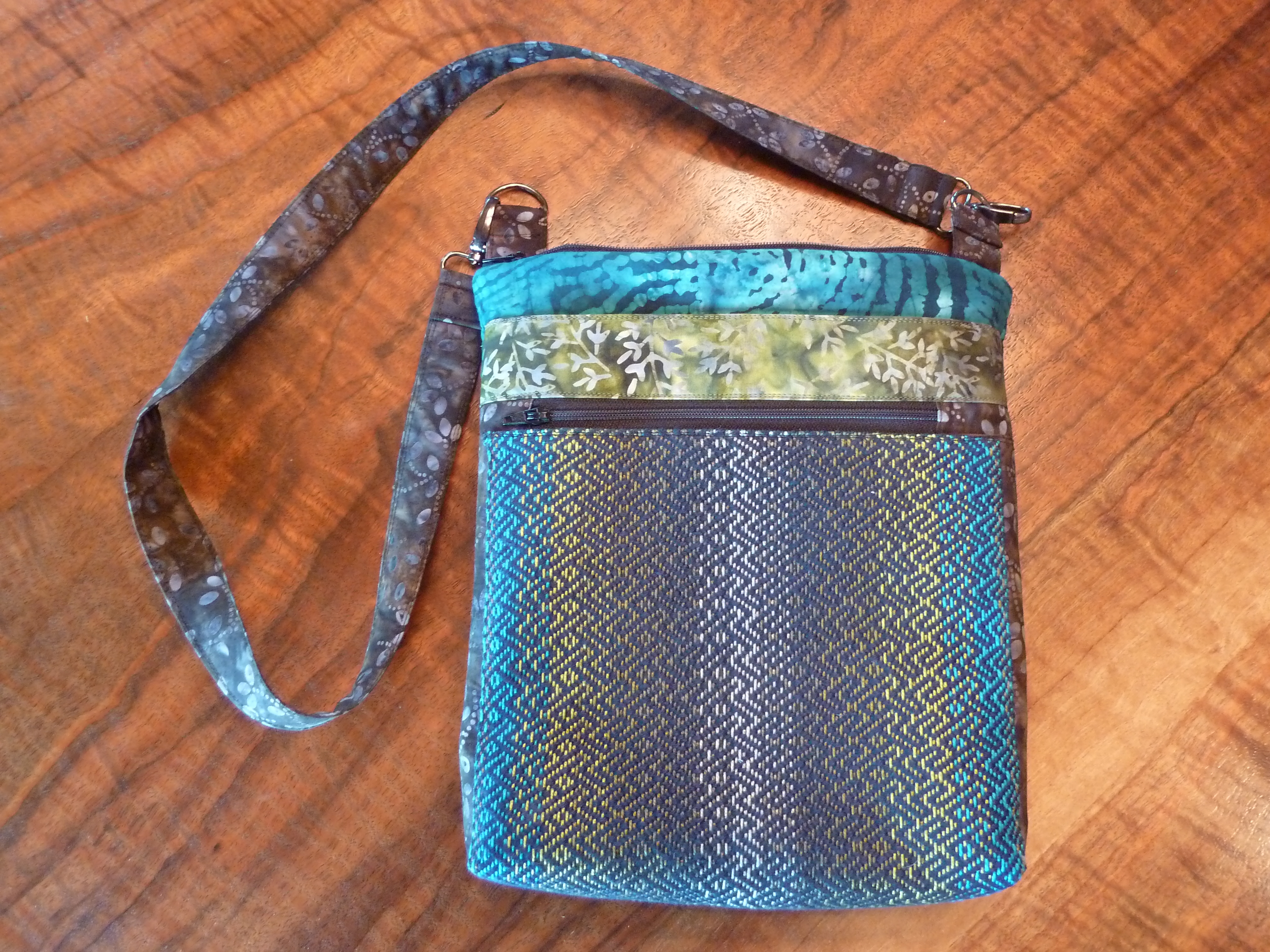
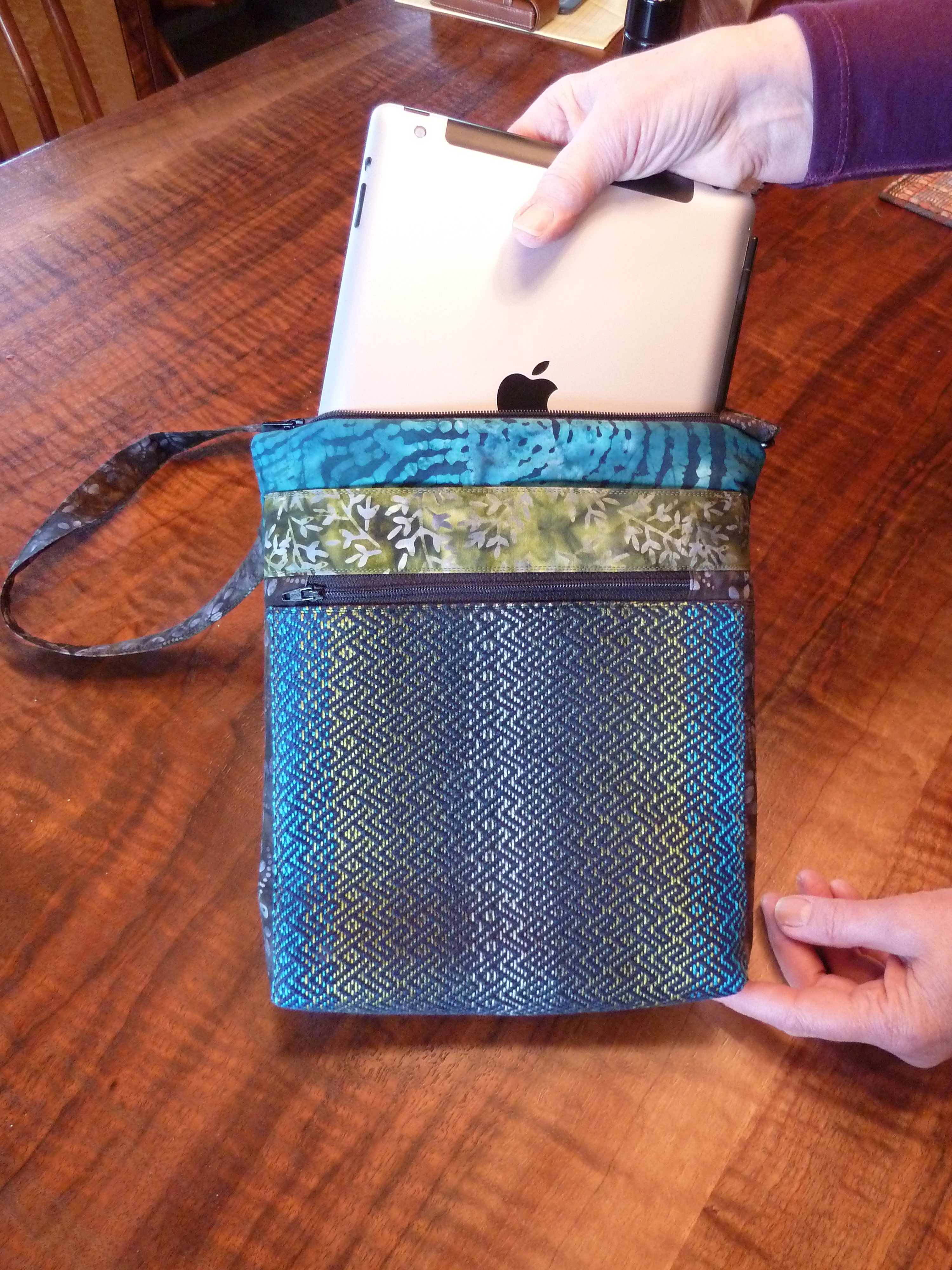
My neighbor, who is a talented quilter, made me this cool bag as a thank-you for teaching her to weave over the last couple of months.  It is from a pattern for an “iPad purse” and she has already made many of these for herself and for gifts.  The pattern is Barbados Bag from Pink Sand Beach Designs.

For mine, she used a length of cloth I had woven at the end of a warp for my plaited twill scarves.  There wasn’t enough length left for another scarf, but I didn’t want to waste the warp and knew I would use the extra cloth eventually for something.  So it has perle cotton for the warp (the vertical color stripes), and was woven with a very dark navy Tencel weft.   I went to a fabric store in Wenatchee last week and picked out some cotton batik quilting fabrics to go with my woven cloth, and the notions I needed to complete the bag.

She eliminated the inside pockets, as she says they just get in the way when she is putting her iPad into her bag.  There are already plenty of pockets on the outside, anyway.  The back panel is divided down the middle, e.g. for eyeglasses.  She made the main bag out of the batik cloth, then just stitched my woven cloth down on the face – it has finished edges, and wasn’t quite wide enough to go across to the side seams.

iBag 1

iBag 2

I would never have made this for myself in a million years, as I am not really skilled at sewing.  So I am thrilled beyond belief to have this beautiful padded bag/purse for my iPad!

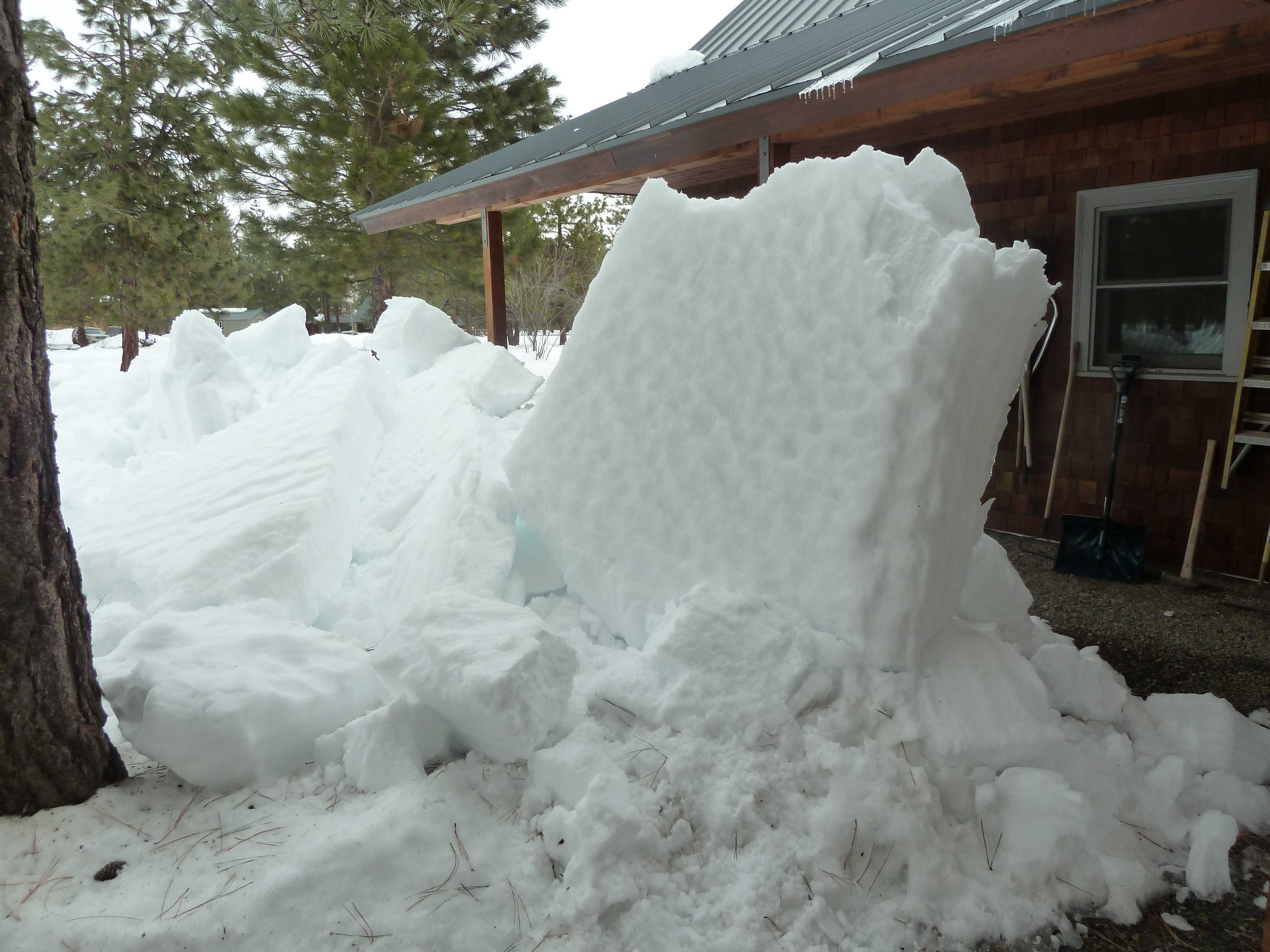
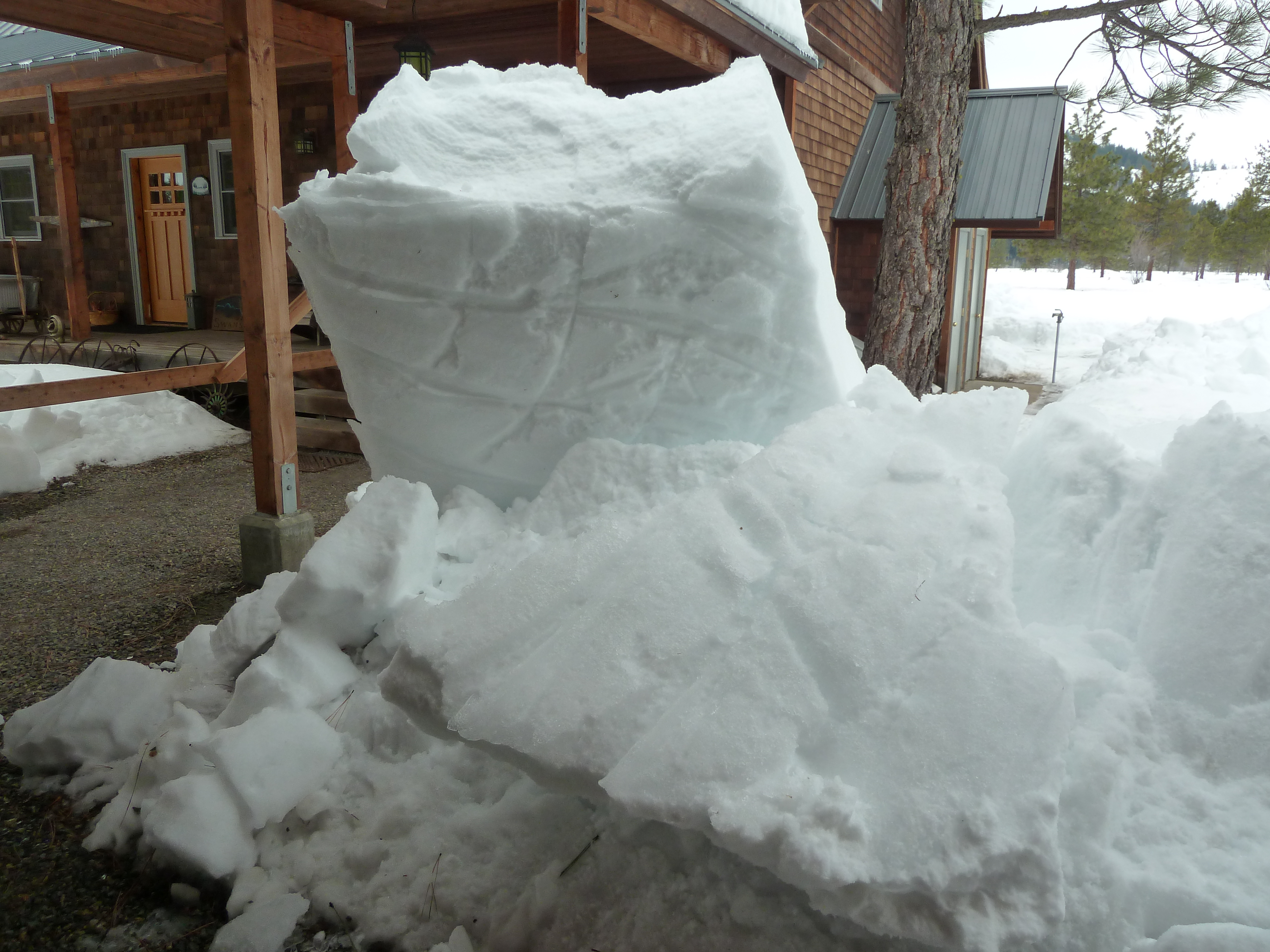
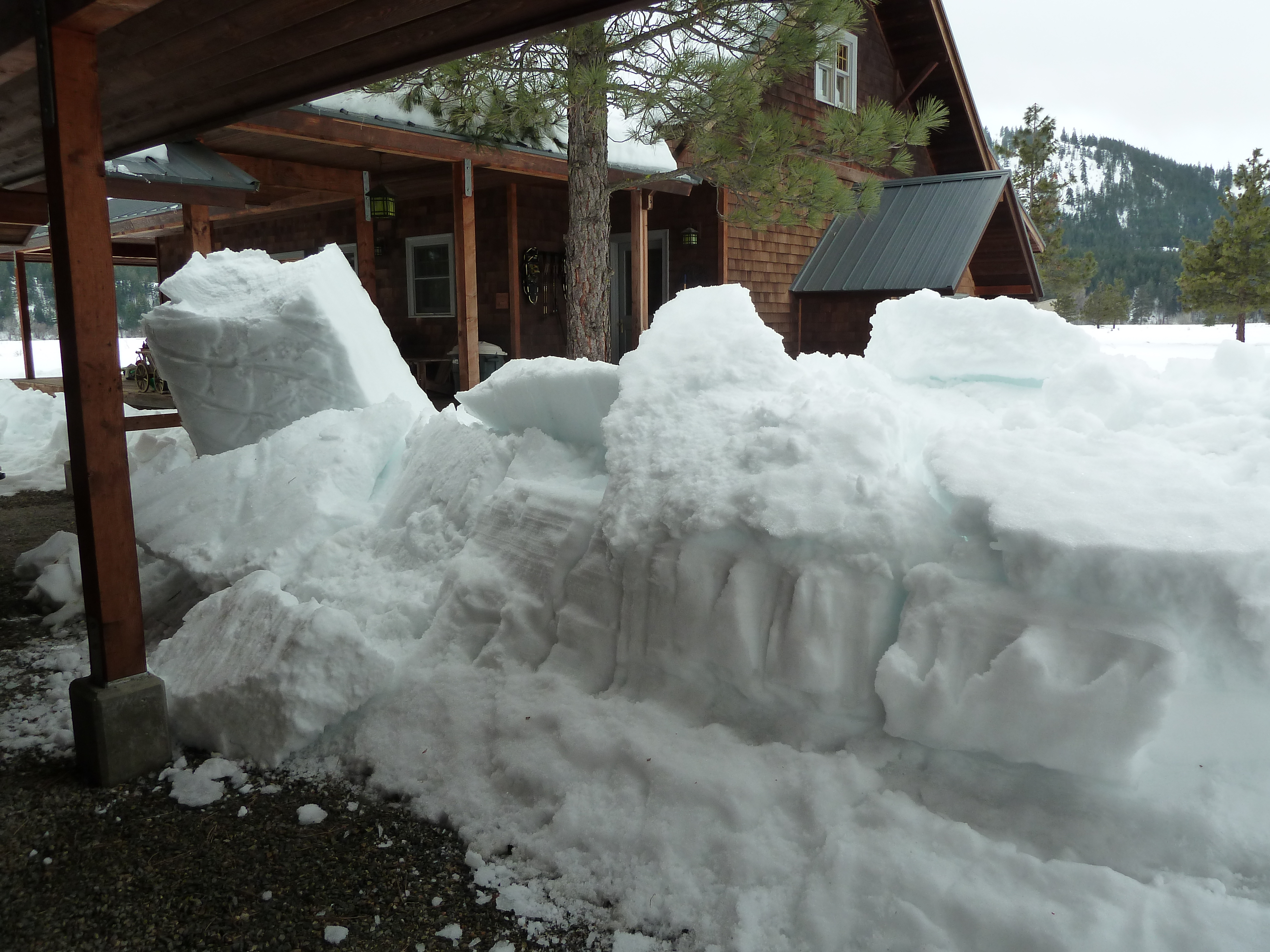
Last night it stayed above freezing and a huge load of snow came down off the shady side of the studio roof – including one really huge chunk.  It looks like a mattress fell off the roof!

P1020307

P1020309

Looking towards the house from my studio door.

Looking towards the house from my studio door.

January Chinook

A few days ago we had one day of unseasonably warm weather – meaning temperatures in the 50’s that day, with a wind.  This set up the perfect conditions for our roofs to shed their snow loads.  All day long there would be sudden loud shuddering swooshing sounds and another huge load would slide off the roof.  It scared the heck out of the cats!  They would just settle into a nice nap and then all of a sudden it sounded like a freight train was running through the house.

along the south side facing the road

along the south side facing the road

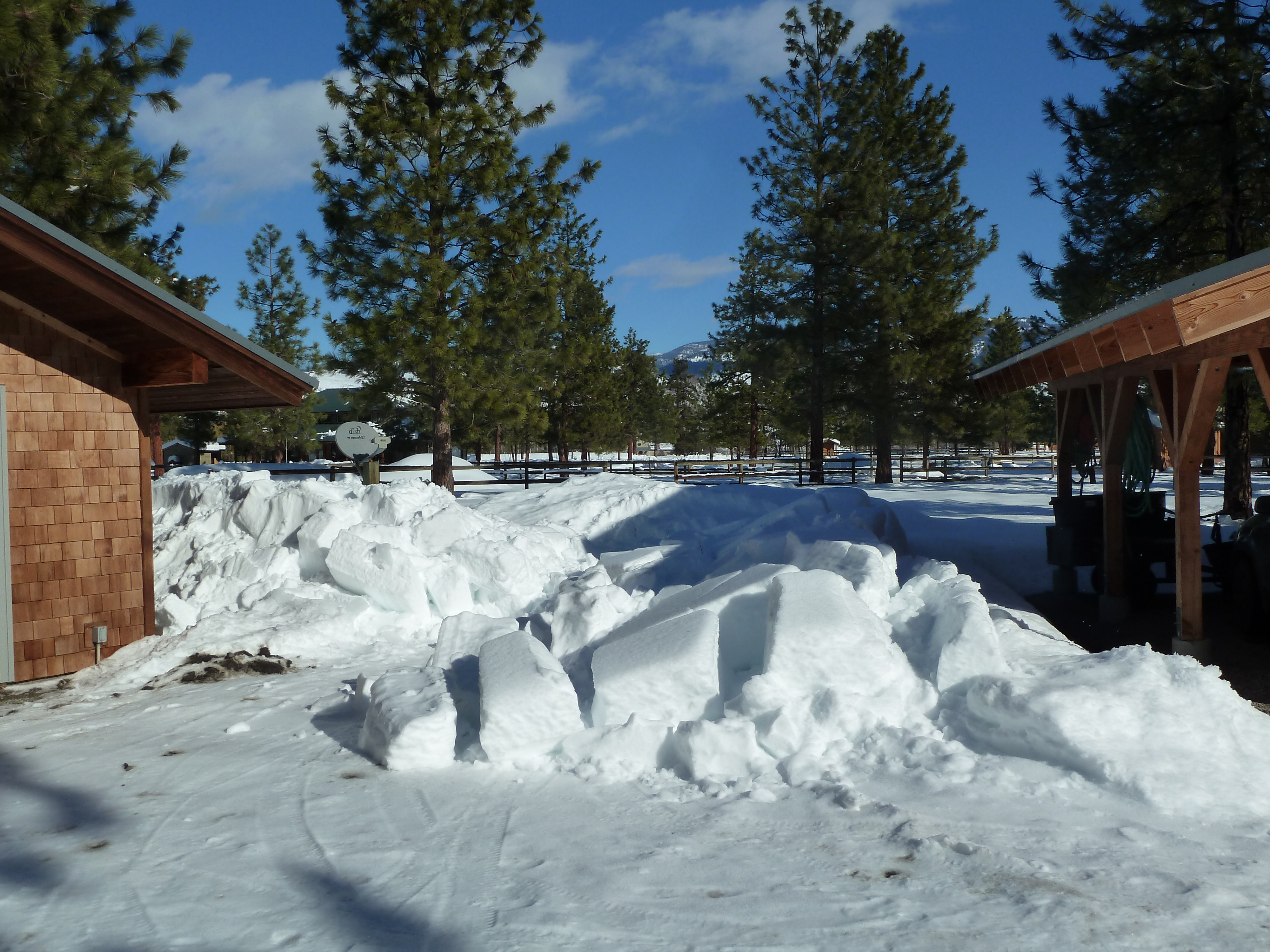
off the carport and studio roofs

off the carport and studio roofs

a pretty formation facing up-valley

a pretty formation facing up-valley. 

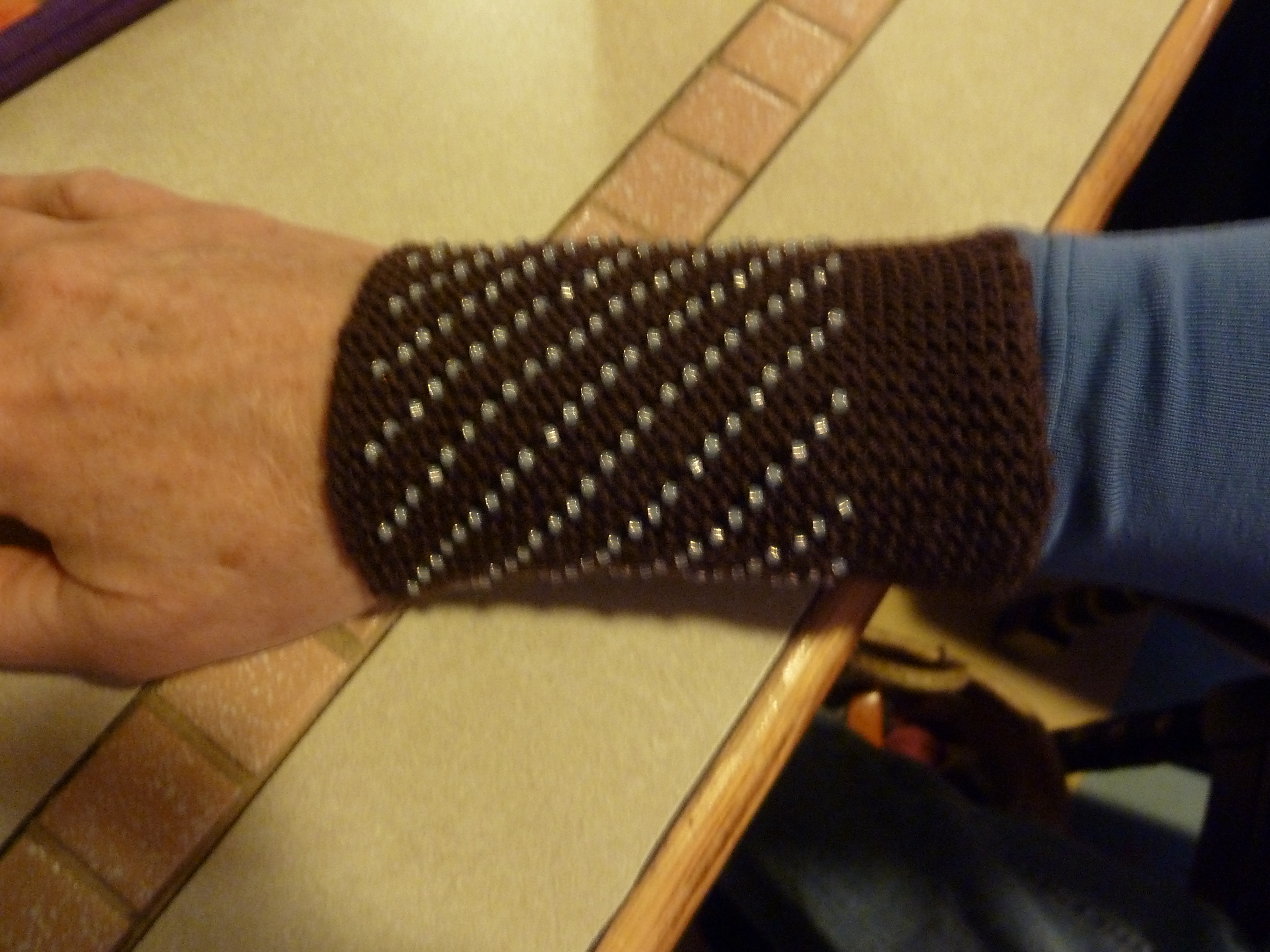
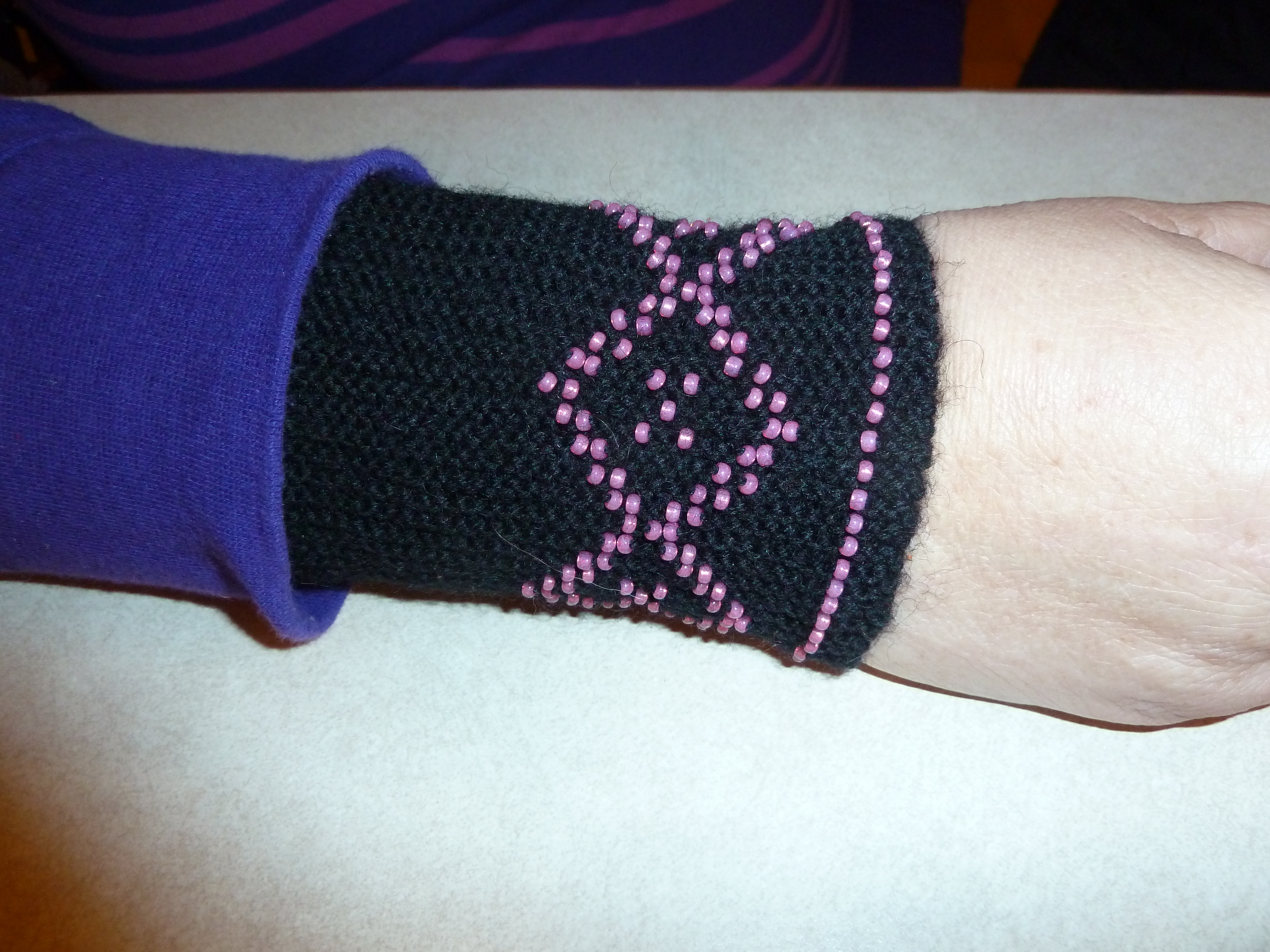
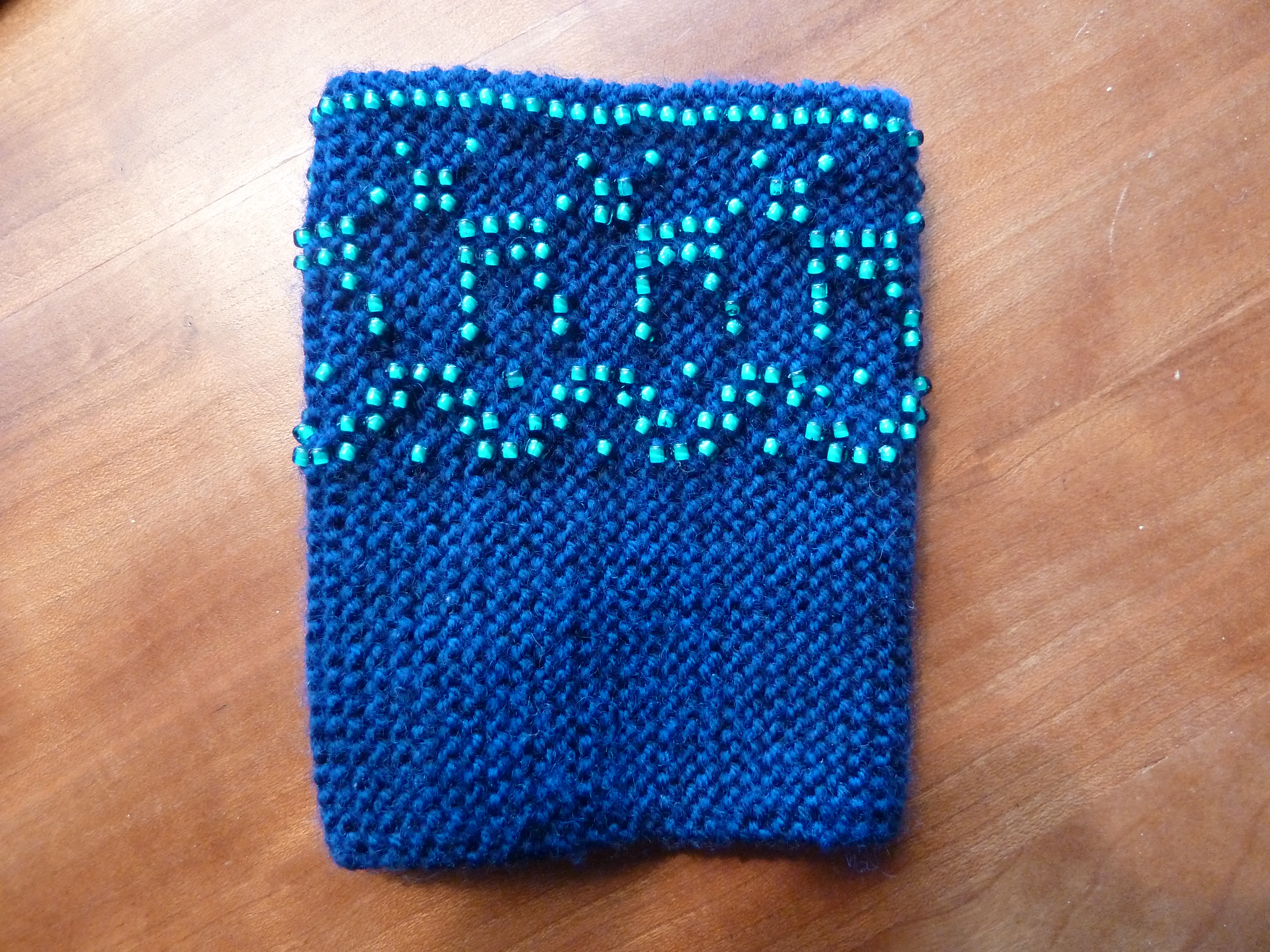
At Knit Night on Thursday, some of the women in my Beaded Cuff class had finished their cuffs (or rather, the first of a pair).  They turned out great!

P1020300

Should have used the flash for that one – I usually get better color without it.

P1020303

Finally Finished

I have been on a mission to finish up some of my knitting UFO’s (Un-Finished Objects), partly because I was tired of them languishing for so long, and partly because I may need them for examples for an upcoming sweater design class at the end of February.

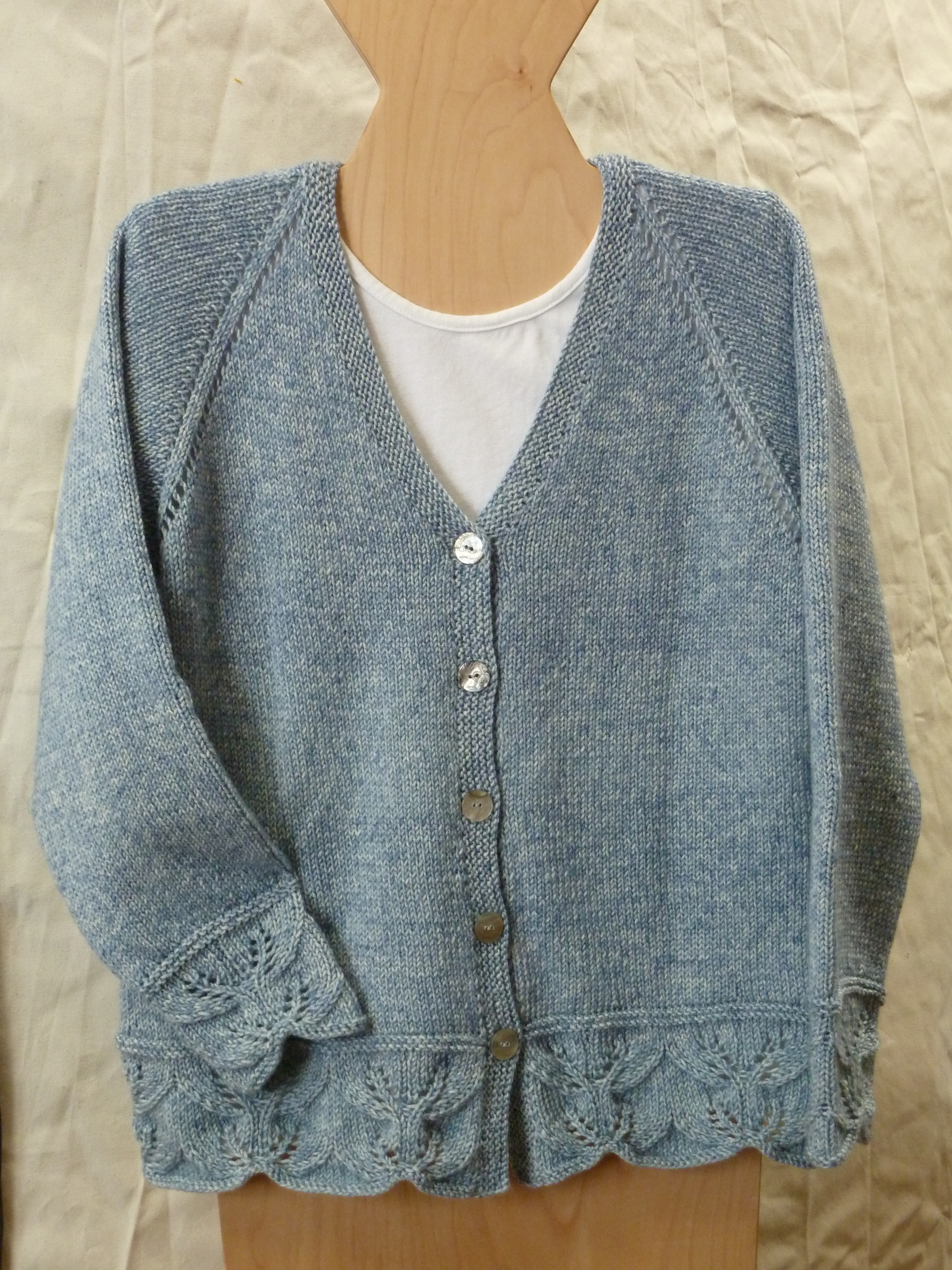
Berry Cluster Cardigan

This one was started in September 2010!  It was based on Karen Alfke’s Unpattern for Raglan Cardigans from the Top Down, which I have used in several classes with her permission.  For this one, I used a different raglan increase with a lace effect:  YO, K1, slip marker, K1, YO on each side of the markers that divide the fronts, sleeves, and back.  I was planning to do some kind of lace edging, so I wanted the raglan increases to be lacy.

The yarn is Queensland Collection “Merino Spray”, 100% extra fine merino wool, in color #5.  I used 8 balls at 135 yds (123 m) per ball.  Needle size 4 mm (US 6) for the main sweater with a gauge of 22 sts to 4 inches/10 cm.  Needle size 3.75 mm (US 5) for the lace edgings.  The dye lots were all the same according to the ball bands, but there is some striping, so I think it wasn’t as consistent as one would wish!

P1020279

P1020282

I searched my knitting library for lace edgings, and most are intended to be knit from the bottom up.  The sweater is knit from the top down, so it would be “more convenient” to just continue with the edging from the top down.  But I really liked this pattern and it was just too much trouble (indeed perhaps not possible) to convert it to a top-down approach.  It is “Berry Cluster II” from Nicky Epstein’s book Knitting on the Edge.

So, after swatching, I knit the edgings separately and then attached them to the live stitches at the bottom of the sweater and ends of the sleeves, using a “Japanese Three Needle Bind Off”.  With the Japanese 3 Needle Bind Off, you pull the stitches off one needle through the stitches of the other needle, all the way across, and then you bind off as a second step.  It seemed to make a less bulky and more invisible join than the regular 3-needle Bind Off.  There are tutorials out there on the web.

The sweater was finished with a simple garter stitch band, which I thought went well with the garter stitch portions of the lace edging.  There are buttonholes for the 5 buttons, but I think I will leave it buttoned and just pull it on and off over my head.  Also, the Berry Cluster II lace pattern calls for sewing on clusters of 3 beads at the base of each lace motif.  I had actually purchased some small graphite colored round beads, and started sewing them on, but it was just too fiddly and made the sweater look dressier than I really wanted, so I abandoned that idea.

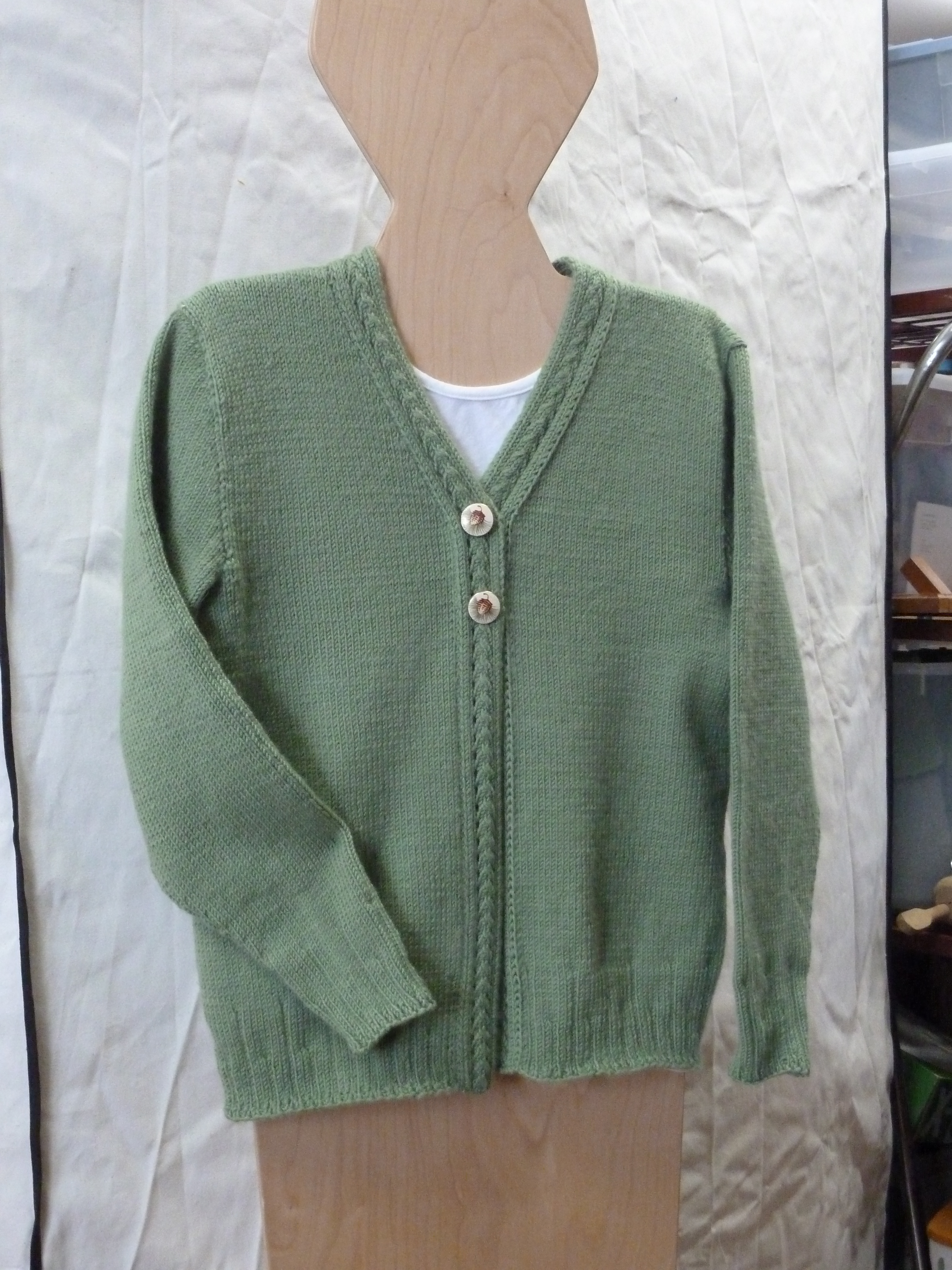
Pinecone Pullover

This one was started in September 2011.  It was based on Karen Alfke’s Unpattern for Set-In Sleeve Cardigans from the Top Down.  I used this Unpattern as the basis for another class last year, and I have to be honest and say I do not like her solution for the knit-in sleeve cap.  It has way too many stitches in it and does not fit nicely into the armhole in the manner of a sewn-in sleeve cap.  However, I am a big fan of one-piece construction and therefore spent many hours working out another method of planning and knitting the sleeve cap for my class.  One of the sleeve caps on this sweater was probably ripped out and re-knit at least 3 times!  I think my method works well, but it proved to be hard to teach – just a little too much math for some folks.

The yarn is Naturally Yarns “Me”, merino & cashmere 8-ply from New Zealand (80% merino, 20% cashmere), shade 812.  I used 12 balls at 111 yds (102 m) per ball.  Needle size 4 mm (US 6) for a gauge of 21 sts to 4 inches/10 cm.   Bad news:  this yarn is discontinued due to the cost of cashmere.  Good news:  I have more of it in other colors!

P1020287

P1020289

The sweater features some of the “extras” included in the Unpattern, namely side shaping, and “purl darts” at the bottom of the sweater and sleeves for a nice non-rolling finish to stockinette stitch.

To make the sweater more interesting, I used a lace and cable pattern, from the book Classic Knitted Cotton Edgings by Furze Hewitt and Billie Daley, for the front bands.   They were knit and attached to the sweater edge as I went, starting from the bottom of each front, then grafted where the two bands met in the back of the neck.  This method is shown best (IMHO) in The Principles of Knitting by June Hemmons Hiatt, although I have worked out some refinements, which I needed to do for this project and then to teach the method to others.

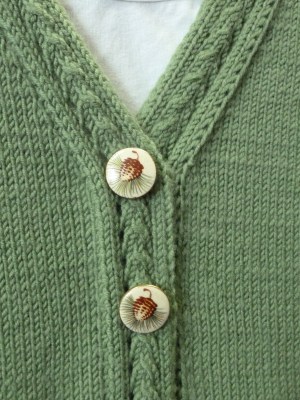
The two ceramic pine cone buttons were purchased long ago at an antique mall and I have been saving them for just the right project.  Aren’t they wonderful?  I do have a “thing” about pine cones.  I sewed the 2 fronts together between the button locations, as I intend to pull it on over my head.  Then simply sewed the buttons on top of the band for decoration.

Beaded Cuffs

These are probably the oldest UFO’s – started them more than 10 years ago.  I was making them for my younger niece, who was thinking of being a veterinarian at the time.  Now she is almost 29 and about to get her Ph.D. in biochemistry from Texas A&M.  We are flying down for the dissertation defense and her birthday in April.P1020292

I wanted to finish them so I could remember how to do it before teaching a class on beaded cuffs last weekend.  I had 8 intrepid souls and they all seemed to be getting it, maybe even enjoying it!  The method and some basic patterns are from my friend Susanna Hansson: Off the Cuff: Basic beaded wrist warmers.
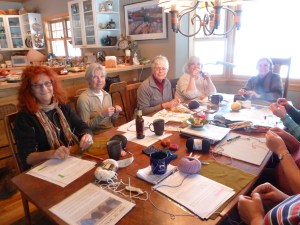
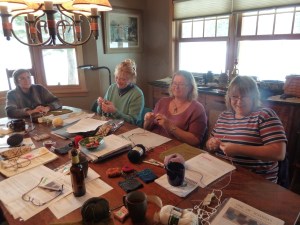
beaded cuff class 1

beaded cuff class 2

Cold Weather Cats

It has stayed well below freezing for what seems like weeks now.  Brrr.  This means our snow is sticking around although there hasn’t been any new (although we may get a light snowfall this week).

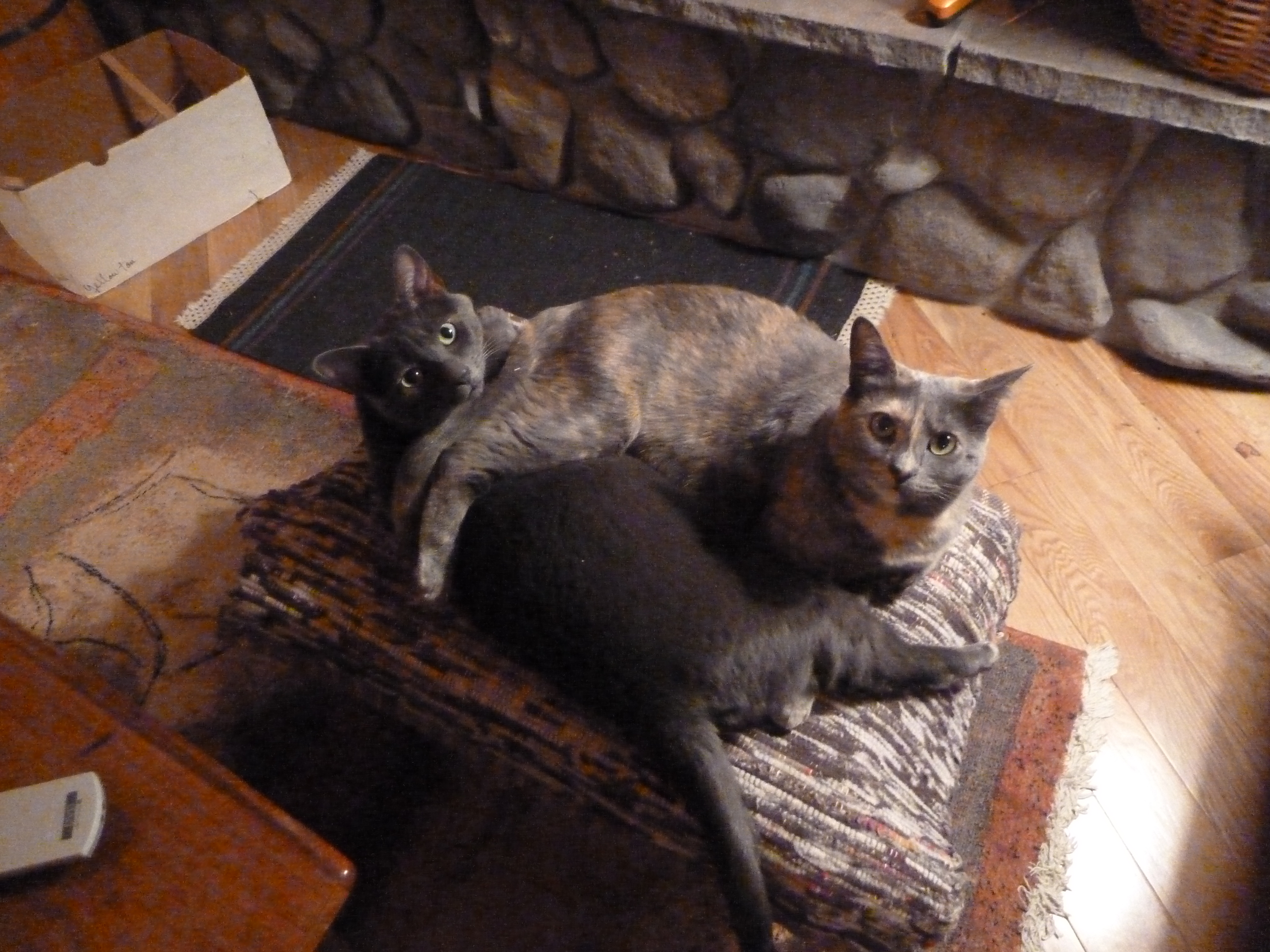
The cats just love the fireplace insert in the evening.  It has a fan that blows hot air into the living room, and we have a footstool set up in front of it for their lounging:

Stormy & Juno basking in the heat

Stormy & Juno basking in the heat

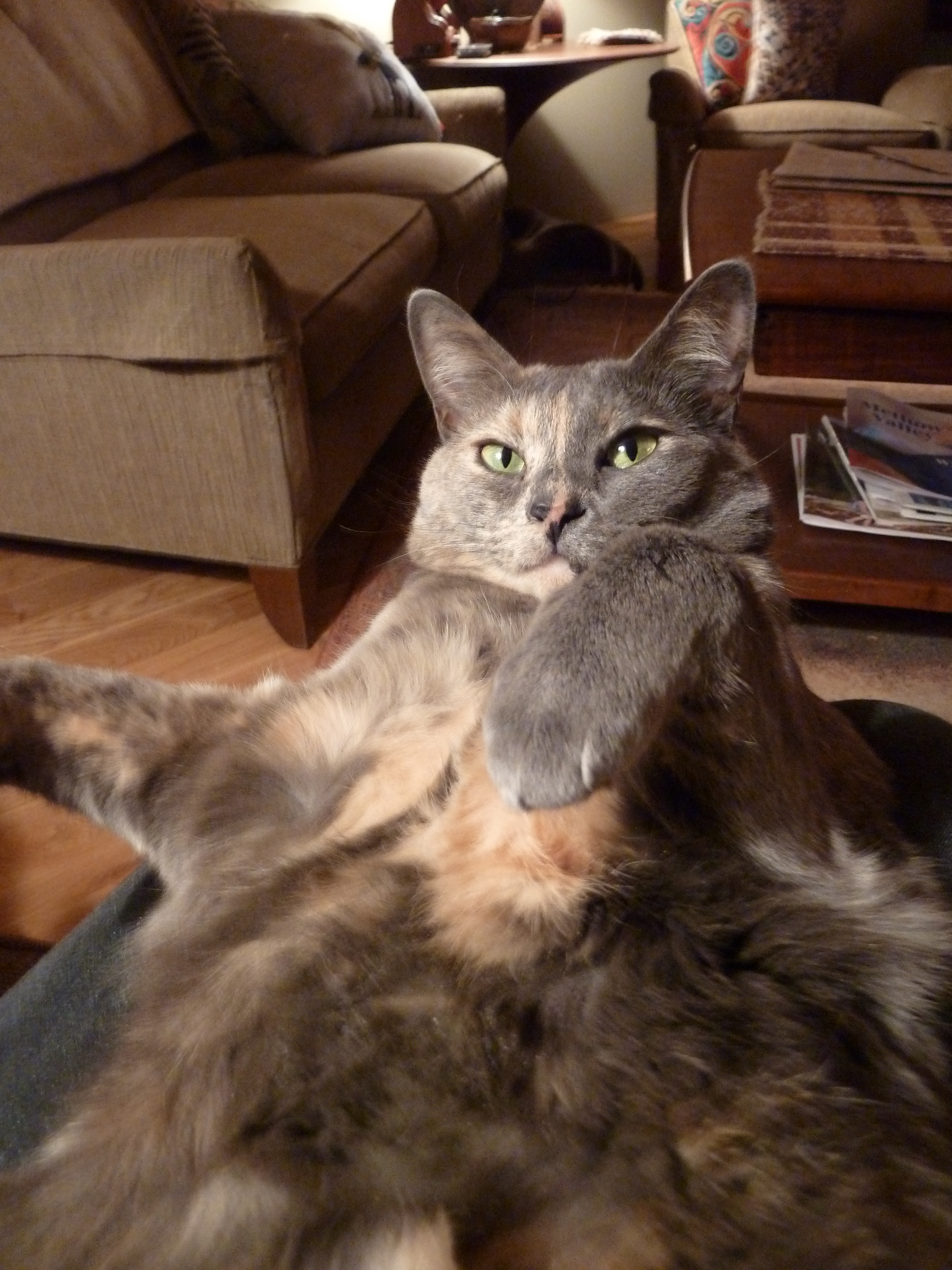
Juno the lap cat

Juno the lap cat

you looking at ME?

you looking at ME?

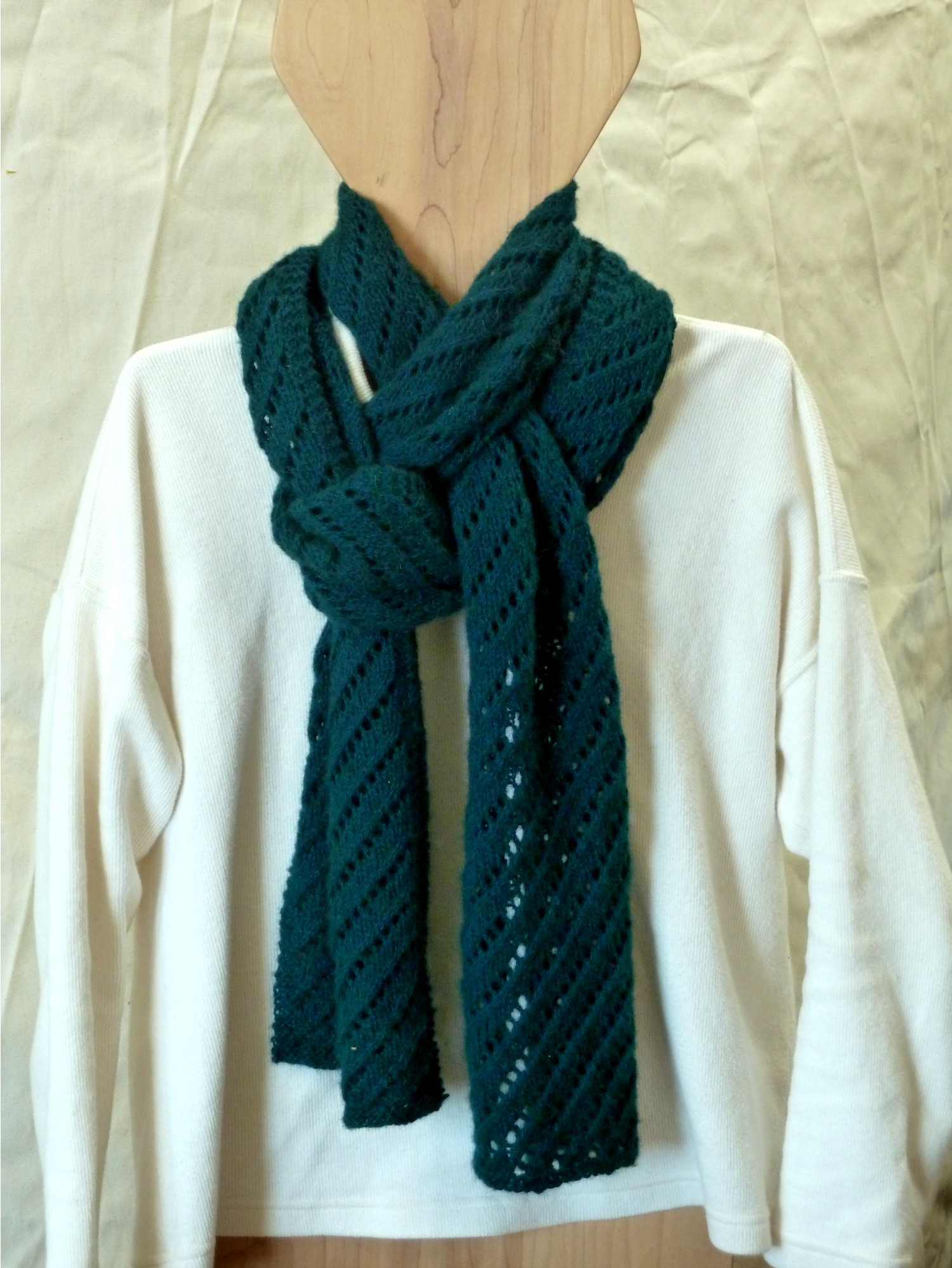
Here are some pictures of the bison/merino scarf I finished a few weeks ago.  It is just so yummy and warm.  The pattern is “Diagonal Lace Scarf & Wrap” from Churchmouse Classics.  It is an easy knit (just an 8-row repeat) but also not boring.  I used 2 skeins of Buffalo Gals 70% bison/30% merino (dyed by Judith MacKenzie, and probably no longer available) so a total of about 520 yds to make the sport-weight scarf version of this pattern.

bison merino scarf 1 bison merino scarf 2 bison merino scarf 3

and the latest Mosaic Mojo Hat:

Noro Kureyon in reds/purples plus Charcoal Cascade 220

Noro Kureyon in reds/purples plus Charcoal Cascade 220

Recent Rugs

It was really cold here the end of last week and over the weekend.  As in negative digits Fahrenheit in the mornings!  I think it was Saturday when it was -10 F. when we got up in the morning, and not getting above 15-16 F in the afternoon.  But clear and sunny and beautiful with all the snow.  Last evening the temperature started climbing (we are still only talking a “climb” from 5 to 9 degrees F. by the time we went to bed).  But today felt almost balmy in comparison – I could even go outside in just a sweater and no coat to load stuff into the car without feeling like I was going to freeze to death.

I have been weaving steadily away on rugs for the 3-4 weeks, and do take pictures as I go along before they go out to the galleries.  But I have fallen behind on my blogging!  So here are some pictures.  I have been trying to use up various materials I have had laying around, and trying some new things.

First I did a series of denim and/or corduroy rugs, to use up boxes and boxes of pre-washed strips I got from the woman from whom I bought my first loom.  By the way, the “Rxxx” number is my rug number from the time I started weaving these about 5 years ago.  Thus, R119 is my 119th rug.

R119: blue jeans denim on medium tones

R119: blue jeans denim in medium tones

R120: blue jeans sequenced from black through bleached

R120: blue jeans sequenced from black through bleached

R121: grey and green corduroy, sequenced

R121: grey and green corduroy, sequenced

R122: shirting weight cottons and corduroys, sequenced

R122: shirting weight cottons and corduroys, sequenced

R123: blue jeans denim in lighter tones

R123: blue jeans denim in lighter tones

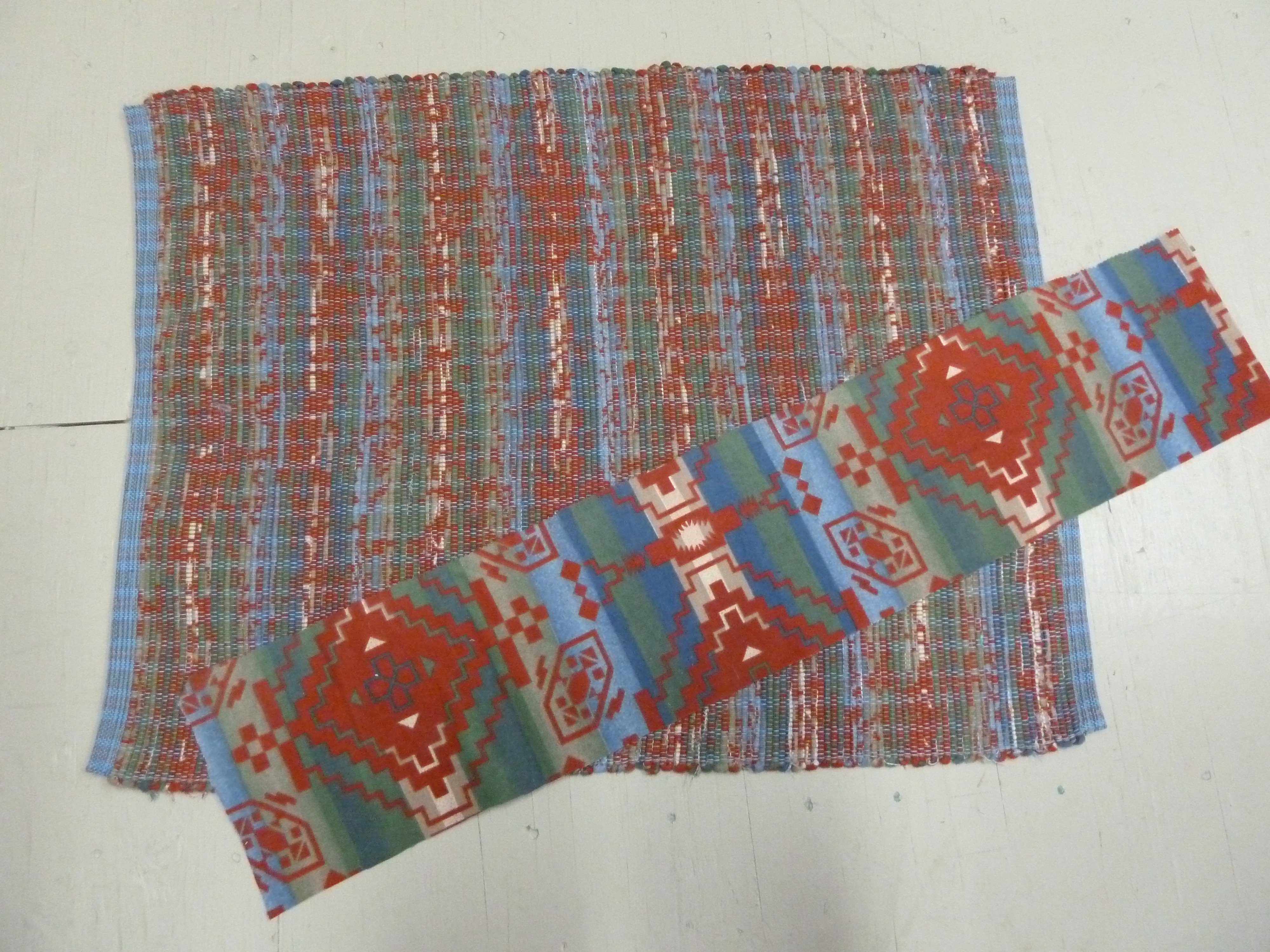
Next I turned my attention to a flannel duvet cover that my Dad gave me a while back.  I wanted to try a method described in The Rag Rug Handbook  by Janet Meany & Paula Pfaff.  Yikes!  It must be out of print and sought after, because they want a fortune for it on Amazon.com.  There was also an article in Handwoven magazine that built on this idea – to preserve the color and pattern of a piece of cloth by cutting it 1.93 times as wide as the width of your rug in the reed, then sewing it into a tube and cutting it in a spiral fashion to get one long continuous strip of cloth to weave with.  No-one explains where the 1.93 ratio comes from so I took it on faith.

I had to cut a piece off the side of the duvet cover to obtain the required width.  That’s the strip that is shown with the rug.  As you can see, it definitely preserved the color order and to a degree, the pattern of the original cloth.

R124: flannel duvet cover

R124: flannel duvet cover

This was so much fun that I then turned to hacking up two wool blankets that I got from someone who was clearing out their mother’s house.  I didn’t worry about the 1.93 ratio, just used the full width of the blanket.  I figured each blanket was big enough to get 2 rugs, so I divided them more or less in half lengthwise.

Blue, gold and cream blanket and rugs:

The blue blanket before sewing in a tube and cutting the strups

The blue blanket before sewing in a tube and cutting the strips

R125 and R126:  blue blanket

R125 and R126: blue blanket

Rose, gold and cream blanket and rugs:

The rose blanket before cutting into strips

The rose blanket before cutting into strips

R127 & R128: rose blanket

R127 & R128: rose blanket

Pretty cool how the color order, even within the cream and gold stripes, was preserved.

Last week I decided to open some boxes marked “Leesburg afghan – Reds”.  This is material I got with the first loom and it was time to either use it or get rid of it!  These are afghan selvages from Leesburg Looms & Supplies in Ohio.  My initial reaction was “holy cow, this stuff is UGLY”.  I mean, some of this was really garish.  But you know what, once I packed it into a rug and mixed up the colors, I was pleased with the result!

R129 - red afghan selvages

R129 – red afghan selvages

R130 - red afghan selvages

R130 – red afghan selvages

R131: scraping the bottom of the barrel

R131: scraping the bottom of the barrel

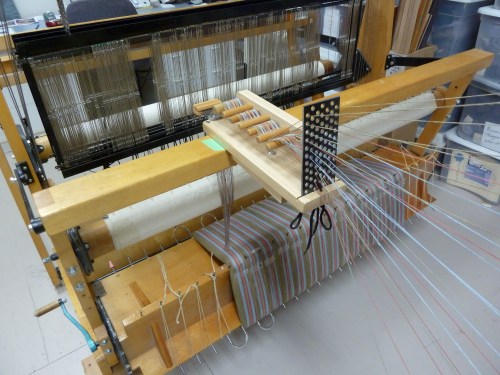
I have also been helping my neighbor set up a towel warp on my “Baby Mac” portable loom – taking her through the whole process of winding the warp, sleying the reed, threading the heddles, and today winding the warp onto the back beam.  Sometime this week it will be ready for her to take the loom to her house to do the actual weaving.  Let’s just say she has already expressed an appreciation for how much work goes into a handwoven product!

And I am knitting.  Finished a beautiful lace scarf using Judith Mackenzie’s 30% bison/70% merino which I still need to photograph.  Am finishing up a sweater I started over 2 years ago, as I will need it as a sample garment for teaching a class in Wenatchee at the end of February.  And always knitting more Mosaic Mojo hats:

gray/tan Noro Silk Garden and blueberry Cascade 220

gray/tan Noro Silk Garden and blueberry Cascade 220

handpaint wool held with Kidsilk Haze, light teal Cascade 220

handpaint wool held with Kidsilk Haze, light teal Cascade 220

bright Noro Kureyon and violet Cascade 220

bright Noro Kureyon and violet Cascade 220

Sold two of these at the Winthrop Gallery yesterday, so I guess hat season isn’t over yet.


Winter Wonderland

It snowed a lot yesterday – maybe a foot at the house (we are down on the main valley floor near Winthrop, elevation about 1760′ ).  Last week our snowplow guy called and said the engine on his truck had gone out and he wouldn’t get it back until Thursday Jan 10th.  We hoped there would be no major snow until then, but obviously that didn’t work out.  Then this morning, Rick went out to run the snowblower around and it wouldn’t start.  Actually it isn’t even trying to start – it has an electric starter and absolutely nothing is happening.

But we can get in and out of the driveway OK especially with the Toyota Tundra in 4WD.  We called a neighbor up the road to see if he can come and plow our driveway out sometime today.  Meanwhile it is supposed to warm up to the mid-40’s today and possibly even rain a little.  YUCK!  Then get cold again starting tomorrow.

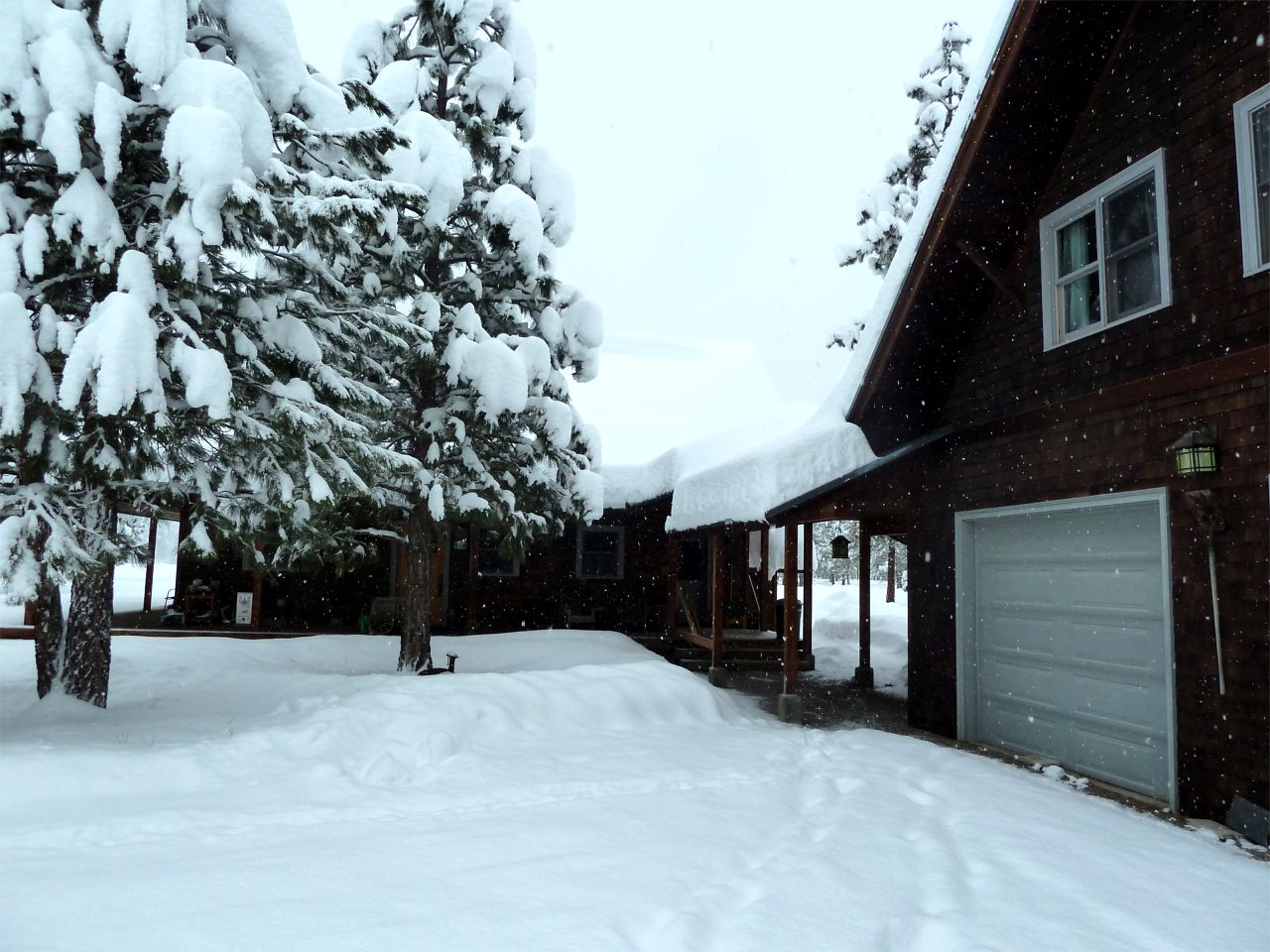
snow 1-9-13 a

garage and entry to the house

snow 1-9-13 b

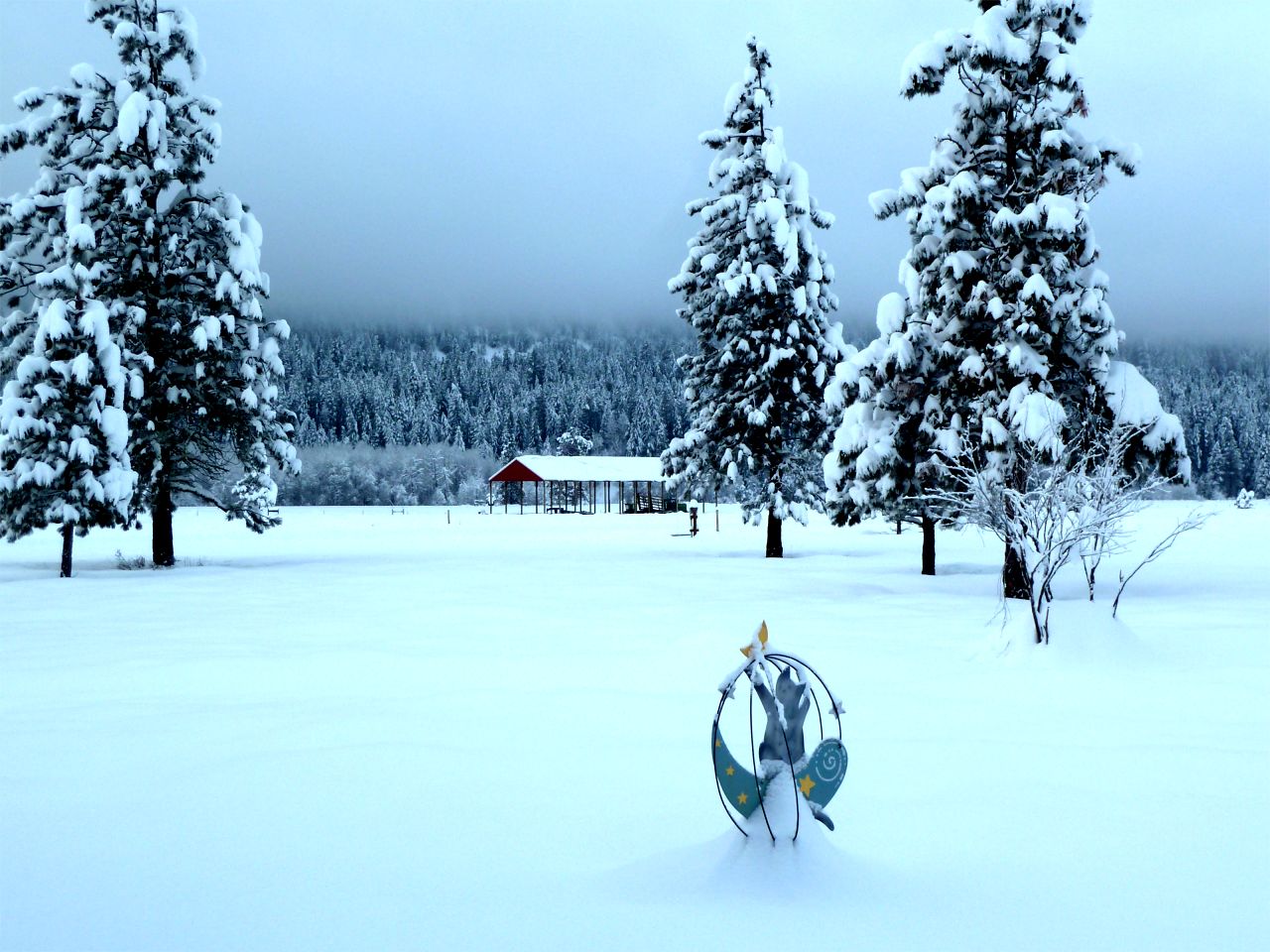
looking across the valley floor

snow 1-9-13 c

our “snow gauge” – Loki in the Stars

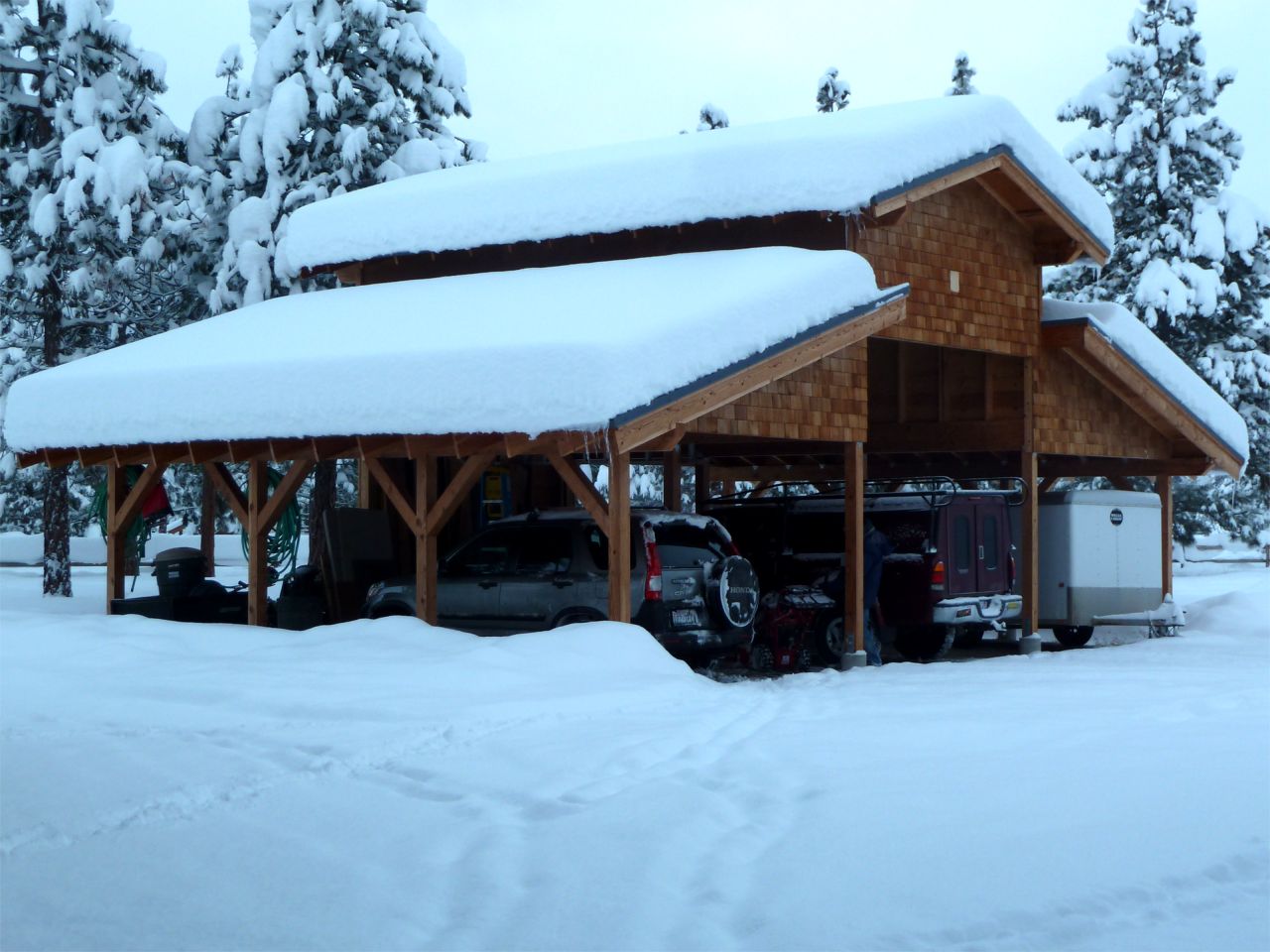
snow 1-9-13 d

carport with its load of snow!

Winter is Here!

We returned from 6 nights away to find at least 18″ more of snow (we had about a foot before we left).  Our snowplow guy had come, but Rick had to do quite a bit of snowblowing yesterday to clear the path to the woodshed, etc.

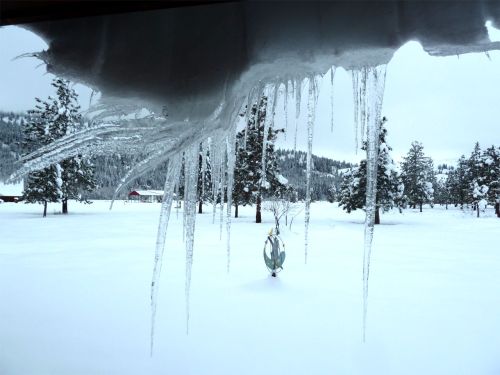
Here is the scene from the back deck – there is an amazing curving icicle formation coming off the roof:

icicles 28Dec2012

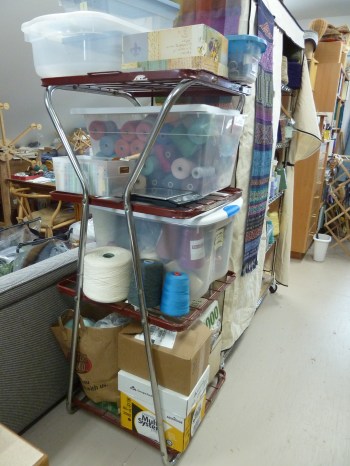
We made a couple of antique shop finds in Seattle and on the way home.  Mainly this cool vintage (?) bread store rack that has a Pillsbury Co. metal plate on the bottom shelf.  Fortunately it disassembled or else we would have never gotten it into the Honda CR-V.  Once put back together yesterday in my studio, I immediately filled it up with boxes of weaving yarns etc.

P1020163

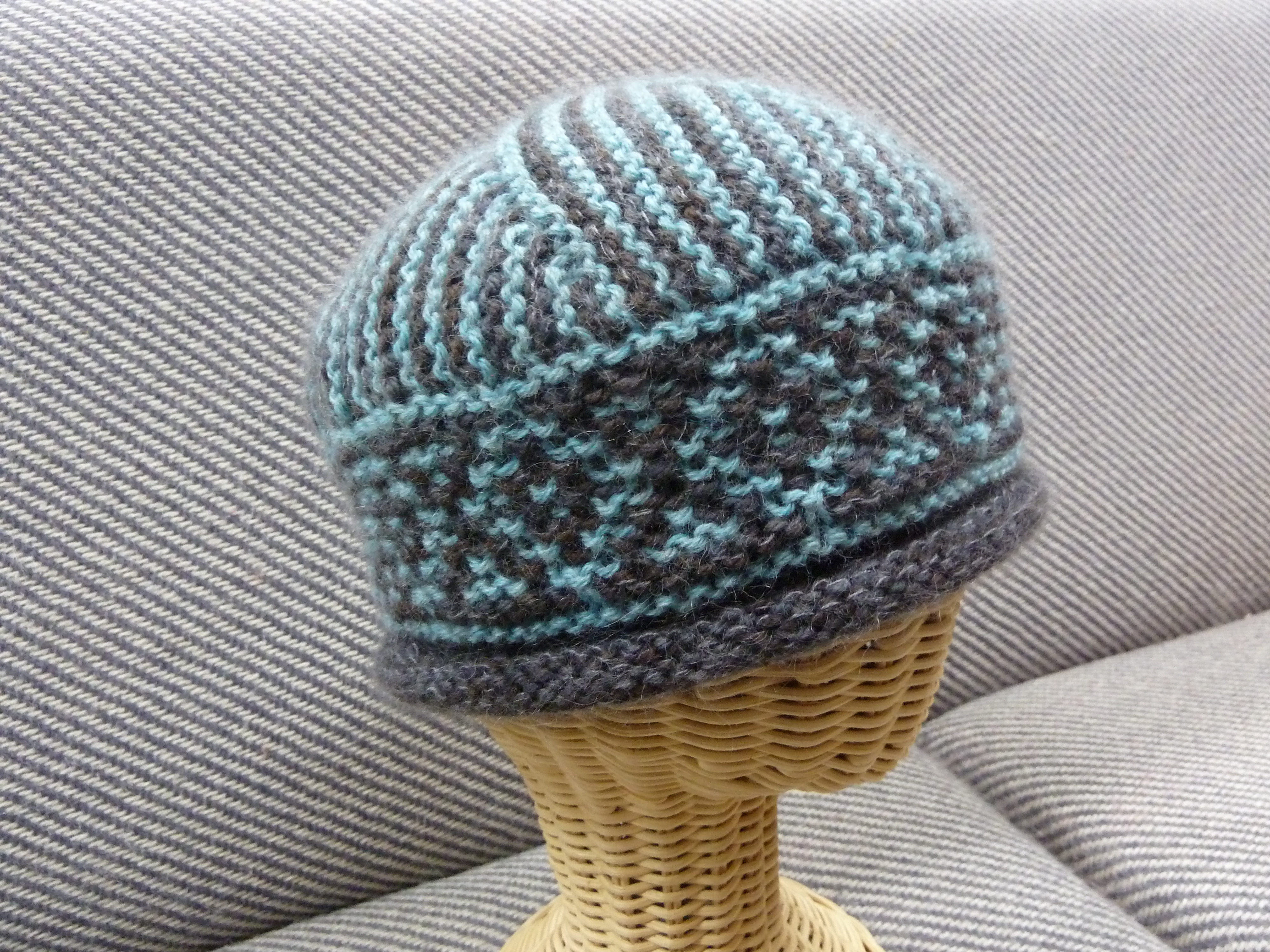
And in Monroe, WA I found another wicker mannequin head…I like these for hat display and photography.  Very reasonably priced, too, compared to what I am seeing on eBay (if you can find them at all).

wicker head Dec 2012

I finished another Mosaic Mojo Hat while on the road:

grey-brown Noro Silk Garden and violet Cascade 220

grey-brown Noro Silk Garden and violet Cascade 220

Mosaic Mojo is up on Ravelry

We returned home last night, from almost a week away at the Coast (aka Seattle/Anacortes).  Took the cats with us and they traveled very well – we stayed at the La Quinta Inn near the Seattle Center, which is a pet-friendly hotel, and very comfortable too.  Spent a lot of time with friends and family, and we saw The Hobbit in 3D at the Imax Theater at the Seattle Center.  Loved it!

While we were gone, I had an inquiry about the Mosaic Mojo Hat pattern from a blog follower.  So I made it a first order of business today to get my designer and store information set up, and put the PDF pattern up for sale on Ravelry.

Here is the link:  Mosaic Mojo Hat

and it is also listed in my blog sidebar under “Where to Find My Work.”

Denim & Diamonds

Last week I turned my attention to making two items I had promised to the Confluence Gallery in Twisp for the silent auction at their December 8th fundraising event.  This year it was called “Black Tie:  Denim & Diamonds” which gave folks a chance to dress up (or down) for the evening.  I actually didn’t attend, as I was headed to Seattle that day for a get-together with friends and various errands – but Rick went and he said it was well attended and a lot of fun.

I was asked for a denim rug for the auction.  Well, that meant I had to put rug warp on the big loom!  I usually put about 50 yards on the sectional warping beam, enough for at least 30 rugs.  This time I remembered to try an idea I had seen on the Macomber Looms and Me blog (it’s also in her PDF manual that you can buy and download from her blog).  This is to use short sections of 1/4″ plastic tubing to “fence off” the sections on either side of the one you are winding, so the threads can’t jump the tracks, as it were.  The original tipster said they bought the tubing at a pet store (used for aquariums).  I got mine in the plumbing section of our local hardware store.  For about 50 cents it solved all my problems with having to watch the section-winding like a hawk to make sure the threads didn’t get into an adjacent section.  I needed 8 pieces of tubing, each about 4-5″ long, so I could place two on each fin of the beam on either side of the section being wound.

rug warp Dec2012 1

rug warp Dec2012 2

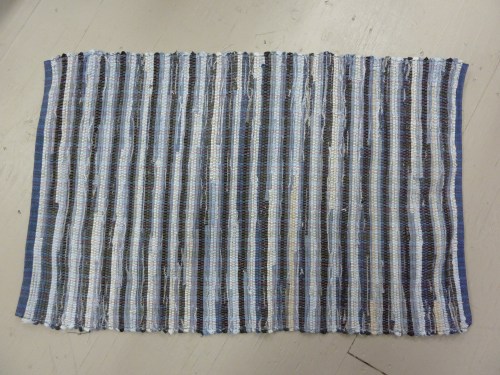
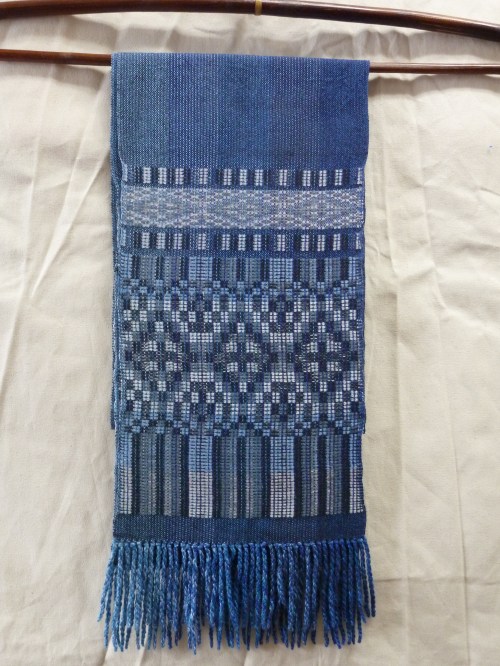
I still have several boxes of pre-washed denim strips that came with the loom, which I purchased from a woman in the valley in 2007.  I pulled out 6 shades of denim, from white through pale blue to dark blue, then black and charcoal, and sewed them in sequence.  This produced the rug below:

Denim & Diamonds Rug

Then I turned my attention to finishing the polychrome summer & winter scarves that have been “underway” for months on my Baby Mac (Macomber model CP portable loom).  I had put on a warp in shades of blue and it was perfect for the Denim & Diamonds theme.  There was enough warp for 3 scarves and I wanted to finish them all if possible, rather than cut one off and then re-tie.  I had finished the first scarf quite a while ago and was partway through the second one.  So I did get them all woven, but only finished the fringes and washed/pressed this one, to have it ready for the Confluence event:

Denim & Diamonds scarf 1

Denim & Diamonds scarf 2

I really love the colors in this one, and wove a second one like it that I am planning to keep!

Also finished one more Mosaic Mojo Hat:

Mojo Hat 1107 a

handpaint Blue Face Leicester held with Kidsilk Haze, plus charcoal Cascade 220

I am now taking a rest on these and actually <gasp> KNITTING SOMETHING ELSE.

A Bulky Spinner

No, not me!  I may have had a little too much Thanksgiving dinner, but it’s not THAT bad….

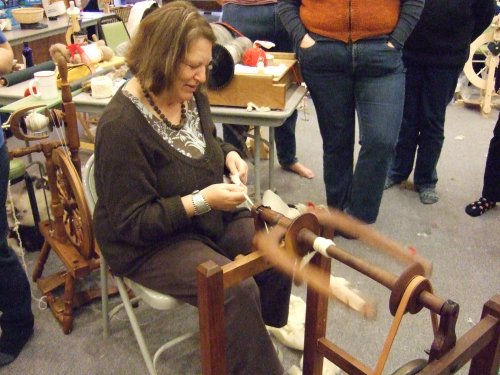
Back in February 2010 I attended spinning camp on Orcas Island with Judith Mackenzie, and the theme was “Ethnic Spinning and Knitting: Cowichan, Aran and Icelandic.”   We spun Icelandic fleeces for Icelandic lace or the more bulky Lopi-style knitting yarn.  We spun Clun Forest wool to make a 5-ply yarn for traditional Aran sweater knitting.  And we spun on an Indian-head spinner to make the loose, thick yarn used for Cowichan sweaters.

Here is a picture of Judith spinning on her Indian-head spinner at that workshop:

Indian head 2

Later that year we took a trip to Sacramento, CA to attend my niece’s wedding celebration.  On the way down we camped in our pop-up trailer.  From Mt. Lassen NP we went through Chico, CA and in an antique mall there I spotted an Indian-head spinner!  There had been a fire at the antique mall about a year earlier, and it was sitting forlornly in a back room all covered with ash – they hadn’t even bothered to clean it off.  I was tempted but didn’t buy it that day.  But it kept calling to me, so on the way back north we stopped into Chico again and the bulky spinner came home with us.

Here is how it looked when we got it home and before it was vacuumed:

Indian head spinner dirty

Since then it has just sat in my studio.  Last week Rick took it down to the shop and really cleaned it up – put on new finish and everything.  It is beautiful!  Looks like black walnut.

Indian Head spinner restored 1

Indian Head spinner restored 4

Underneath the treadle he found the maker’s mark.

Indian Head Sid Sharples label


It turns out these wheels were made by Sid Sharples and another man in California in the 1970’s.  They are retired now.  They were made from black walnut or dark maple.  It was called the California Bulky Spinning Wheel and also known as a “Cowichan Spinner”.  I have found a few pictured on blogs or Flickr on the web – and one was listed on eBay last January, but the guy didn’t get any bids on it.  As an added surprise, I was talking to my friend Sara down in Twisp last week, and it turns out she used to have one of these – it was the very first spinning wheel she owned!

So now it is going to live with Judith Mackenzie.  Why?  Because my teacher and mentor in all things spinning, weaving and generally fiber-related suffered the loss of her ENTIRE STUDIO due to a catastrophic fire in Forks, WA in late October.  I mean everything (it was a teaching as well as a personal studio).  Looms, spinning wheels, all kinds of related equipment, not to mention all her fiber (fleeces, yarn, etc).  Due to the age and nature of construction of the building she was unable to get an insurance rider.

Three of her friends immediately put together a website and are spearheading an effort to raise money and donated equipment to help her rebuild her studio and continue with her career as a fiber artist and nationally known teacher:

Rebuild Judith’s Studio

Check it out – and donate a little if you feel so inclined, to help this wonderful woman recover from a real blow.