Feeds:
Posts
Comments

Twisp River Fire

We just went through a big fire event and I thought I would post a few pictures.  It was a fire up the Twisp River Road that started last Wednesday (August 19) and just blew up in a matter of hours.  Both Twisp and Winthrop were put on level 3 evacuation (which means “get out now”).

From our house Wednesday afternoon, looking south towards Twisp

From our house about 3 pm Wednesday afternoon, looking south towards Twisp

Some folks have asked how we knew about the evacuation level.  After some neighbors came around and told us we should start preparing to leave, we started to listen to our local radio station KTRT.  Then we got an automated call on the home phone from Okanogan County Emergency Management with the evacuation notice.  Later, around 6 pm, a state patrol car came around the neighborhood.  By then, we had most of our things out in the car, pickup truck and cargo trailer.  We wound up staying 2 nights with friends about 6 miles south of Twisp.

Looking up Twisp River Rd about 7:30 pm on our way south

Looking up Twisp River Rd about 7:30 pm on our way south

Things were just as bad or worse over the hill in the Okanogan Valley, by the way.  A lot of this was on the national news.   Three firefighters died and another one was terribly burned last Wednesday when the fire first broke out – that is the worst part of this whole thing.

On Friday they seemed to have things under control near Twisp so we decided to head back home but leave our things packed up in the vehicles for the time being.

Smoke column north of Twisp on our way back into town

Smoke column north of Twisp on our way back into town

There was still fairly active fire in a wildlife management area north of Twisp River Road, and Friday afternoon they started up with the DC-10 fire retardant planes and water bucket helicopters.  That seemed to knock it down quite a bit but they are still working on containing that end of the fire as I write.
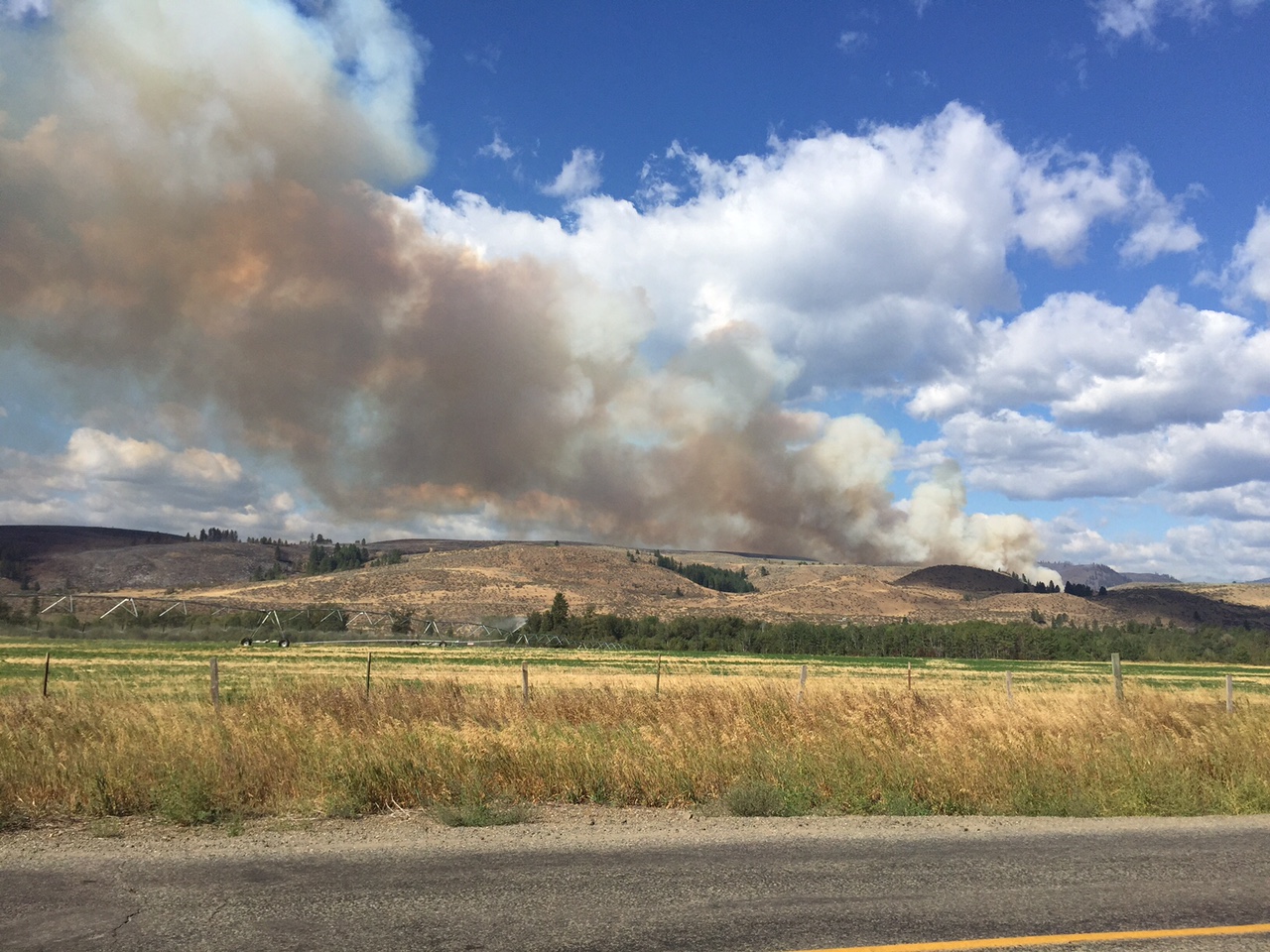
Friday morning

Friday morning

Friday afternoon about 4 pm from across the valley

Friday afternoon about 4 pm from across the valley

There was a good update on Methow Valley News Online yesterday (Sunday, August 23).  The Twisp River Road fire is just part of the bigger Okanogan Complex and is being managed by a Type 1 Incident Team as part of that bigger complex.

We are mostly moved back in now and I actually got to spend some time weaving yesterday.  We know we are very fortunate compared to what some other folks have been through this past week.

We finally found a great guy who is an experienced carpenter, but only looking for small jobs when he is in the valley.  We have a couple of projects to do around here, and first up will be exterior stairs to parts of the deck.  The house wasn’t quite finished when we bought it 4 years ago, and the “steps” were very temporary.

These are designed to match the stairs for our main entry under the breezeway, that Rick did last fall.  Those have wooden treads, as they are under cover.   The rest of them will get snow and ice, which we don’t want to pile up all winter on wooden treads.  The stringers are done and awaiting metal stair treads which we are getting from Alpine Welding in Twisp.

Off the front corner leading to guest and trailer parking

Off the front corner leading to guest and trailer parking

Two stairs off the back porch, one from the French doors and one leading to the woodpile

Two stairs off the back porch, one from the French doors and one leading to the woodpile

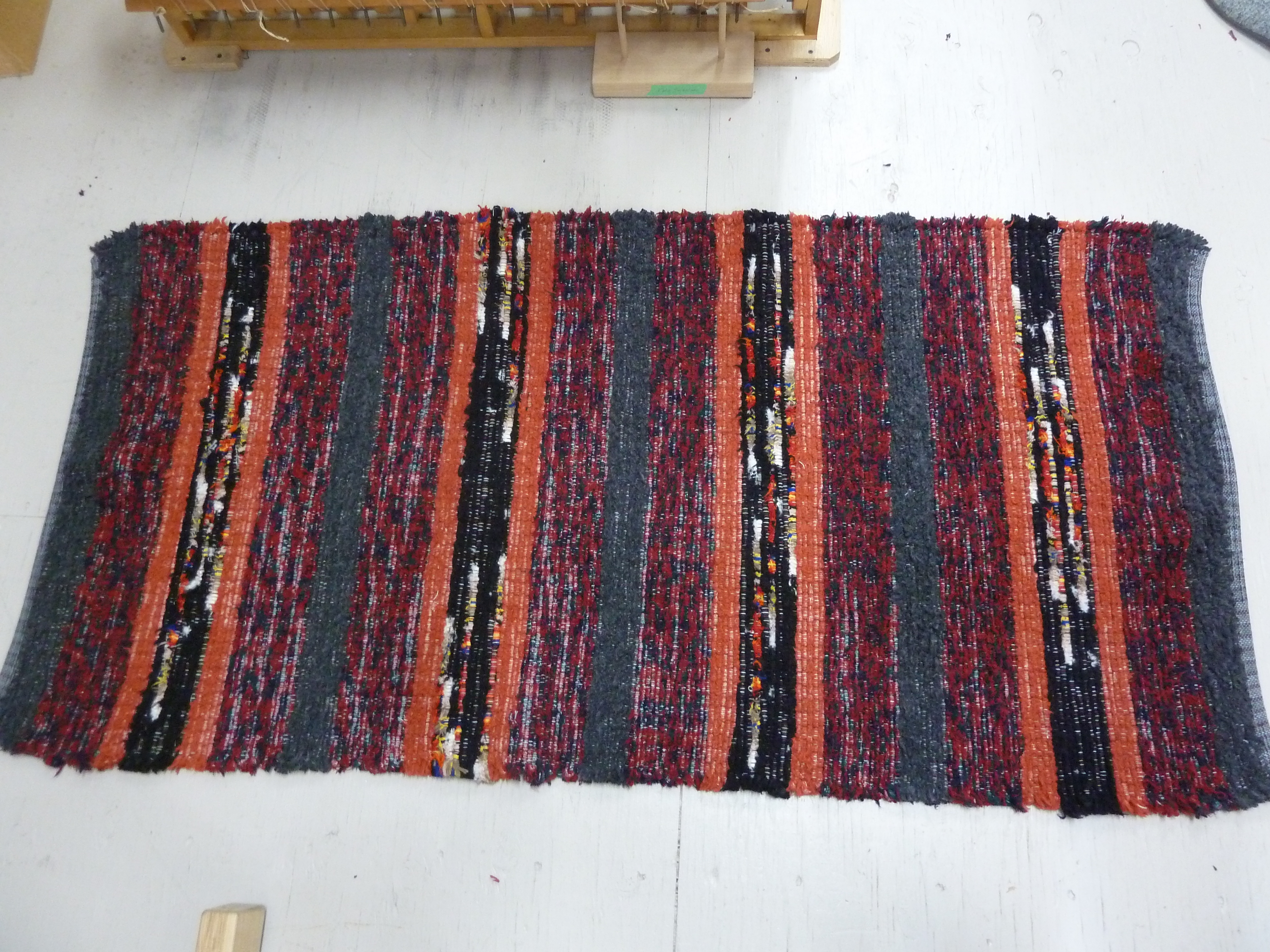
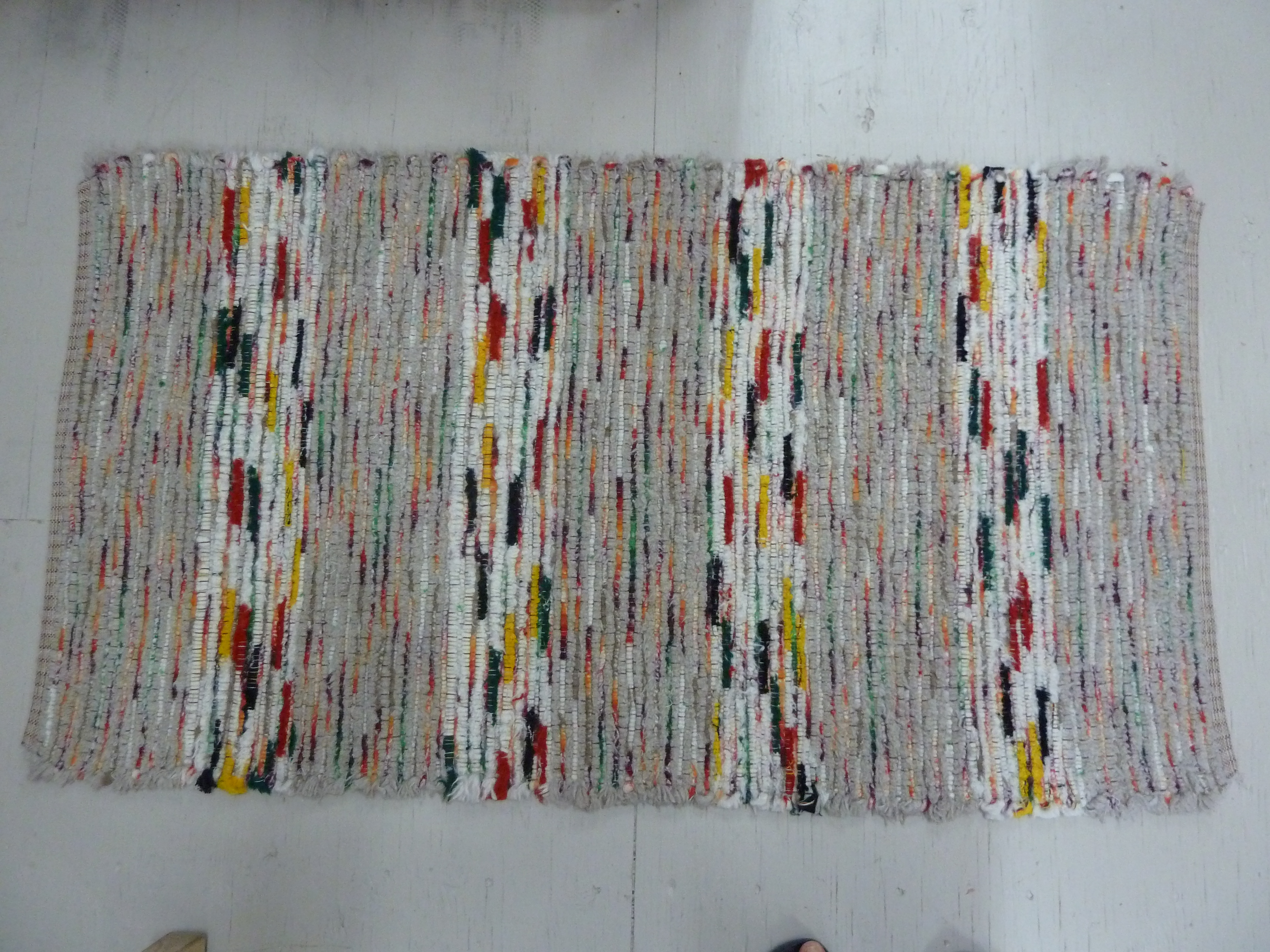
Weaving rugs again now, to get some inventory out to the galleries for the summer, and use up my stash of Pendleton wool selvage material.

R216

R216

R217

R217


R218

R218

R219

R219

R220

R220

R221

R221

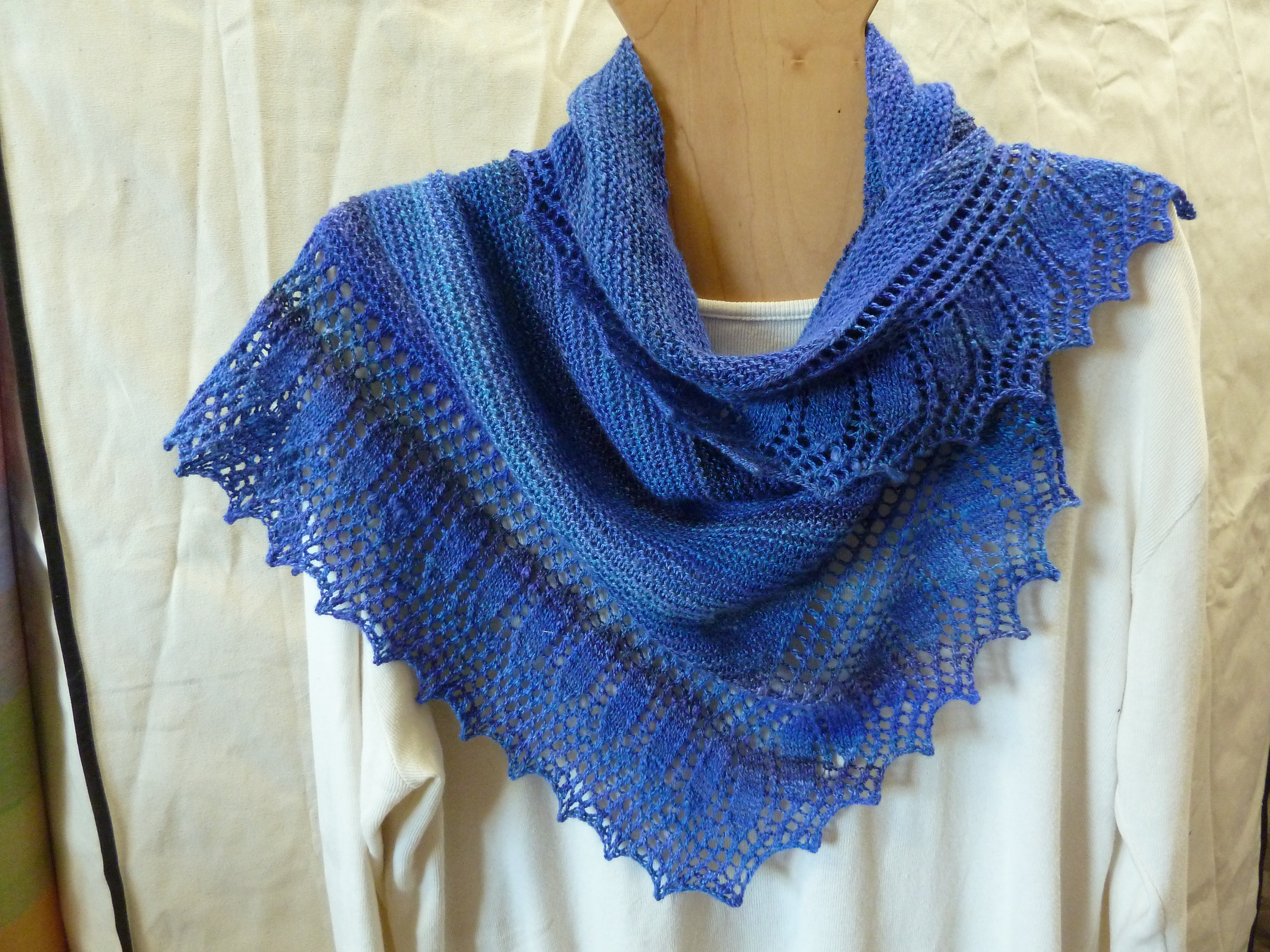
And I finished knitting this lovely shawlette, using my silk/wool handspun yarn: “Magrathea” by Martina Behm.  I had very little yarn left over!

Magrathea 1

Magrathea 2


Nice Nests

Earlier this week, a friend came by who has started a business making Nice Nests, “breeding boxes made from salvaged scrap wood and reclaimed hardware, designed specifically to provide functional breeding habitat for cavity-nesting birds. He also offers installation and consultation services for landowners interested in enhancing breeding habitat for more than three dozen species of cavity nesters in the Methow Valley.”  The quote is from a recent article about him in the Methow Valley News.

Rick had quite a bit of pine soffit material to give him (left over from building our house), and also a big box of miscellaneous hardware, some of it old.  Patrick was really excited about the hardware – he uses “found objects” and cool old stuff for perches and handles.

Yesterday morning he came by with 4 Nice Nests for us!  They will go up on pine trees around the house next week, and hopefully we will get some bird families to move in.  They all are easy to open up for cleanout, and he uses rough wood or scores the inside face of the doors so the little hatchlings can get a grip to climb out when it is time to leave the nest.

The hole on the green one is 1-1/8″ and he said it would only be used by wrens, chickadees or pygmy nuthatches.  The orange one has a 1-1/4″ hole and would be for red or white breasted nuthatches.  The two bigger ones have 1-1/2″ holes and would attract western bluebirds and also tree or violet-green swallows (but these boxes are also the most flexible, as some of the smaller birds could use these too).  Now we are going to have to get out the bird book and binoculars and learn to recognize these species!

Nice Nests

Here is Nice Nests on Facebook and also his Nice Nests website (very well done, by the way).

Yet More Silk Scarves

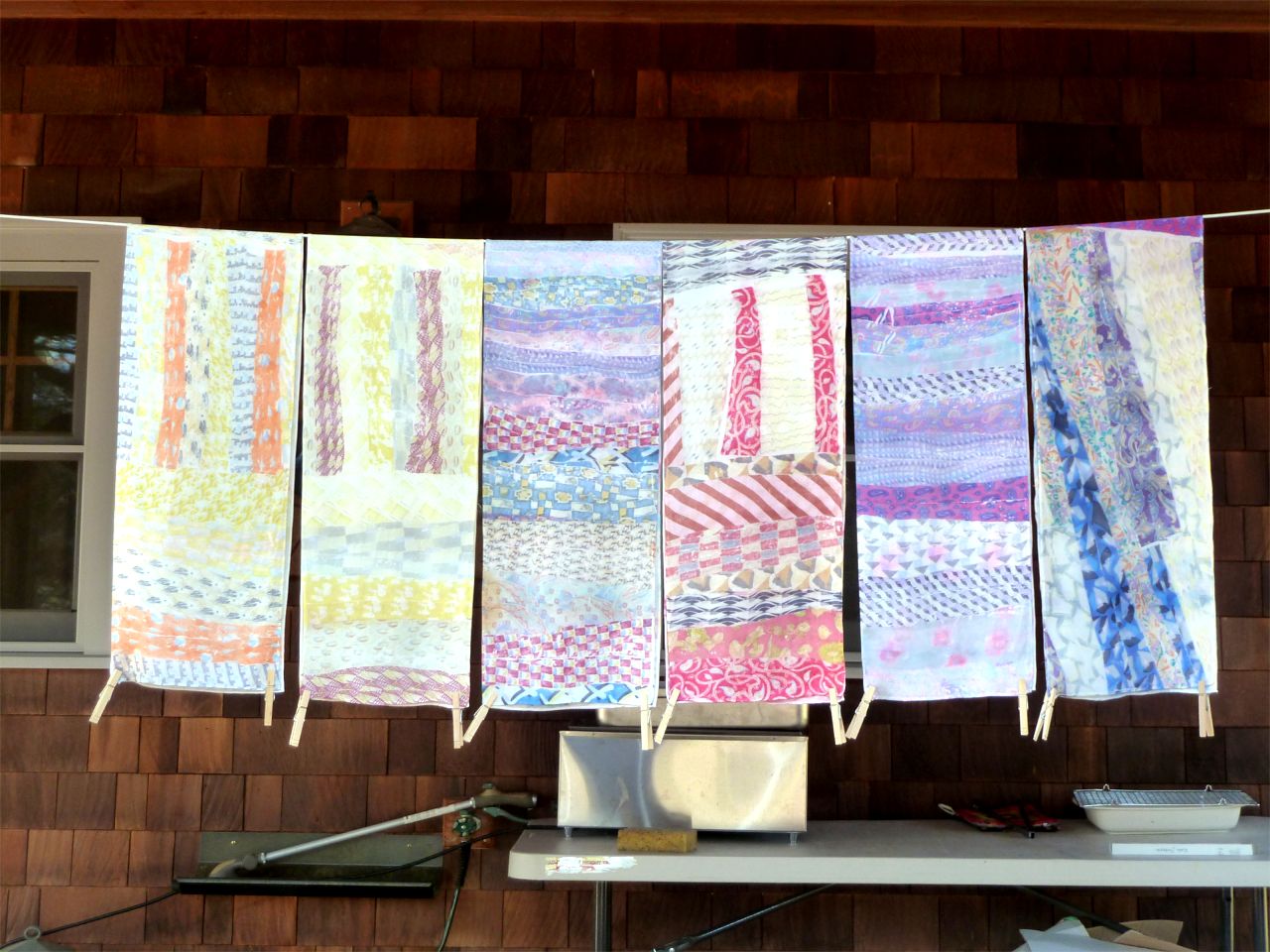
Last week my back-door neighbor did a “tie dye” silk scarf day with her Friday bicycle group, and I went over to help out.  It was a lovely sunny day, and they were very nice women who were a little trepid about the whole thing.  The main concern was if they were choosing colors and arrangements that would work – we told them you couldn’t necessarily tell what colors were going to transfer anyway, so just go for it!  They all turned out well and of course I was so busy I didn’t take any pictures.

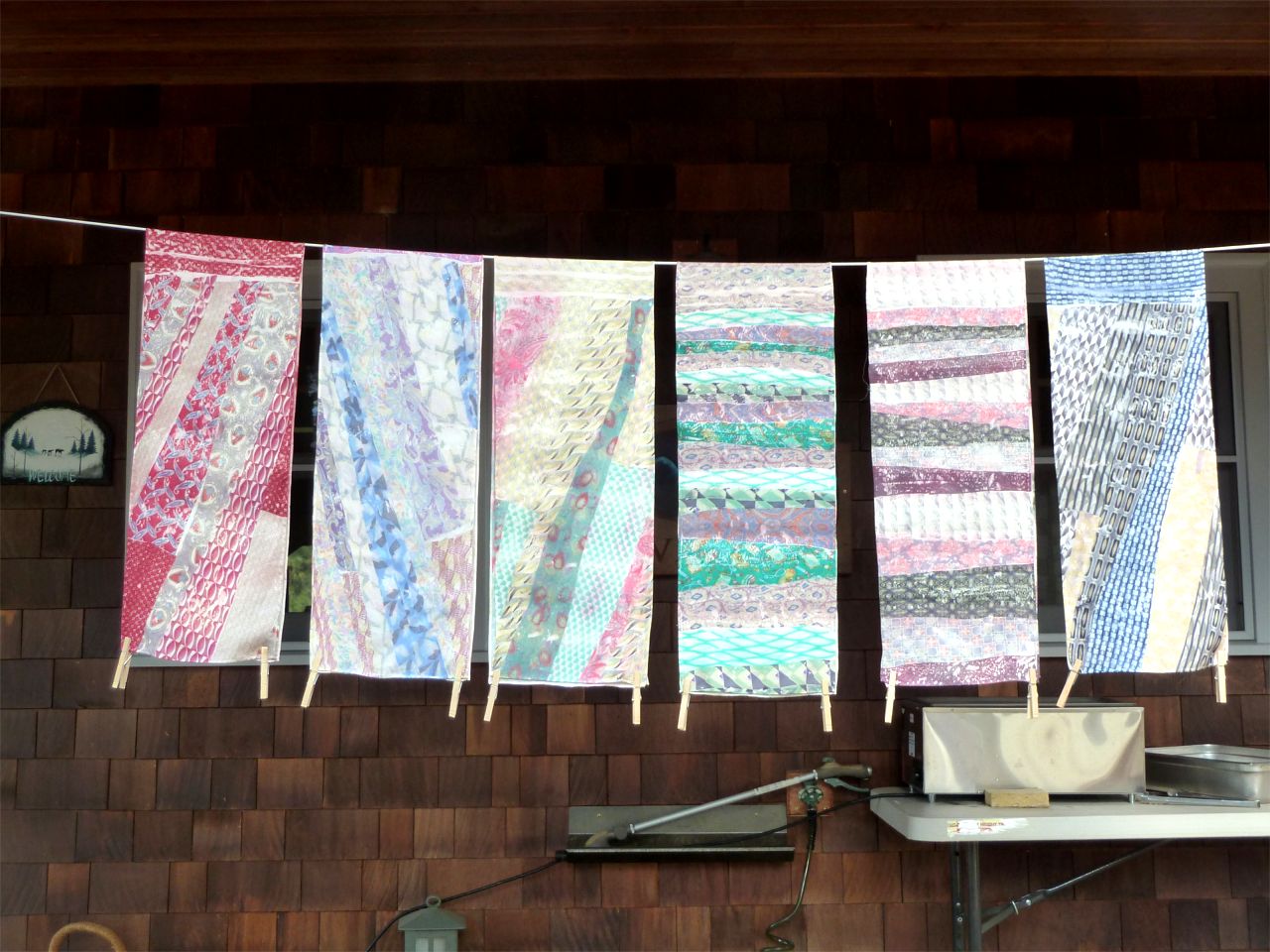
But it did inspire me to do some more myself, using the silk ties I had picked up over in the Skagit Valley when I went to visit my Dad, brother and sister-in-law a couple of weeks ago.  Some of these were from “second use” tie pieces, and although the scarves came out somewhat paler in color, I think it worked.

May 2015 set 1

May 2015 set 2

I have these for sale at the Winthrop Gallery in Winthrop (obviously) and down in Twisp at the new D*signs Gallery (that is how she spells it).  No website yet, but it is an added location for one of the partners in Methow Gallery at Twispworks, where she will do her graphic design and sign painting, in addition to running the new gallery space.  It’s really well done and a great addition to the arts scene in Twisp – you locals, go check it out.

This week I am pre-dyeing some scarf blanks a variety of colors, so will have some more on a colored background (instead of white) sometime in the next week or so.

After several days of chilly, cloudy weather, we are back to sun!  It is supposed to be in the low 70’s for the rest of the weekend at least.  Lots of flowers out now, and we hope to get back up in the hills while the arrowleaf balsomroot are still glorious, and the lupines are coming on.

This coming weekend brings ’49er Days in Winthrop and also the annual Sunflower Marathon and Relay sponsored by Methow Trails.  We will miss all that fun because we are headed over the mountains for Mother’s Day weekend and family visiting.  It should be a glorious trip over the North Cascades Highway, with snow still in the high peaks.

More Silk Scarves

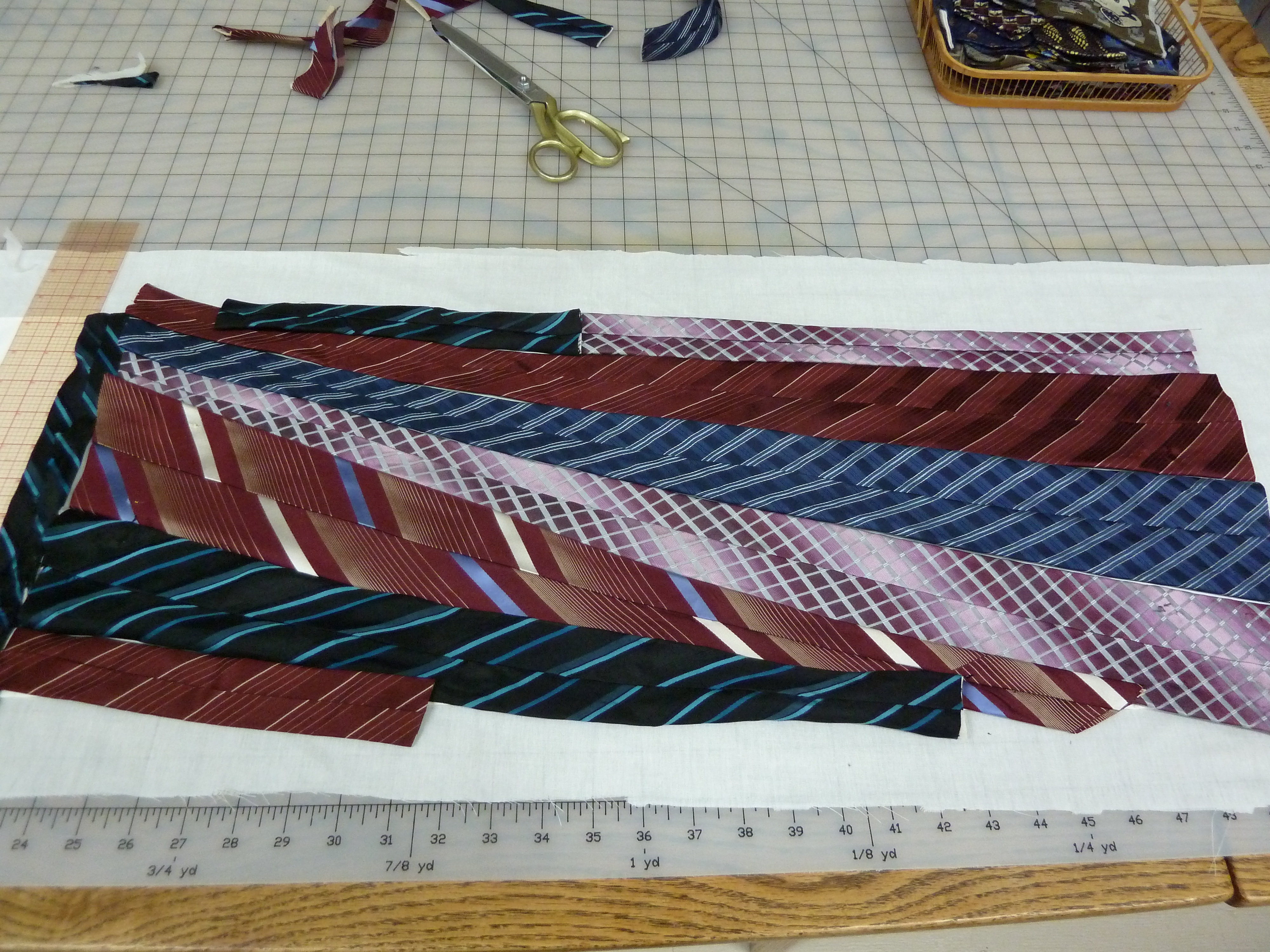
A couple of weeks ago I followed up on our guild’s silk scarf project by doing 11 more at home.  I had purchased a dozen scarf blanks and had picked up a bunch of neckties already, so was ready to go.  I also wanted to experiment with a couple of things, like re-using the necktie material if it seemed like it still had enough color in it, and pre-dyeing the scarf blanks before doing the dye transfer part.  So it was a week of play in the studio, and a break from weaving!

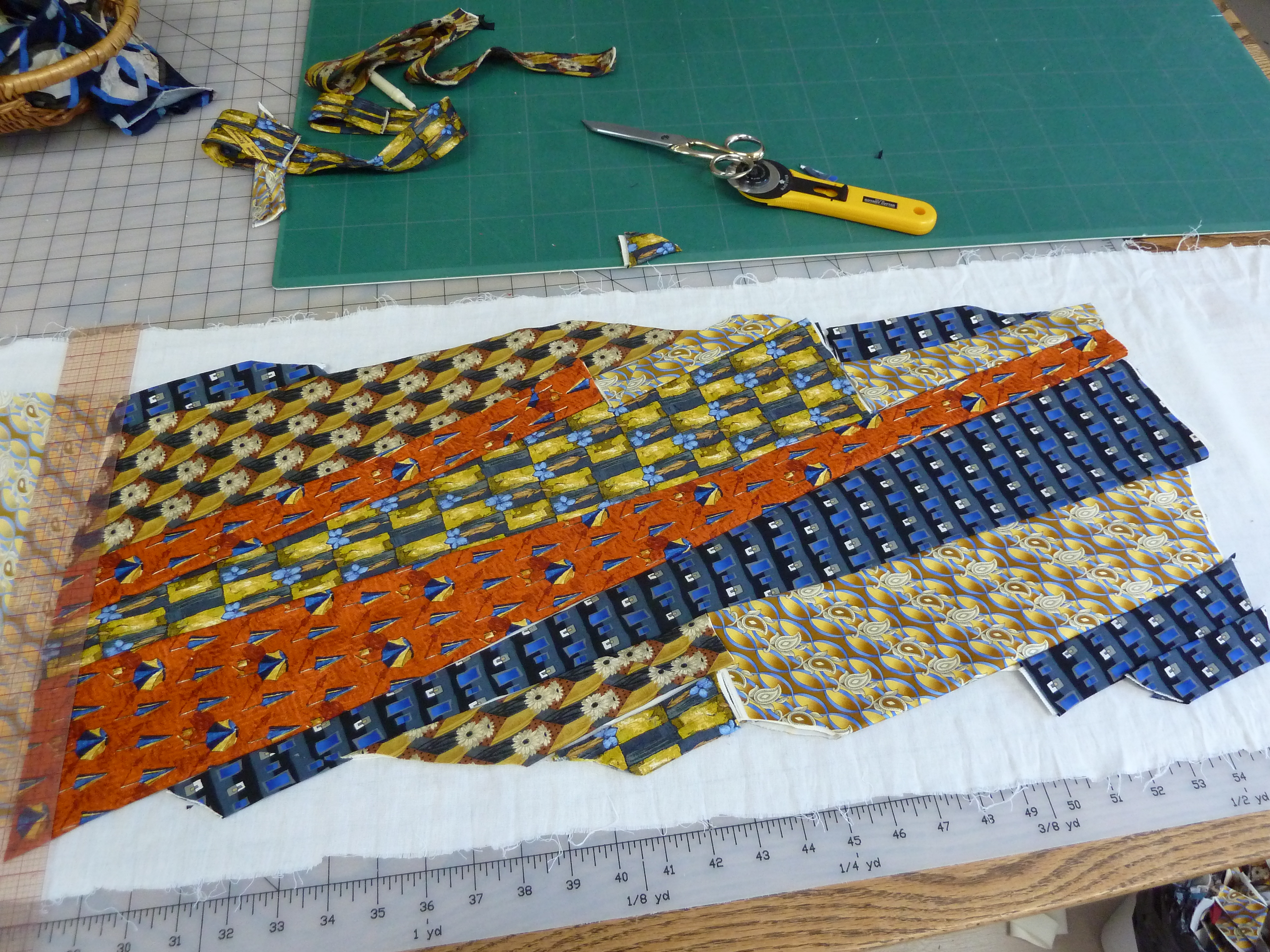
This layout:

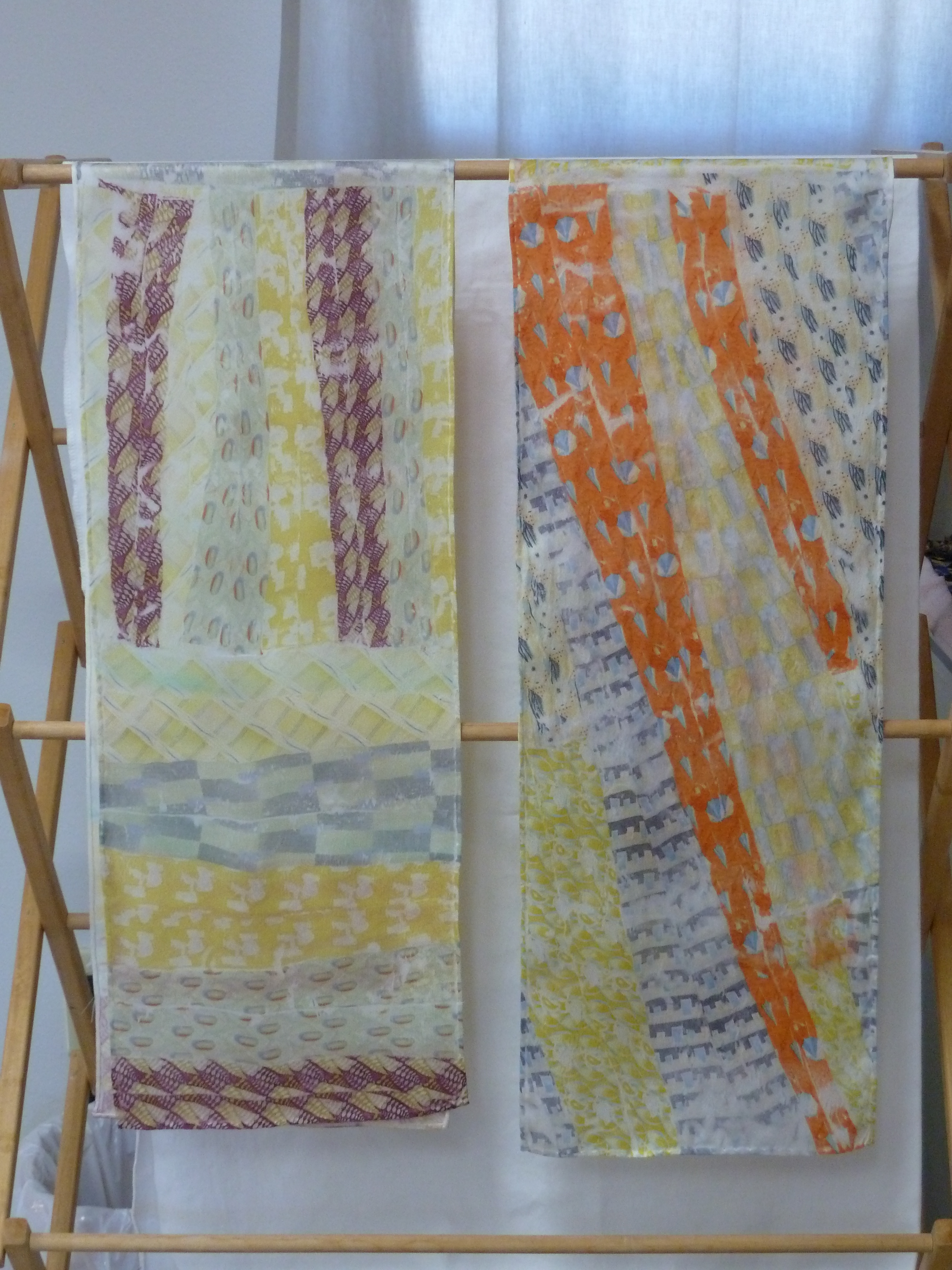
P1040564led to the scarf on the left below.  Notice that the scarf on the right has some white areas.  It turns out the trickiest part is rolling them up so that no wrinkles form in the scarf blank, as this leads to undyed areas.  I later fixed this scarf by putting it through the process again, laying pieces of necktie across the undyed areas only.  It added more visual interest, so all was well!

P1040582

The next was an experiment with woven, as opposed to printed, necktie material.  In our workshop, I learned that the woven ones don’t transfer their dyes as well, but I had already purchased some and was hoping to not completely sacrifice them to the waste bin.  The problem is that the dye is in the thread the material is woven from, instead of being printed on the surface of the tie.  Only one of these came through very strongly.

P1040566I later put this through again with some additional pieces that I knew would transfer dye, to make it more interesting. It is the scarf on the right.  The one on the left is the first one I did at our guild’s workshop.P1040581

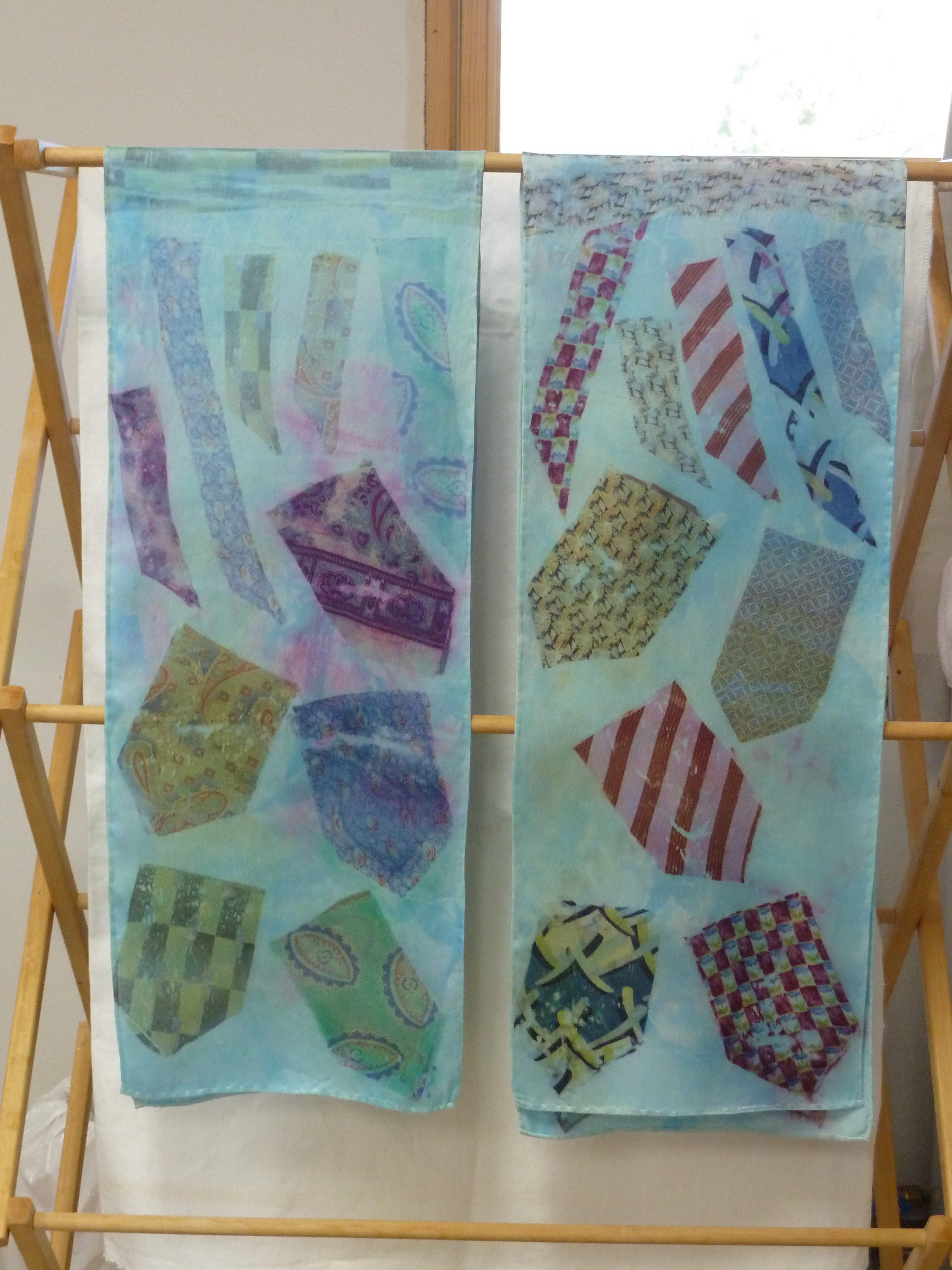
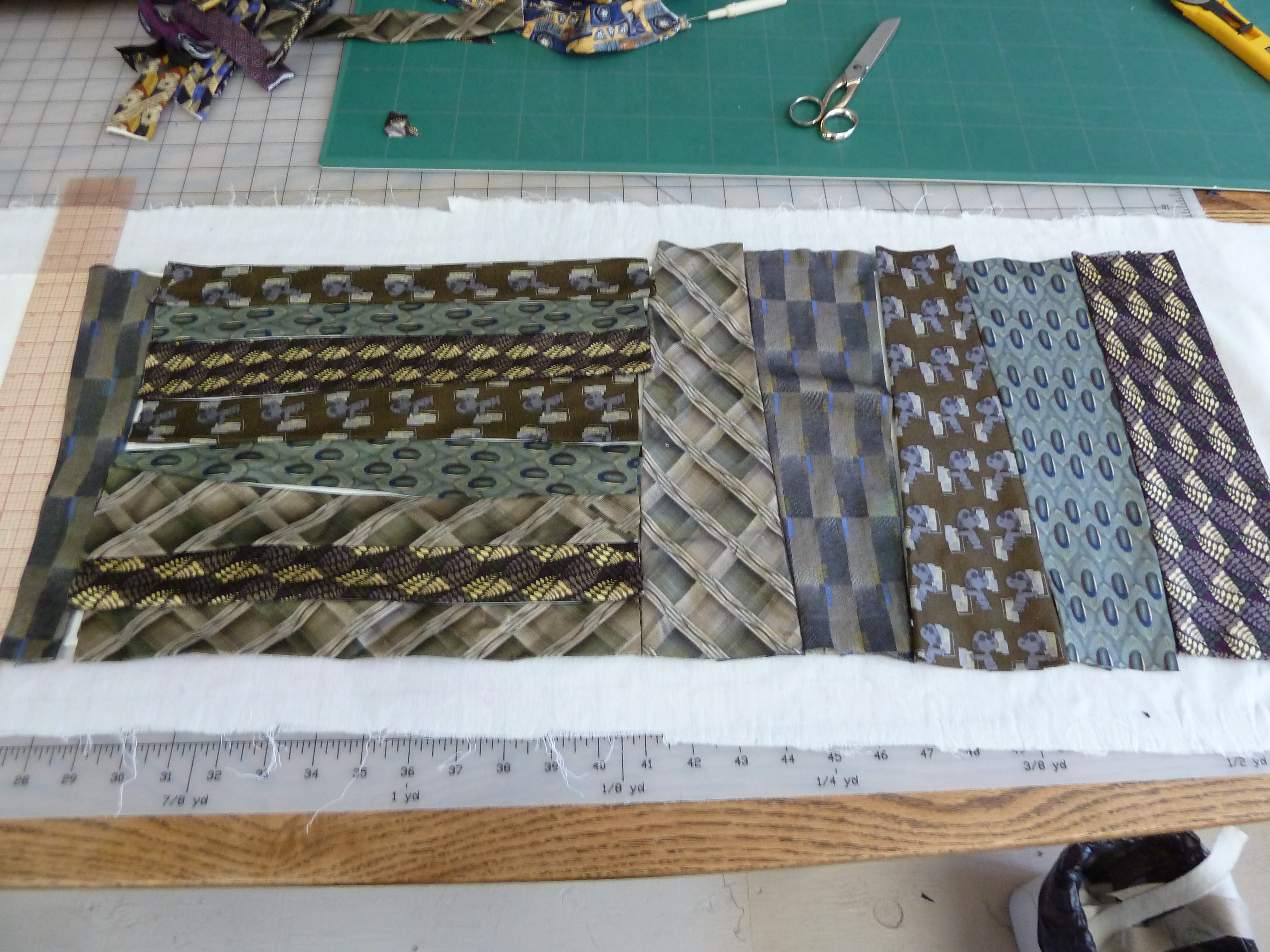
This layout used some of the wide end pieces that have lining on the back (so that side won’t transfer dye).  I found that I could open up the narrow end and lay it on the back side of the wide end, thus getting printed fabric on both sides.  For these scarves, I pre-dyed the scarf blank a pale turquoise color first, so I didn’t have to completely cover the scarf blank with necktie material.

P1040571This led to the one on the left:

P1040576Another layout on a pre-dyed scarf with the wide end of neckties:

P1040573

which is the one on the left:P1040579

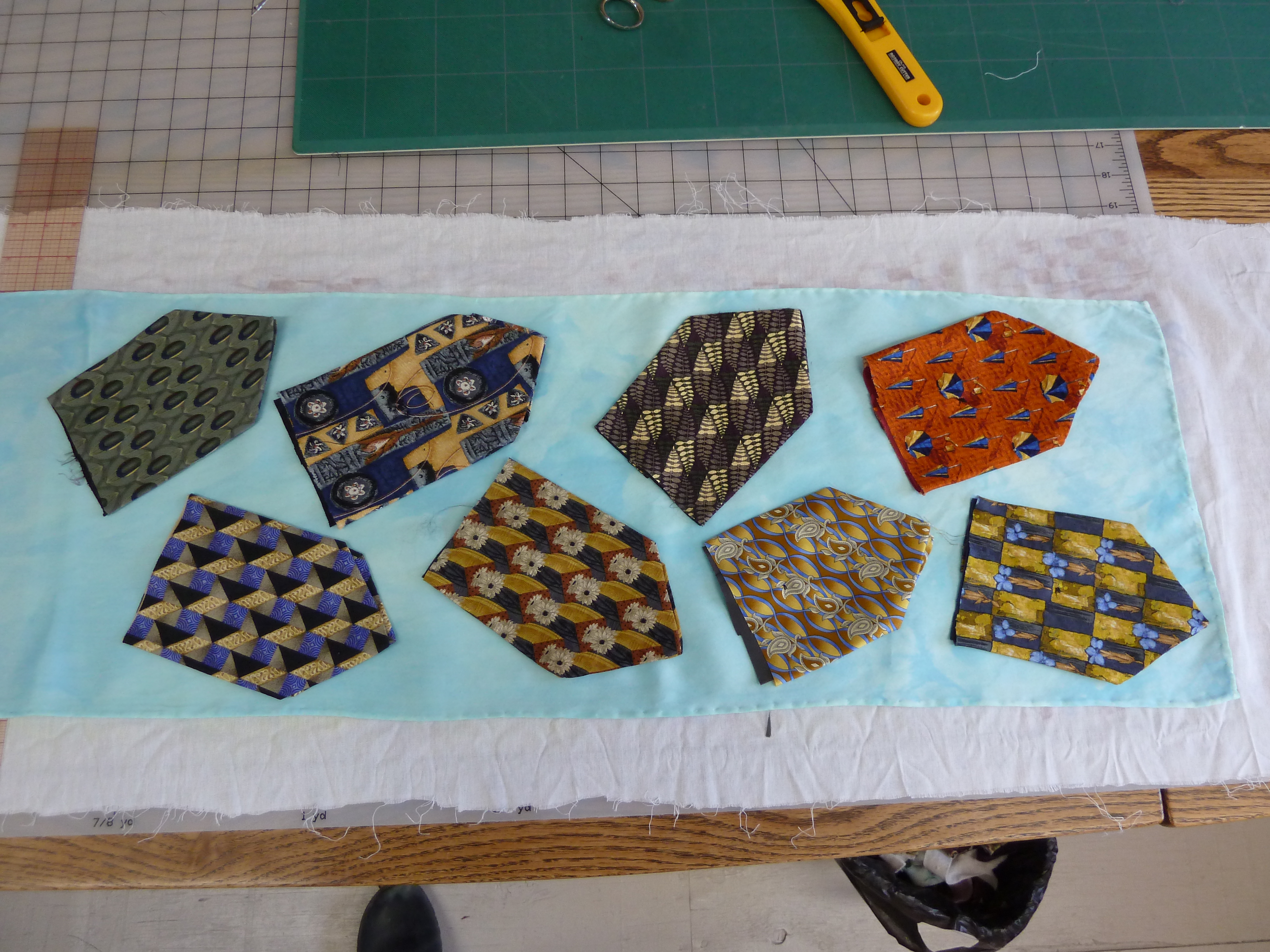
Loved this orange tie!  I think it has enough dye left to use at least one more time.

P1040583

It, and this one, led to the 2 scarves below.

P1040584

It’s interesting that the olive green tie above only came through as lemon yellow on the scarf.

P1040589Here are a couple more that I didn’t get layout pictures for.

P1040591

I have taken 10 of these up to the Winthrop Gallery.  I found a neat old broom display at the White Buck Trading Co. sale last weekend, and fitted it up for a scarf display.

P1040599

P1040600

Aluminum Groundhog Day

Miscellaneous news from the home front today.

The Airstream emerged from its winter burrow yesterday, and did not return!  We have projects to do before we take off on a road trip in early June.  Rick almost has the new armrests for the front sofa done.  We want to pull the rear window and clean it up like we did with the others last year.  And, we need to seal the exterior seams – this was done at the factory when it was built in 1973, and the Spokane Airstream folks told us that once it is done again, it will be good for at least another 20 years.

P1040594

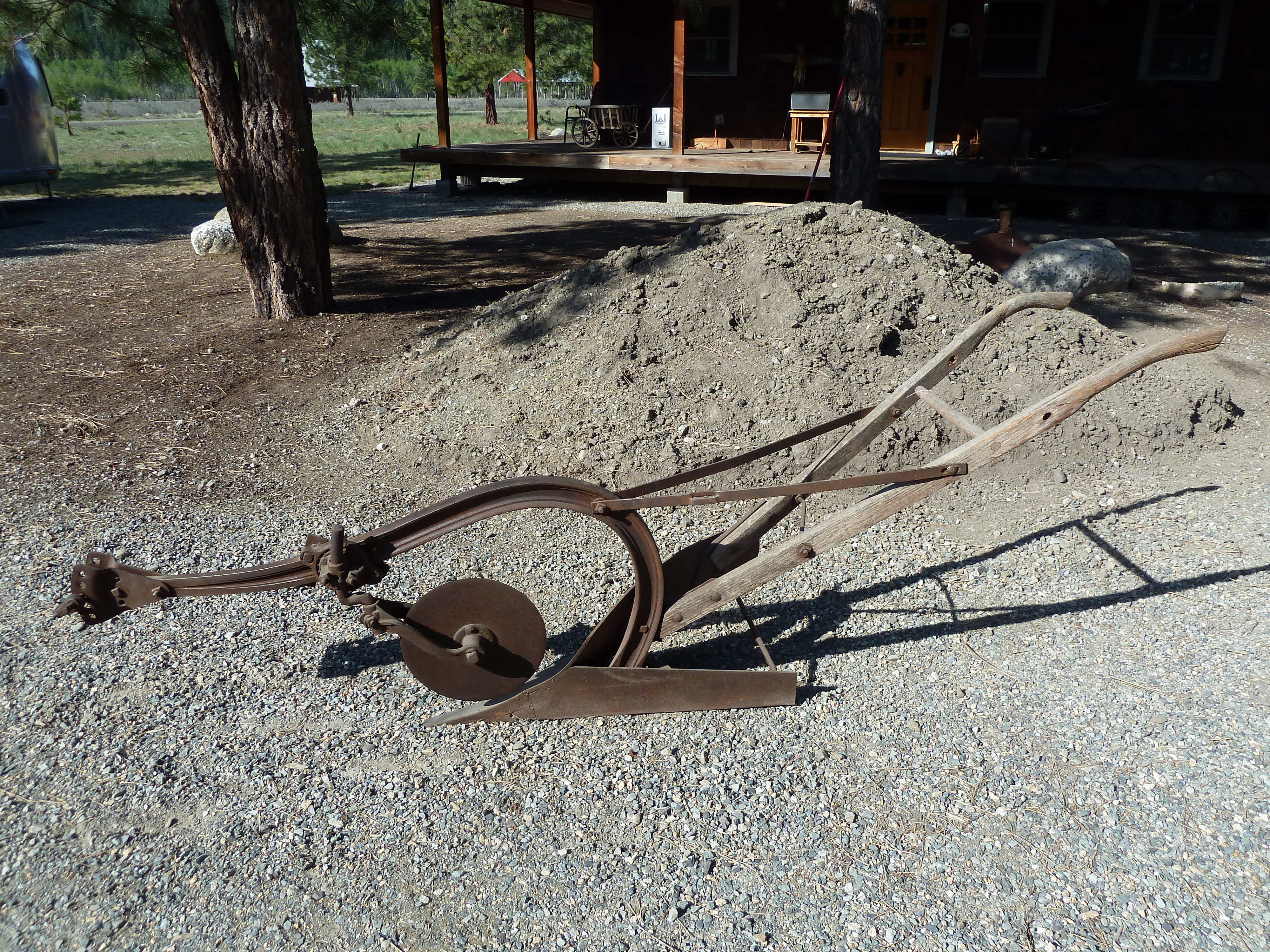
The White Buck Trading Co. in Winthrop (Western themed stuff, and a “museum” of old stuff) closed its doors several months ago.  They have leased half the space, and yesterday re-opened to sell off the old stuff.  Rick picked up some woodworking tools on Saturday, and yesterday we went back and picked up this cool old plow for next to nothing.  It will be “yart” (yard art).

P1040595

Signs of spring and new life  – the farm down the road has 3 baby Highland cows, and piglets too.

P1040598

A friend of mine showed me a cool way of draping my new shawls last week, and I thought I would share it.  Often when you just wrap a shawl around your shoulders, you have to hold the ends with your arms, or pin it in some way.  It doesn’t want to hang down straight or stay on your shoulders all by itself!  This method achieves that, if you are just wearing it as a large scarf, not wrapped around you for warmth.

Start by folding the shawl in half across the middle:bias drape 1

Now draw the bottom edges away from each other.  The goal is to create a fold that is on the bias of the fabric.  You may have to play around with how much of an angle you want:

bias drape 2

Now hang it around your shoulders, so the crossed edges are against your neck and the bias fold is hanging across your shoulders.  This is the tricky part.  On a person, we could get the bias fold to run straight across the back.  On the manniken, I had to drape it a little differently, but it still looks nice.

bias drape 3

Now the ends hang down straight in front.  On these shawls, it also shows off the 2 sides of fabric nicely!

bias drape 4

You could do this with a narrower scarf as well, and any kind of shawl or scarf – not just handwoven.  I also tried putting it on with the bias fold up against my neck and the crossed edges hanging below towards my shoulder blades.  You can make a kind of “shawl collar” this way, and the ends still hang down straight in front.  So play around with it and see what you think!

Four Shawls & A Cowl

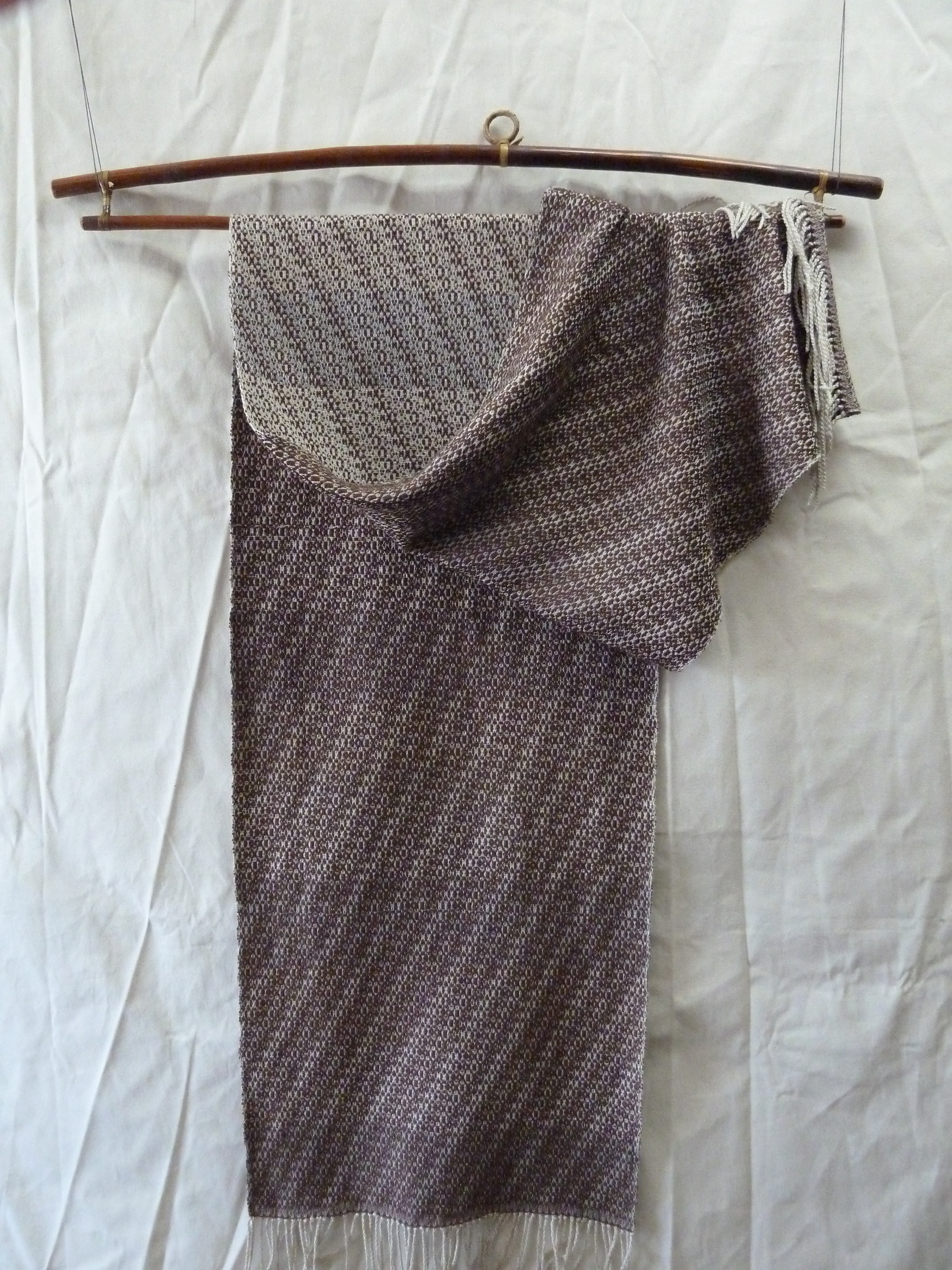
This week I finished the four shawls for my guild’s challenge project.  As previously noted, these were all done on the same warp of 20/2 mercerized cotton, and the same threading (extended manifold twill) and tie-up.  But I used different treadlings for each one, and different materials and colors as well.  They seemed rather stiff right off the loom, but after washing and pressing they have a lovely hand and drape.

Pattern weft:  brown 8/2 rayon used doubled, Tabby weft: 20/2 mercerized cotton, changing color every pattern repeat

1 brown rayon a

Pattern weft: variegated 8/2 tencel used doubled, Tabby weft:  10/2 tencel

2 gold meadow a

2 gold meadow b

Pattern weft: solid teal 8/2 tencel used doubled, Tabby weft:  10/2 tencel

3 teal tussah a

Pattern weft: variegated 8/2 tencel used doubled, Tabby weft:  10/2 tencel

KS spring meadow shawl

I had enough warp left to weave this cloth (table mat?) in black 5/2 pearl cotton with a 20/2 gray pearl cotton tabby weft.  Used the same treadling as the 4th shawl above.

black&white mat a

front side


black&white mat b

back side


On the knitting front, I just finished a cowl using some of my handspun yarn.  It was a 2-ply and approx. laceweight.  One of the singles was spun from a merino/tencel dyed top from Chasing Rainbows Dyeworks.  The other was merino/cashmere in the same colorway.  These are dyed in a regular repeating color sequence, which I was careful to preserve in the spinning.  When plied together, the same colors lined up pretty well so I got this nice soft striping when knitting with it.

Zuzu Petals Cowl

The pattern is “Zuzu’s Petals” by Carina Spencer (available on Ravelry or her website).  I was pretty much getting gauge on the recommended needle size, even with the handspun.  But I tried it on when partway done and decided it was fitting a little too close around my neck, so I took it back to the point where you quit knitting back and forth and join in the round to begin the lace chart.  Then continued the stockinette part with the same increases until I had added 24 more stitches (two 12-st repeats of the lace) then went on and joined in the round and finished it up.  I think it works much better for me, or at least in this yarn.

I just love this little cowl – it may be my favorite thing I have knit this year!

Silk Tie Soiree

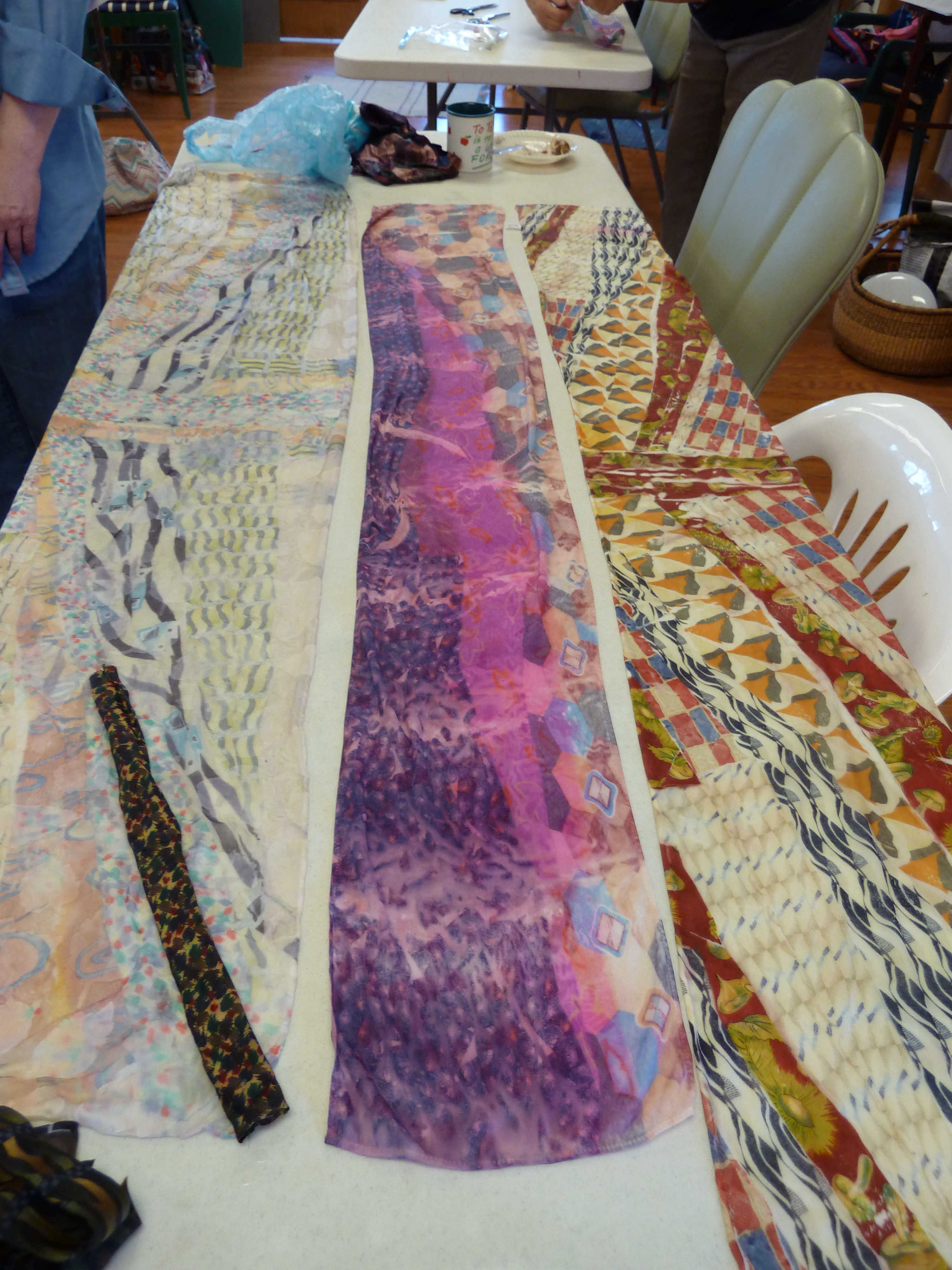
Yesterday was a really fun day at the guild room.  We have been planning to do a group project, which was to learn how to dye silk scarf blanks by transferring dye from recycled silk neckties.  We collected a bunch of neckties from various sources and ordered 11″ x 60″ silk charmeuse scarf blanks from Dharma Trading Co.  A couple of women from the Seattle Weavers’ Guild came over to visit and lead us through the process (there are also some YouTube videos out there that are pretty good).

Basically you lay out a piece of muslin bigger than your scarf (a couple of inches on each side), then lay the washed and ironed scarf on it, right side up.  It takes about 3 neckties worth to cover one end of the scarf in a pattern.   Don’t open up the ties, just remove the labels, as you want fabric on both sides – although you do need to remove the wide end as there isn’t fabric on both sides in that area.  Fold the other end of the scarf over, to sandwich the necktie pattern between the 2 ends.  Fold the muslin over, then roll the whole thing up and secure (but not too tightly) with cloth strips or string or something.  The roll is placed in a hot water bath with vinegar in it and kept just below boiling for about 2o minutes.  They tend to float so you have to come up with a way to keep them submerged!

Here we are starting our layouts:

P1040512

P1040513

P1040514

This was mine:

P1040515

and another  one:

P1040516

One very interesting thing was that the color of the necktie doesn’t necessarily predict how it will come out on the scarf!  Some just transfer their dye more completely.  Others transfer as a paler color, or a different color.  So there is a definite element of serendipity to this whole process.  But they all came out really cool.

P1040522

mine is the one on the right


P1040523

P1040526

I have more neckties and scarf blanks here at home, so will be doing more of these!

A Learning Experience

Our guild has an annual “challenge” project which we work on throughout the year (read: at the last minute) and the results are presented in April.  This year the theme is “Twill”.  I decided to use drafts #263-268 in Carol Strickler’s “A Weaver’s Book of 8-Shaft Patterns”.  This is an extended manifold twill from the Bateman manuscript (draft 201 in Shuttle Craft Guild Monograph 40).  The Strickler book offers additional treadling variations.

In March I got started, intending to weave a series of 4 scarves to try out different materials, colors and treadling variations.  I did all the calculations for an 8-inch wide, 12-yard long warp using 20/2 mercerized cotton sett at 30 epi.  Then I wound the warp using my AVL warping wheel, to put it on my sectional beam on the 32″ Macomber loom.  First major error:  I forgot I was winding 2 threads at a time (using 2 cones of close colors, natural and a pale tan).  Using the counter on the warping wheel, I wound as many times as I should have for a SINGLE thread, and got twice as many warp ends in each section as I needed.  So now I had enough warp on there for a 16-inch wide piece, but crammed into 8-inches on the sectional beam.  And I didn’t even realize it until I was partway across threading the heddles.  Oops.

But this did turn into a learning experience!  My advisors at the guild told me to finish the threading and then sley the reed, which would spread it out to the full 16″.  Then wind it forward onto the front cloth beam, inserting sticks frequently to keep it from getting too mushy and stuck together.  Then spread it out in the back and re-attach it onto the cords for the requisite number of sections on the sectional beam.  Wind it back onto that beam using lease sticks in the cross in front of the reed, to provide needed tension.  That was a sweaty palm day, let me tell you.  But by golly it worked (with a few broken threads along the way).  So now I am making shawls instead of scarves.

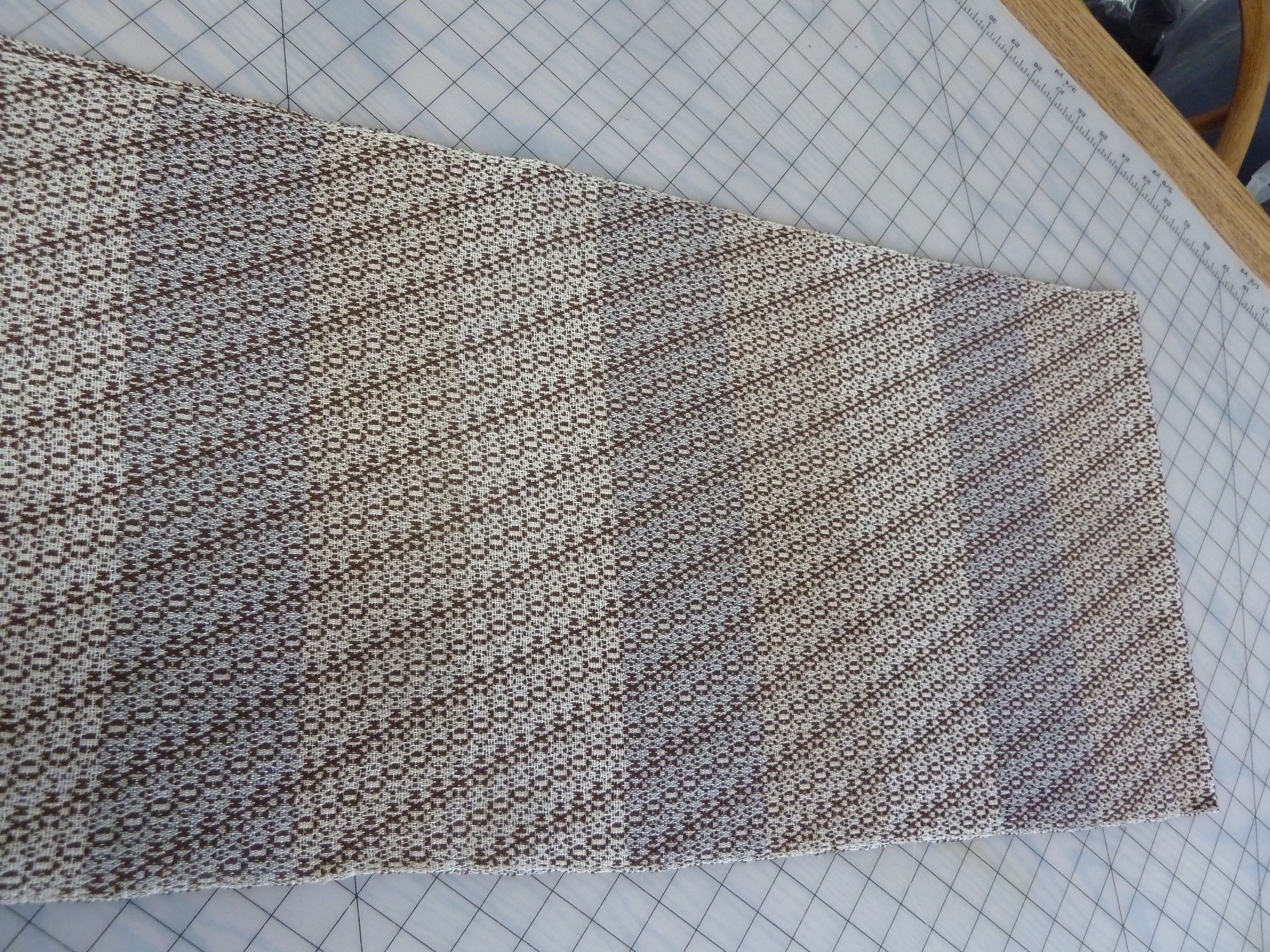
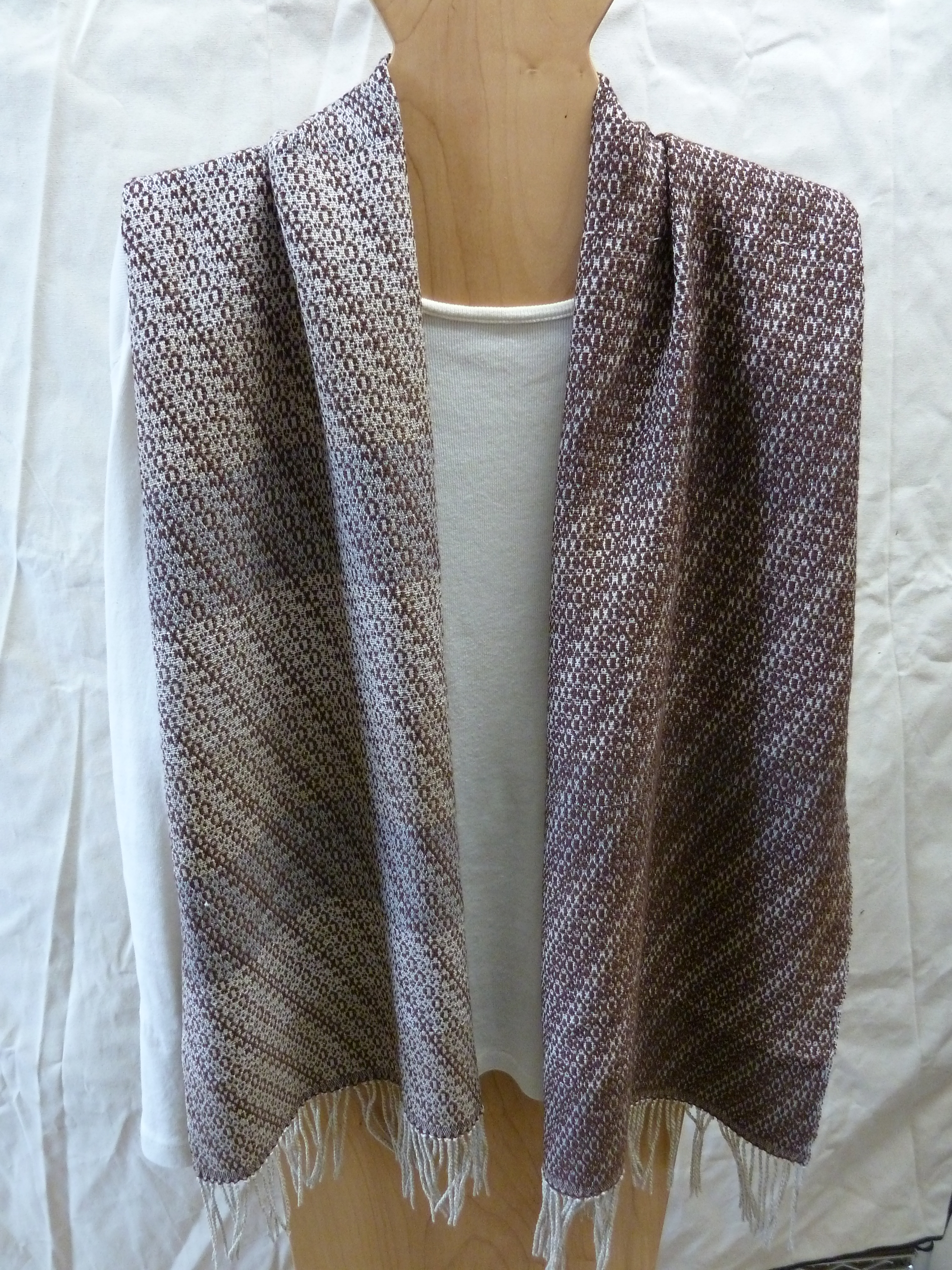
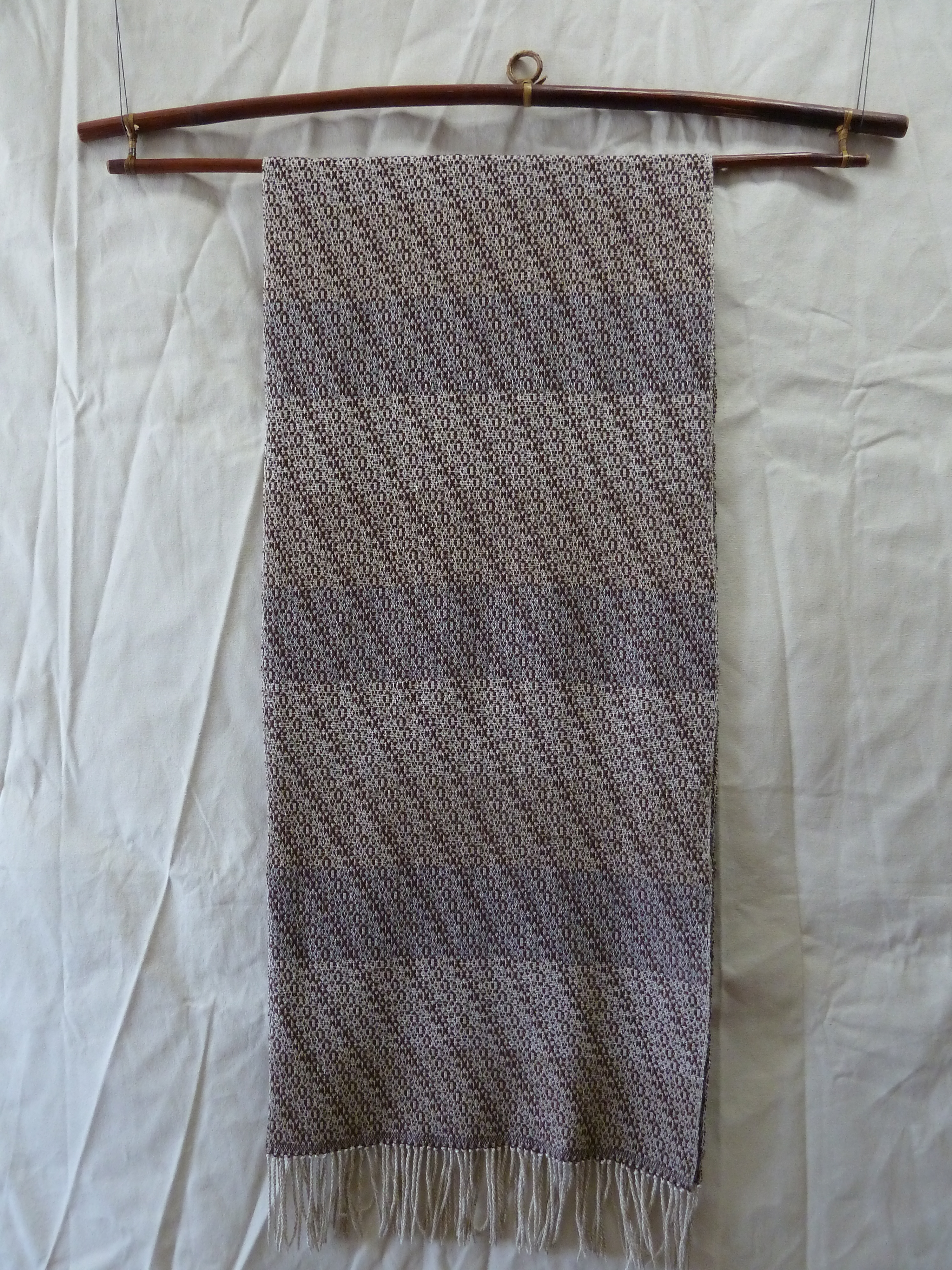
Here is the first one.  The pattern weft was 8/2 brown rayon used double.  The tabby weft is 20/2 mercerized cotton, same as used for the warp.  I was afraid it would be a little boring so I changed the color of the tabby weft every complete pattern repeat – pale tan, natural and a medium gray.  The treadling was the original one from Bateman and is #264 in Strickler.  I wanted to finish this one completely, through the washing and pressing phase, to make sure it had the right drape, before moving on to the remaining three shawls.  It feels good!

P1040508

Notice how different the other side looks:

P1040510

and a close-up of the pattern:

P1040506

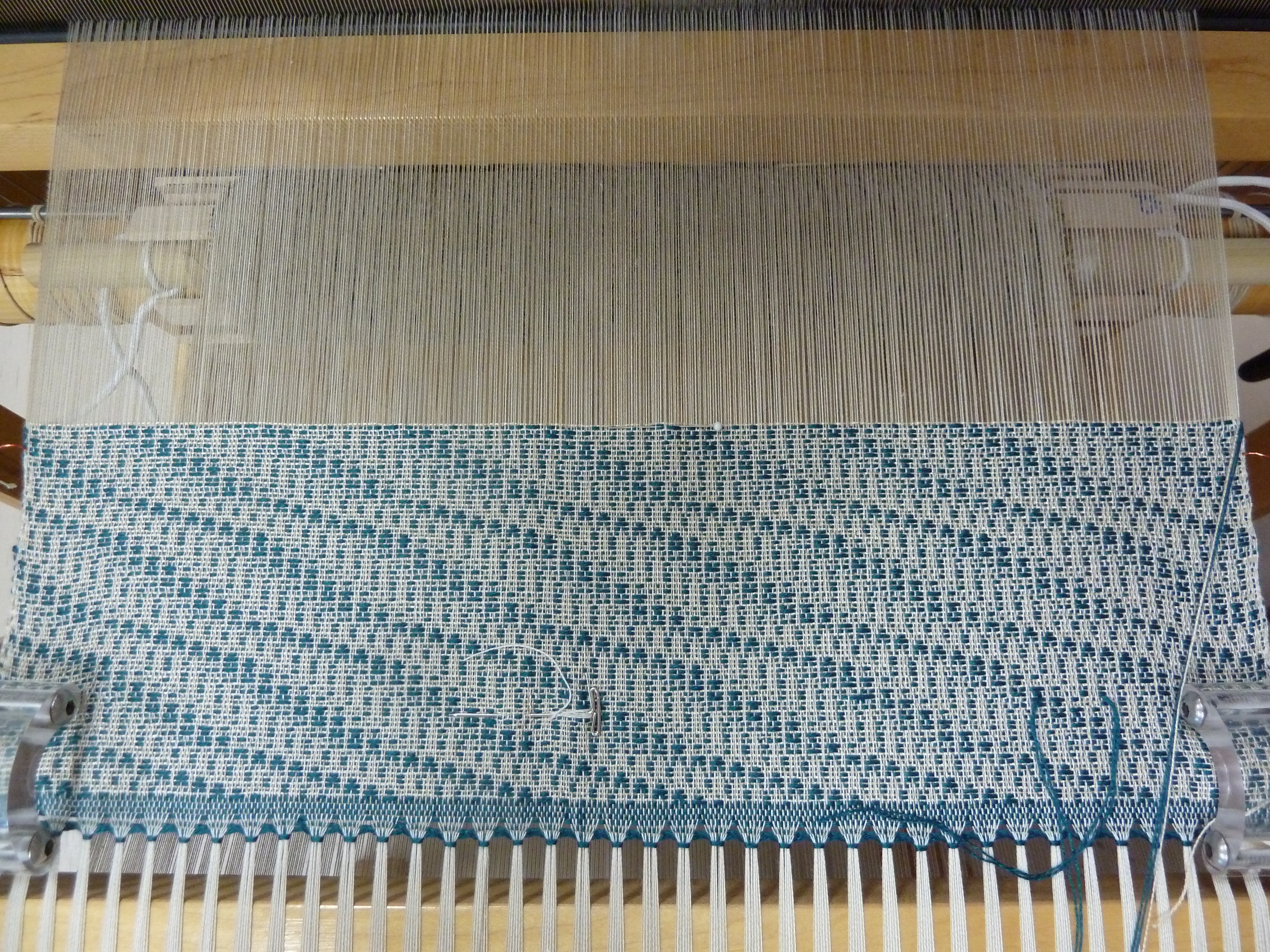
Last week I finished the second one, but it is still on the loom.  I took a picture when I first started it, though.  The pattern weft is variegated 8/2 tencel used double (from WEBS) and the tabby weft is 10/2 tencel in gold.   This is treadling variation #266  in Strickler.

P1040498

I am now working on the third one, using solid color teal 8/2 tencel used double for pattern weft, and 10/2 tencel in color “tussah” for the tabby weft.  This is treadling variation #268  in Strickler.

P1040501

I will post more pictures in a couple of weeks when they are off the loom and finished!

We are having an early spring and the hills, and our yard, are greening up.  There are wildflowers out, and birds coming to nest.  They expect to have the North Cascades Hwy open by the end of the week, which is about a month earlier than normal!  Of course, that does mean the snowpack is low….