I have to admit I was a little crestfallen when I first saw the loom in Port Orchard. It was more dilapidated and rustier than I had expected. However, Rick’s attitude was “nothing that can’t be fixed, let’s load it up and get a move on…” so off we went.
I am fortunate to be married to a man who is a professional woodworker and all-around handy guy, and who thought it would be “fun and interesting” to help me restore the loom (his words, not mine!), and learn more about how they work in the process.
Warning: this is a long post that may be totally boring if you aren’t interested in looms.
At home in the workshop:
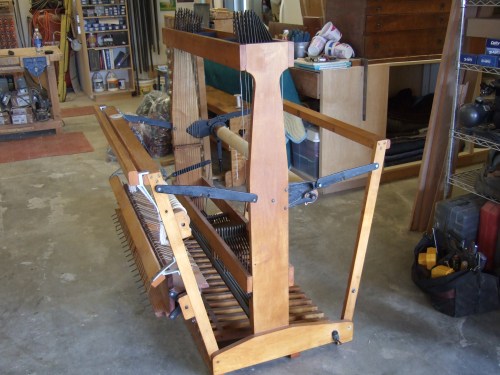
It was dirty and just about anything on it that could rust, had done so. We decided it was best to just take it all apart, clean it up and then put it back together. This meant removing the front and back beams, pedals and the jack mechanisms.
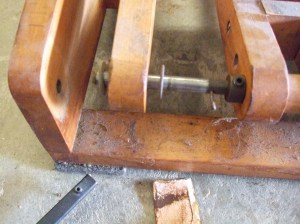
Dirty...
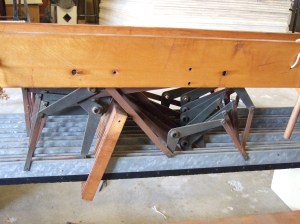
Rust on the steel parts of the lower jacks
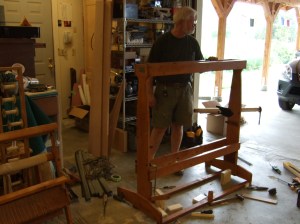
Disassembled
Over the course of the next 2 days, Rick worked on the frame and jack mechanisms. All the bolt heads were rusted so he removed and replaced them, in the course of which he found that two of the bolts were broken off inside the frame. We think the loom must have been dropped at some point, probably during a move, as wood was split as well. But he managed to get the broken pieces of bolt out and put it all back together again with new bolts and brass screws. Much sturdier now! Also one of the treadles had a piece of wood splitting away on the bottom, but he glued that back together again no problem. He went over the frame with a sanding sponge, which cleaned off the dirt and grime and made the original varnish finish smooth and nice looking. The upper and lower jack mechanisms had a lot of rust to be sanded off, plus the chains and S-hooks were all rusted, but these were items that are readily available at the local hardware store so we were able to replace it all with new shiny metal.
Meanwhile I worked on the rusted heddle bars, all 24 of them. These fit into the harnesses or shafts, across the top and bottom and are what the heddles slide on (the heddles are what you thread each individual thread through, so they are raised with the harness they are threaded onto). We developed a method for removing the rust: first a sanding with a rough grit paper to remove the worst of it, then burnish with a wonderful little sanding sponge that is meant for cleaning metal (he got it years ago from Bridge City Tools). Final cleanup with Tri-Flow (a rust remover and lubricant) and steel wool or fine grit paper.
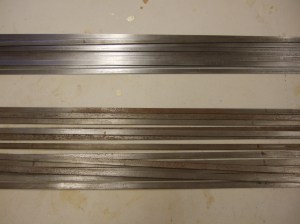
Heddle bars, clean (above) and rusty (below)
The heddles themselves must be the original ones. I called and talked to Eddie at Macomber and they are lighter weight than the inserted-eye heddles they provide now, and they pre-date the flat steel heddles that they used for a while before changing to the inserted-eye ones.
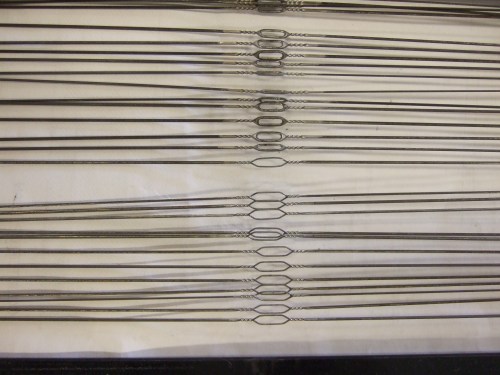
Original heddles, lightweight inserted-eye and plain wire
There are about 800 of the inserted-eye heddles (with solder around the eye) and about 400 of the plain wire ones. I found this out when I went to put them back onto the heddles bars and into the frames. They too needed to be cleaned up, with some rust at the tops and bottoms where they slide on the bars. I wound up using naval jelly, brushing it on liberally and then rinsing it off, drying them thoroughly, then spraying with clear silicone spray per the recommendation of Eddie at Macomber.
I also went over the 16 treadles with the sanding sponge, then put a coat of Profin on them. Now they are pretty clean and new looking.
Reassembly of the loom:
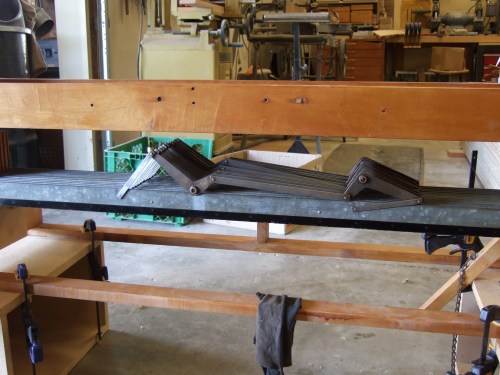
Lower jacks all cleaned up and re-installed
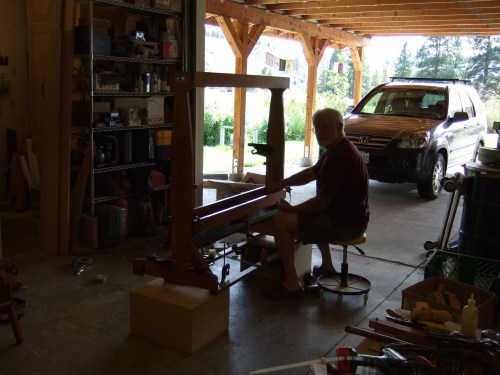
Easier than sitting on the floor!
Yesterday I went to work on the sectional beam, which was (you guessed it) dirty and rusty. I went over all the wood with the sanding sponge to clean it up, then worked down the rust on all 84 of the metal spikes that divide the sections (21 on each of 4 fins). Grrr. This one is a pain.
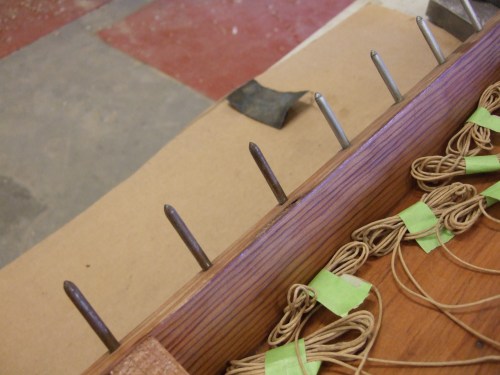
Rusty and clean sectional dividers
The cord on the sectional beam is shot so I have ordered a replacement kit from Macomber, along with new cloth aprons for the front and back beams. Also the reed it came with is rusty and in my opinion, not salvageable, and somewhere along the way it lost most of the hooks that are used to connect the treadles to the lamms (see picture above, they are the crosspieces below the lower jacks) – there were only 8 hooks, and Eddie said they usually send 6 per harness, which would be 72. Fortunately, still available from Macomber.
So it won’t be all ready to go for another week or so, but we are getting there. A labor of love. It’s going to be worth it.


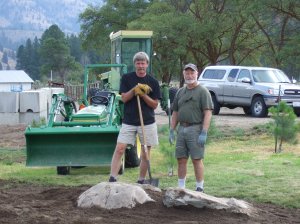
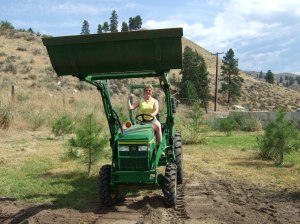
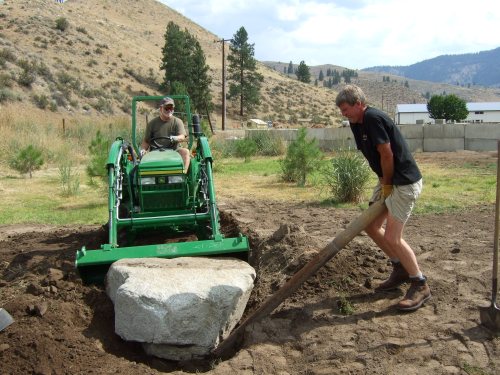
 then proceeded to cart some of it over to the new planting bed in back with the tractor, and spread it out. I went up to Wild Hearts Nursery near Winthrop and picked up some plants to make a start on the new perennial borders. I had to plant something! So they look a little lonely and forelorn, but hopefully all will survive and be nice big vigorous plants next year. We have a couple of varieties of lavender, black-eyed susans and some other types of daisies, gaillardia, perennial geraniums, and some succulents around the rocks.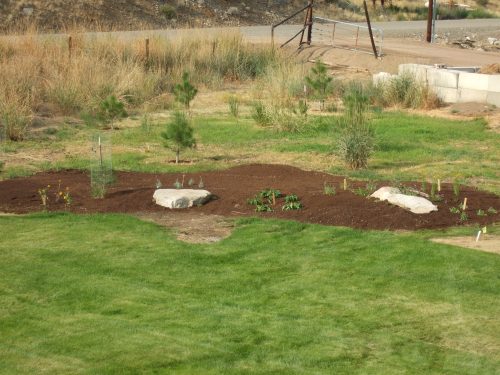
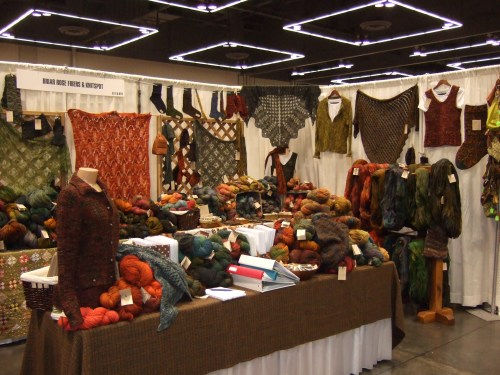
 Off to Vancouver, WA today to install cabinets at our friends’ house. I will also go by the Sock Summit at the Oregon Convention Center. More on this next week!
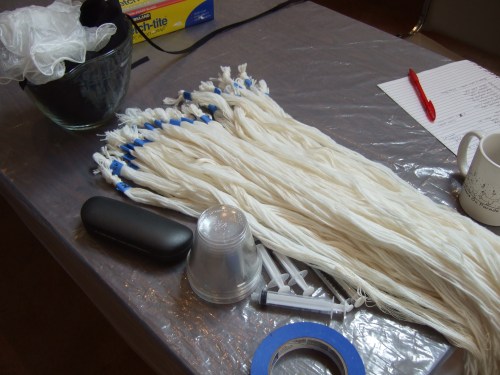 The fiber bundles contained 12 strands each of Cascade 220 (a basic wool knitting yarn), a laceweight wool/silk and a fine spun silk. Each type of fiber takes up the dye a little differently.
 After the bundles were steamed and cooled, we had to unwrap them and rinse them 3 times, then hang them to dry.
 You think that was a repetitive task? But wait, there’s more! The next day we spent taking apart each bundle and tying 3 strands (one wool, one silk/wool and one spun silk) of each color onto 10 pre-printed cards.
 This was a task that did not get finished. I have some here at home that I am still working on, but eventually we will all get the finished cards with everyone’s samples.
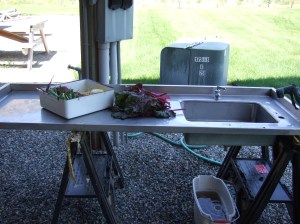





 Twisp of Fate