Feeds:
Posts
Comments

Satiated in Seattle

This isn’t a new post, I just changed the title since it attracted some odd spam…

I meant to post something before we left the valley last Friday, but it kind of got away from me with all the packing and getting ready and all.  So here we are in Seattle with the cats and lots of time on our hands between social activities – but also with very limited internet access, so blogging is a bit problematic.

Last  Saturday we attended a big dinner party with 6 other couples (sometimes there are more) – a longstanding tradition with a group of friends that goes back decades.  Nowadays we call it the “Little Dickens Dinner”.  Our friends who recently built a house at Suncadia over near Roslyn (east side of Snoqualmie Pass) were the hosts this year, and we all stayed overnight in Roslyn so we could, ahem, enjoy ourselves and remain safe from driving back over the pass.

Sunday I got together with some of my knitting buddies and we had a fine time knitting, chatting and snacking on holiday goodies.

Monday we celebrated Rick’s mom’s 91st birthday here at our place, with a home-cooked meal by yours truly.  Dinner with our friends from Redlands on Tuesday, also here.  Dinner with 2 other couples last night, also here!  Starting tonight we dine elsewhere, with Christmas Eve dinner and Christmas Day dinner at Rick’s sister’s, Saturday up in Anacortes with my mom and dad and also my brother and his wife.  Sunday we go over to Bainbridge Island for birthday dinner with our friends from Redlands and I believe a cribbage tournament may also be in the offing.

I hope I can still fit into my jeans by the time we head home next Monday!

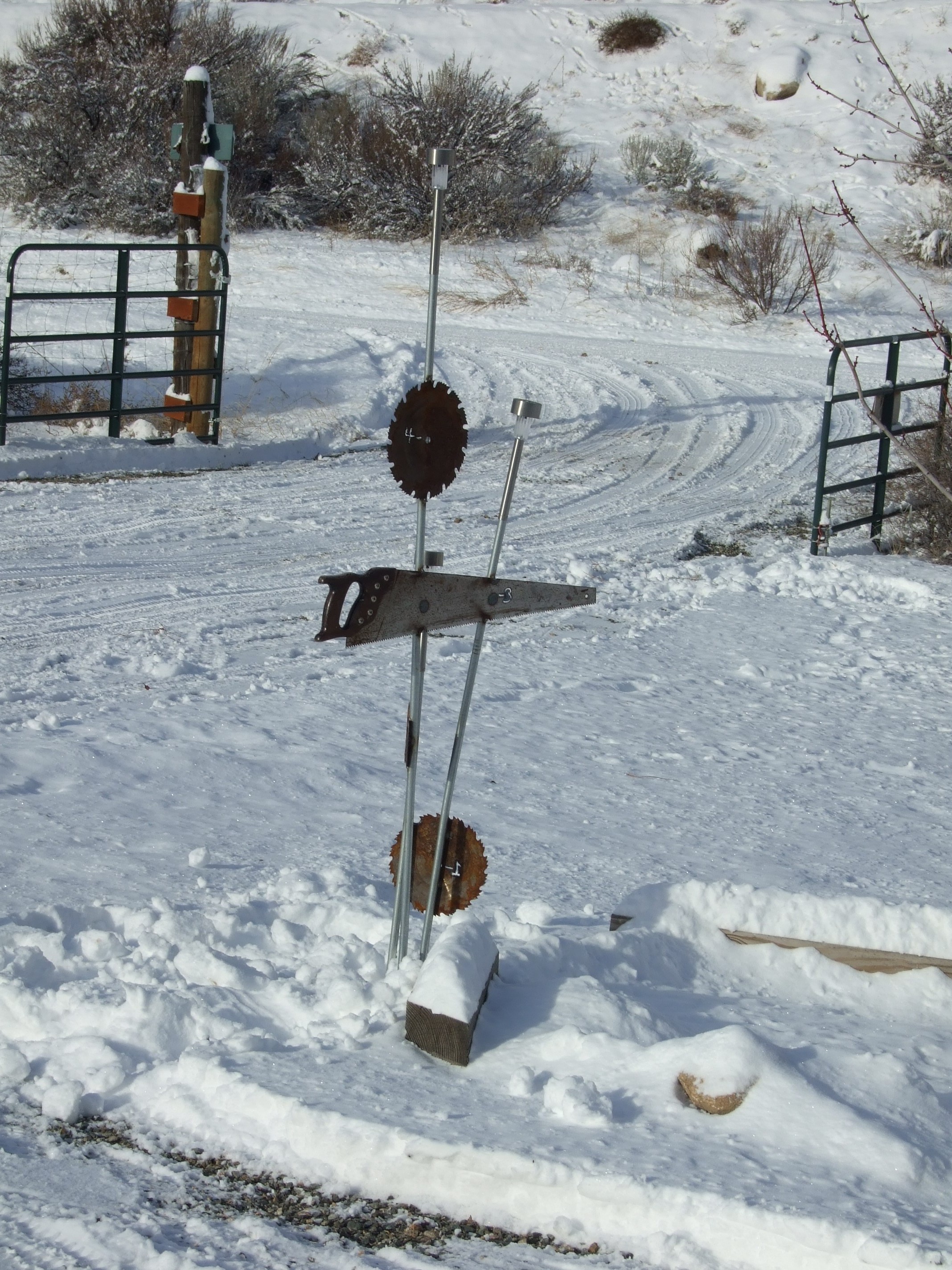
I leave you with a picture of our Christmas present to ourselves:  a “Woodworker’s Snow Gauge” by Okanogan metalworking artist Dan Brown.  Each saw blade has a 1-foot marker on it, going up to 4 feet.  (At the time the picture was taken last week, we only had about 3 inches of snow and from what I hear things have not improved greatly while we have been gone.)  The 3 rods have LED lights and solar cells, and when it gets dark they glow.

Minus One

That was the temperature when we got up at 7 am – minus one degree F, or over 30 below freezing.  Yikes!  Well it stays warm in the shop and apartment so I guess we got this place insulated pretty well.  It has been clear and sunny and beautiful in the valley, although the continuing lack of snow is making us nervous.

The social event last weekend was the Confluence Gallery‘s annual holiday dinner up at The Barn in Winthrop.  Now that doesn’t sound too elegant, but they decorated it in a cabin theme and it was really quite charming.  The food was great, and this year they skipped the benefit auction so it was easier to socialize and mingle after dinner.  Most of the attendees are volunteers, patrons or artists (or all three) so we have a lot in common.  Rick and I had a great time and posed for our pictures in a sleigh:

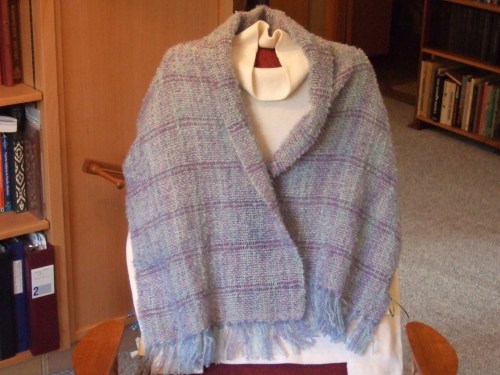
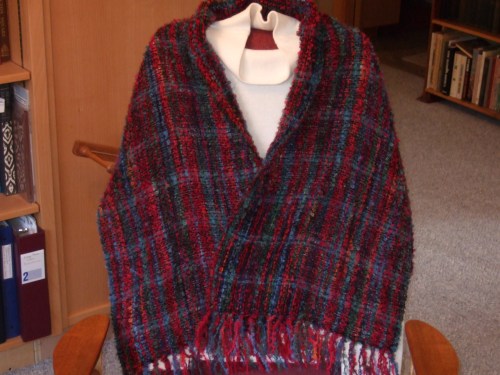
I have been weaving up a storm this week, having finished four shawls using a mohair boucle in colors that remind me of a parrot.  It is a handpainted yarn from New Zealand, and the dyer called it “Lollipop”.  It has proven to be a popular color, as I sold two at the weavers’ guild sale, and then two of these longer ones are on order.  So then I did two more to have some for stock.

I also finished a knitting project – it is a wool vest that I started around the first of November.  The pattern is “Veste Everest” by Veronik Avery, from the Fall 2005 Interweave Knits magazine.  I used some yarn I had in stash, a Karabella yarn called “Aurora Melange.”  It is a superwash extrafine merino in marled browns (or at least, I think “irrestringibile” means superwash…) and feels so soft and cushy and springy.  I was worried I wouldn’t have enough after comparing the yardage of what I had with the yardage of the recommended yarn, so even though it is supposed to be a short vest and I am long-waisted, I finished it to the shoulders as written.  At that point I had more than 2 balls of yarn left (out of eight) and it was really way too short.  So I ripped it back to the underarms and added two more repeats of the cable pattern, or another 4 inches, before finishing it again.  Now it is perfect on me, and I still had one whole ball left!  Curious, but there it is.

"Veste Everest" in Karabella "Aurora Melange"

The marled yarn somewhat obscures the cable pattern, but more so in the pictures than when you are looking at it in person.  Not sure why that is, but I took about 6 shots trying to get better light and definition, to no avail.

Shawl Pins R Us

We’re back in the valley this week after a nice relaxing Thanksgiving weekend visit to Seattle.  After the actual T-day activities, we had a couple of days to just hang out and be tourists in the city.  The weather was great, meaning dry and even sunny on occasion, which meant we could go for long walks.  We got together with friends, also rented movies and stayed in some evenings, and got lots of sleep.

Back in the valley, it has stayed dry and it is getting quite cold.  We could use some snow around here.  The Weatherwatch column in the paper (Methow Valley News) says it will be coming with the waning of the moon… hope so!

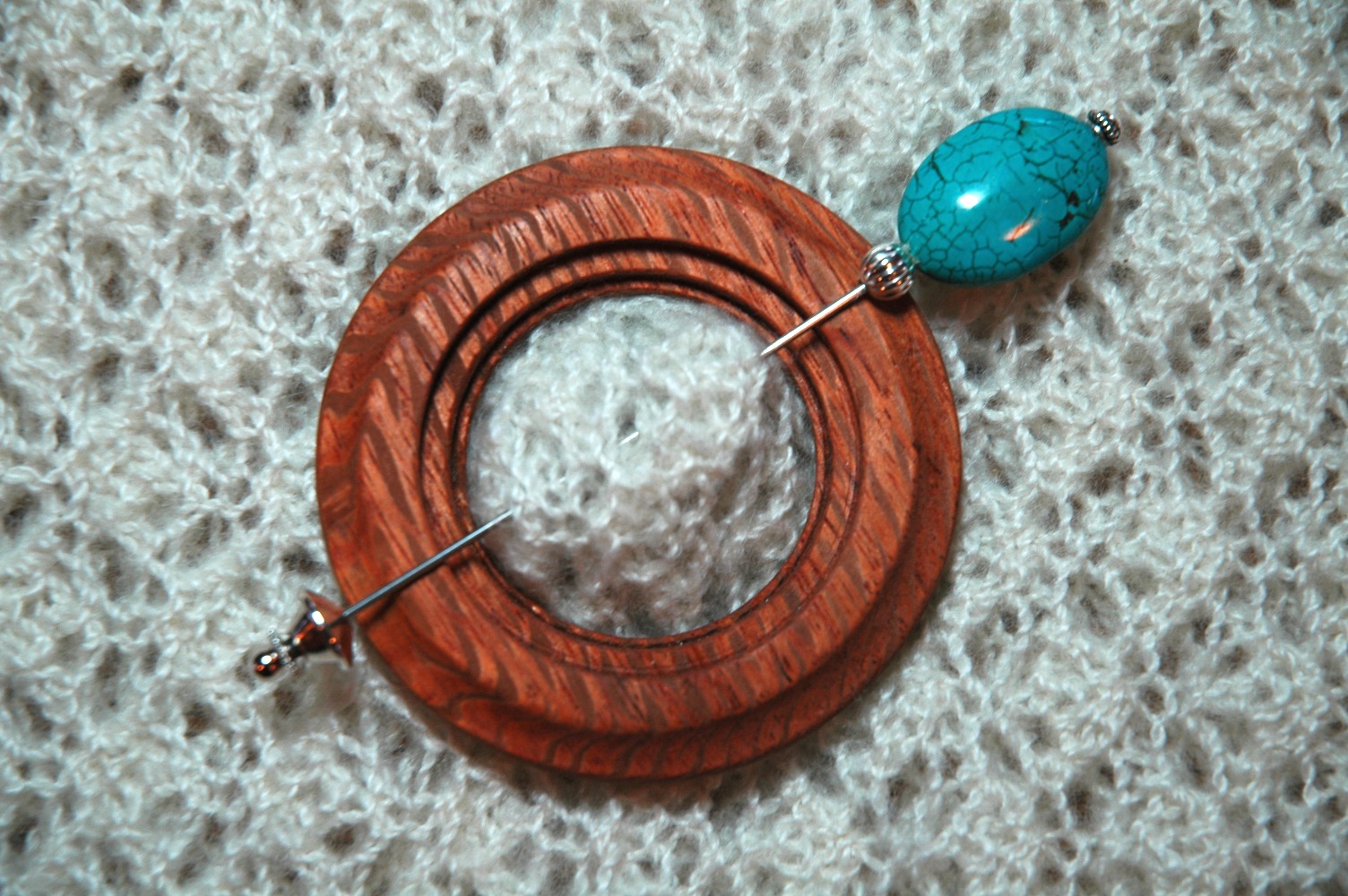
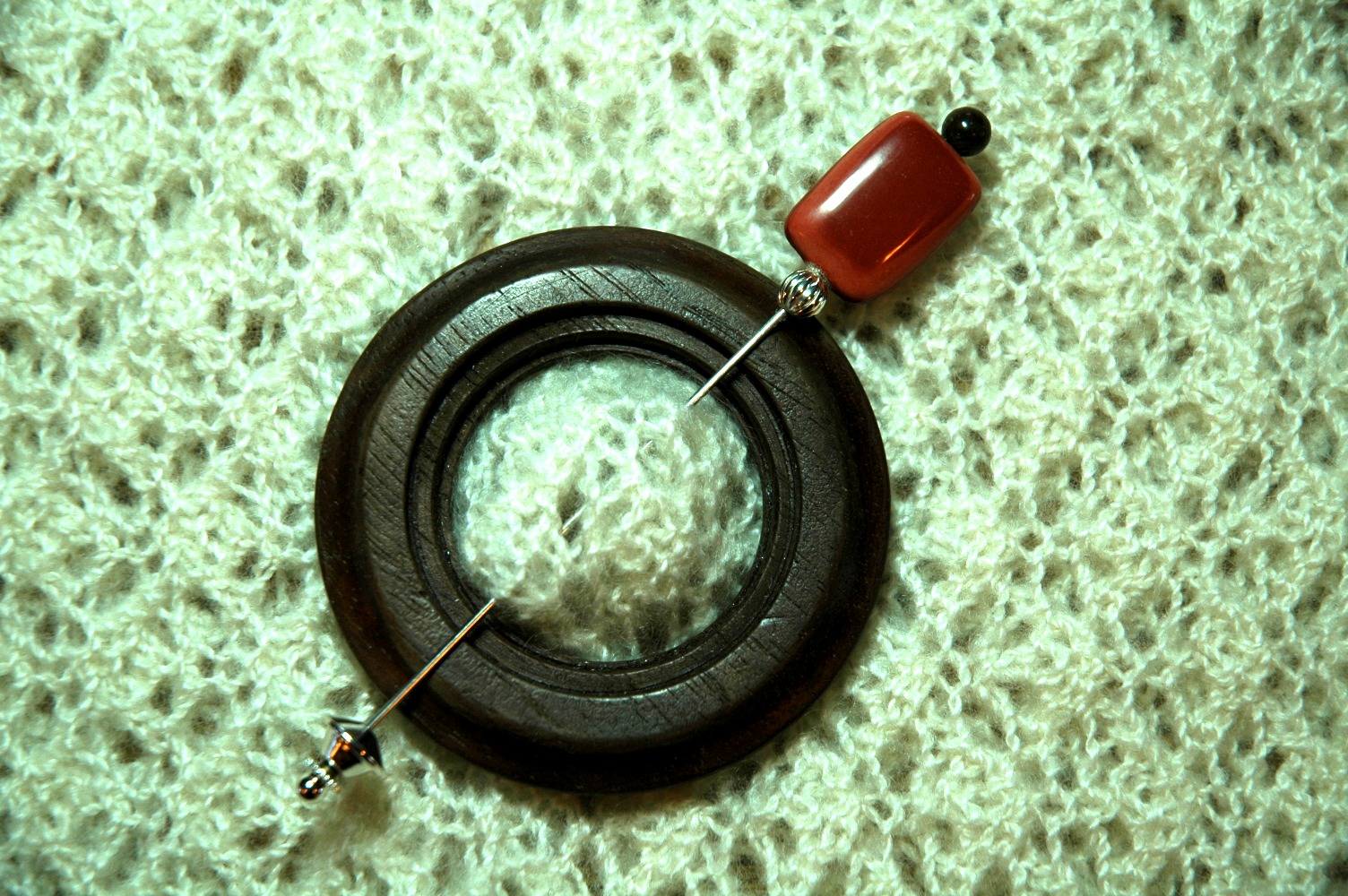
I made a first batch of shawl pins for the guild sale using beads and some wood rings I found at a bead store in Seattle.  Unfortunately, they have run out of the rings and said it was a one-time thing and they would not be getting more.  I had explored some other bead stores while over at the coast for Thanksgiving, and came home with some really pretty semi-precious stones that I wanted to use for the heads of the pins.  But, no rings.

But wait a minute, I am married to a woodworker.  So I asked him a couple of days ago if he thought he could make me some rings that were a little nicer and more interesting than the ones I had purchased.  What a guy – the next thing I knew he was down in the shop up to his ankles in wood chips and had turned out the wood for 108 of them.  108!!  Most of them still need sanding and finishing, but he did finish up enough for me to get some out to the shops on consignment for the holiday shopping season.

And he used some beautiful woods – highly figured maple, lacewood, a very dark and dense walnut from either Paraguay or Peru (he couldn’t remember).

So here’s some of the first batch:

Lacewood with turquoise bead

Walnut with bright green stone bead

Walnut with square red semi-precious bead

Figured maple with semi-precious stone bead

Lacewood with orange semi-precious bead

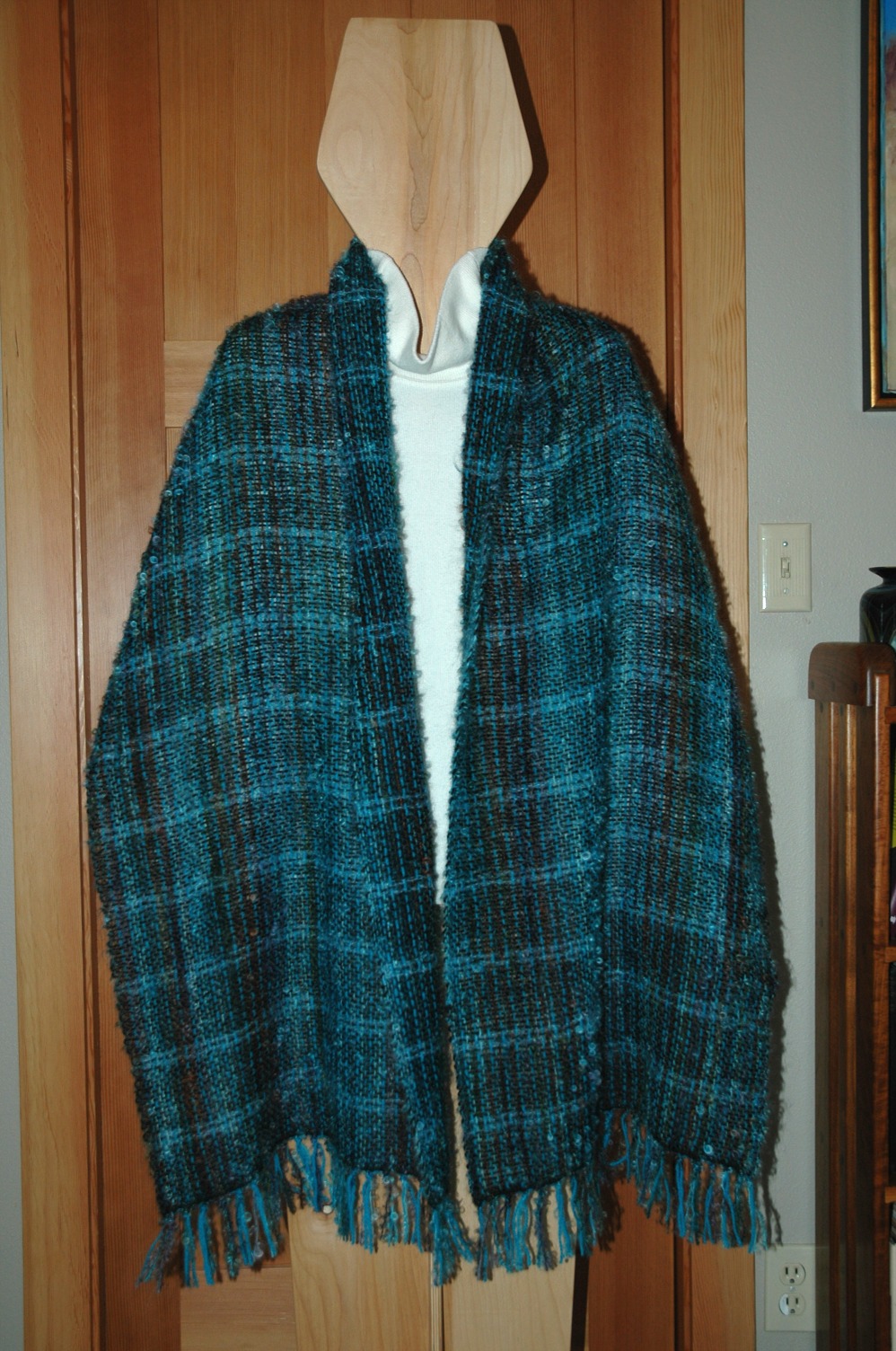
I also finished two longer shawls, having put the warp on the loom before we left for the holiday.  One was woven with rich brown alpaca for the weft, the other with black alpaca.  I took them up to the galleries today (Ashford Gallery in Winthrop and Confluence Gallery in Twisp) and am planning on starting another pair of longer shawls tomorrow.

Blue & turquoise warp with brown alpaca

Blue & turquoise warp with black alpaca

Off to The Coast

We’re off to Seattle (aka “The Coast”) for Thanksgiving with family and visits with friends.  The weather seems to be cooperating so we expect the drive over the passes to go without incident (or accident, that is).  The cats are going along since we will be gone for 5 nights – they usually tolerate the drive without too much complaint, and recognize the apartment once we get there.

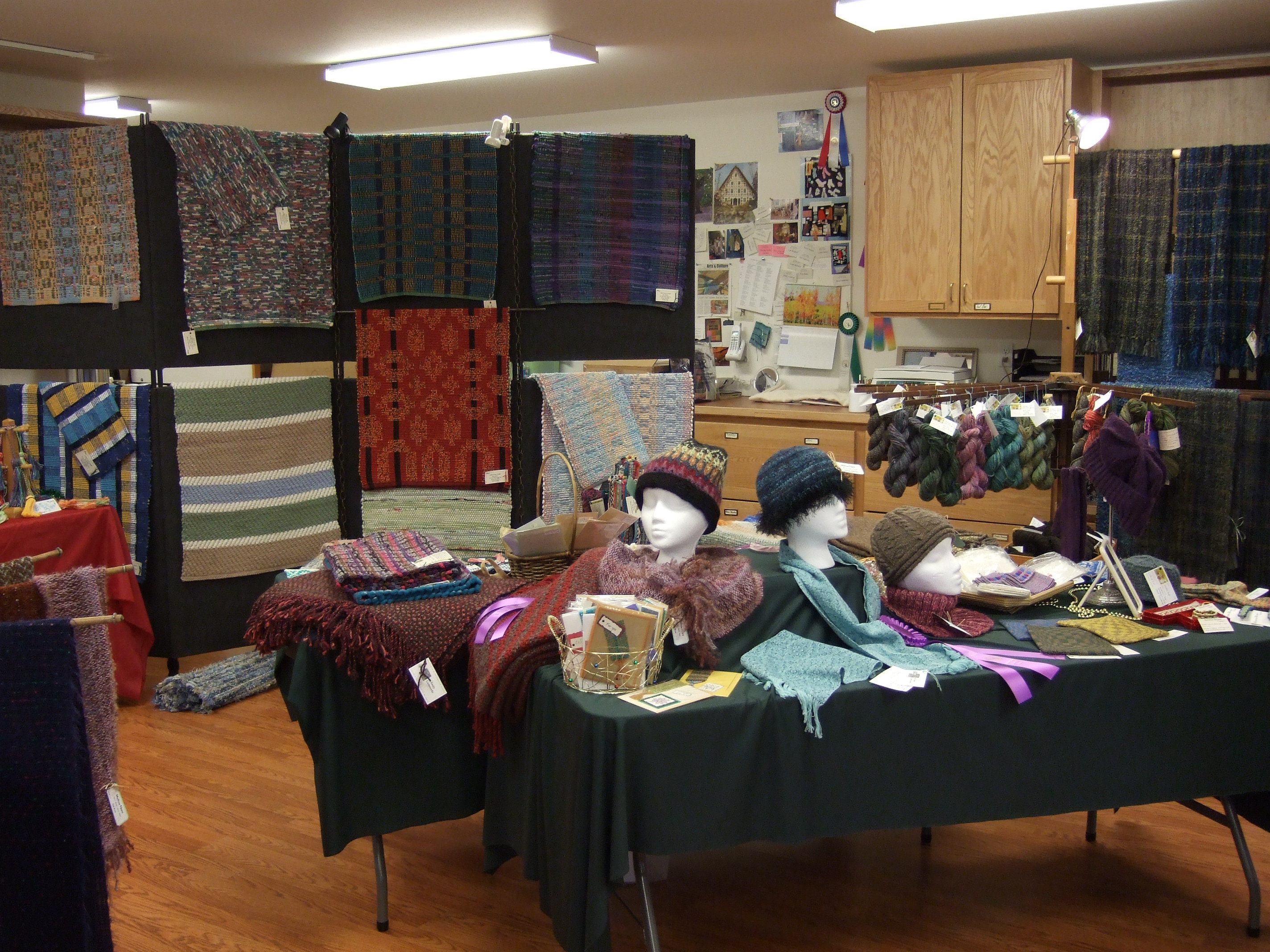
So I will leave you with some pictures of our guild meeting room set up for the sale (which went well), and a promise to resume blogging sometime next week.

We had many rugs on display all over the room

Kay Reiber's shawls displayed on loom

towels displayed on a 72-spool rack

the "tableware" table

MVS&W 2009 Show & Sale

For any readers of this blog here in the valley (or planning to visit the valley this weekend), Methow Valley Spinners & Weavers annual show and sale is happening – today and tomorrow.

MVS&W Annual Show & Sale

Friday, Nov 20 – 2:00 to 6:30

Saturday, Nov 21 – 9:00 to 3:00

137 Old Twisp Hwy

(between Twisp and Winthrop)

I’ll be up there both days, helping out and also demonstrating spinning.  Should be fun!

Rick took the time to make me three plywood mannequins this week.  I got the idea from the Elsebeth Lavold travelling exhibit which I saw last February at the Nordic Heritage Museum in Seattle.  She is a Danish knitwear designer who has published numerous pattern books and also has her own line of yarns.

Painterly Dyeing

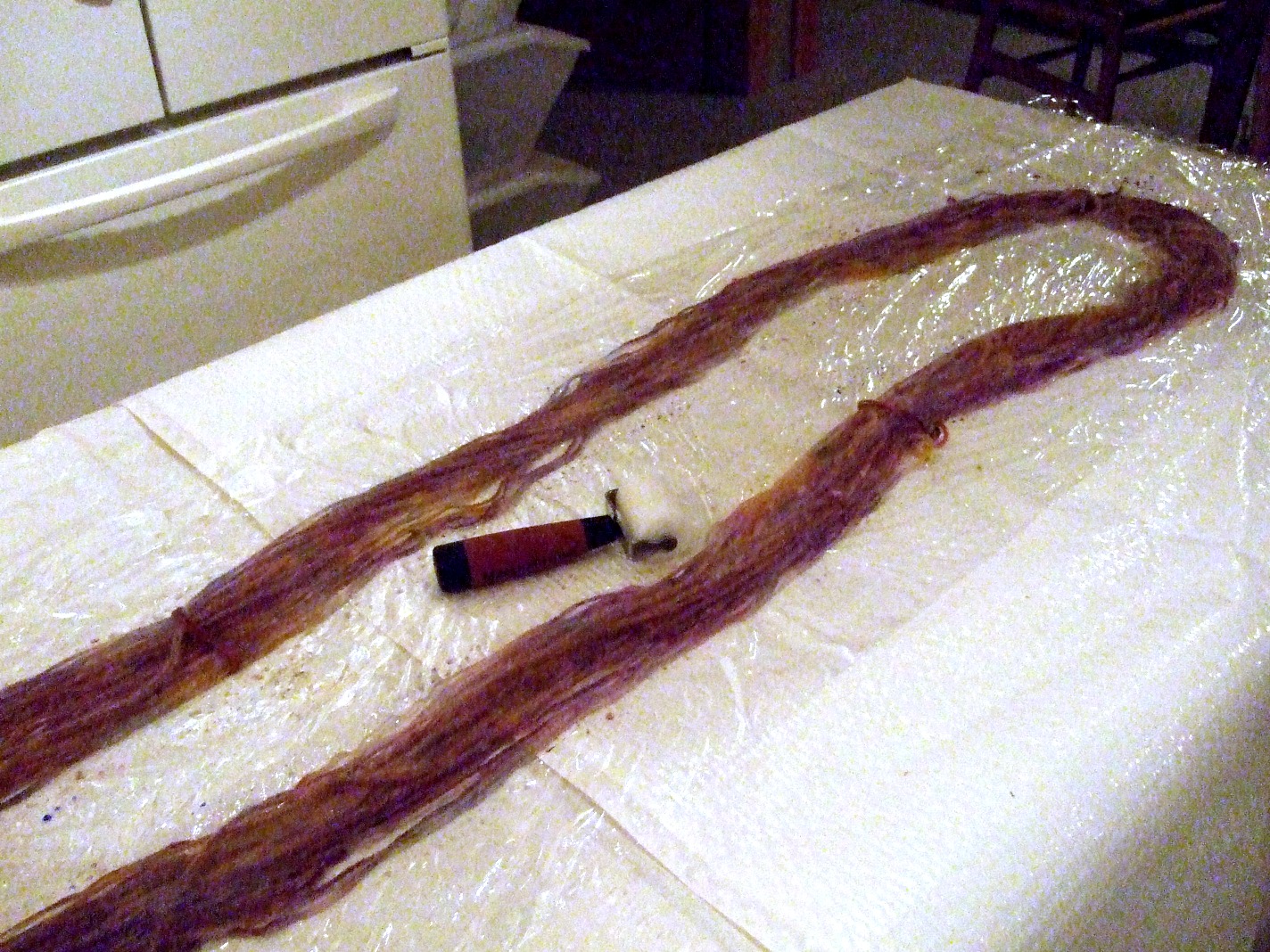
I finally got around to trying out a dye method I ran across last year in the magazine put out by Ashford Handicrafts Ltd in New Zealand (makers of Ashford spinning wheels, Ashford dyes, etc).  After randomly applying 2-3 colors of acid dyes to a long skein of wool using squeeze bottles, a roller is used to work the dyes into the fiber and create new colors where the dyes blend together.  Then the skein is microwaved or steamed as usual, to set the dye.

I had 17 skeins of 3-ply yarn that I spun up over the course of the last couple of months, using roving that was sent to me by my sister in California.  It came from a friend of hers who raises (or used to raise) sheep but she didn’t seem to know what breed they were.  It isn’t a fine wool, probably more like Romney, so I spun it woolen and then made a 3-ply for knitting.

So this is how I spent the last couple of days.  Jeez, it’s a lot of work just skeining everything, soaking, washing it out afterwards, etc.  But it was a learning experience!

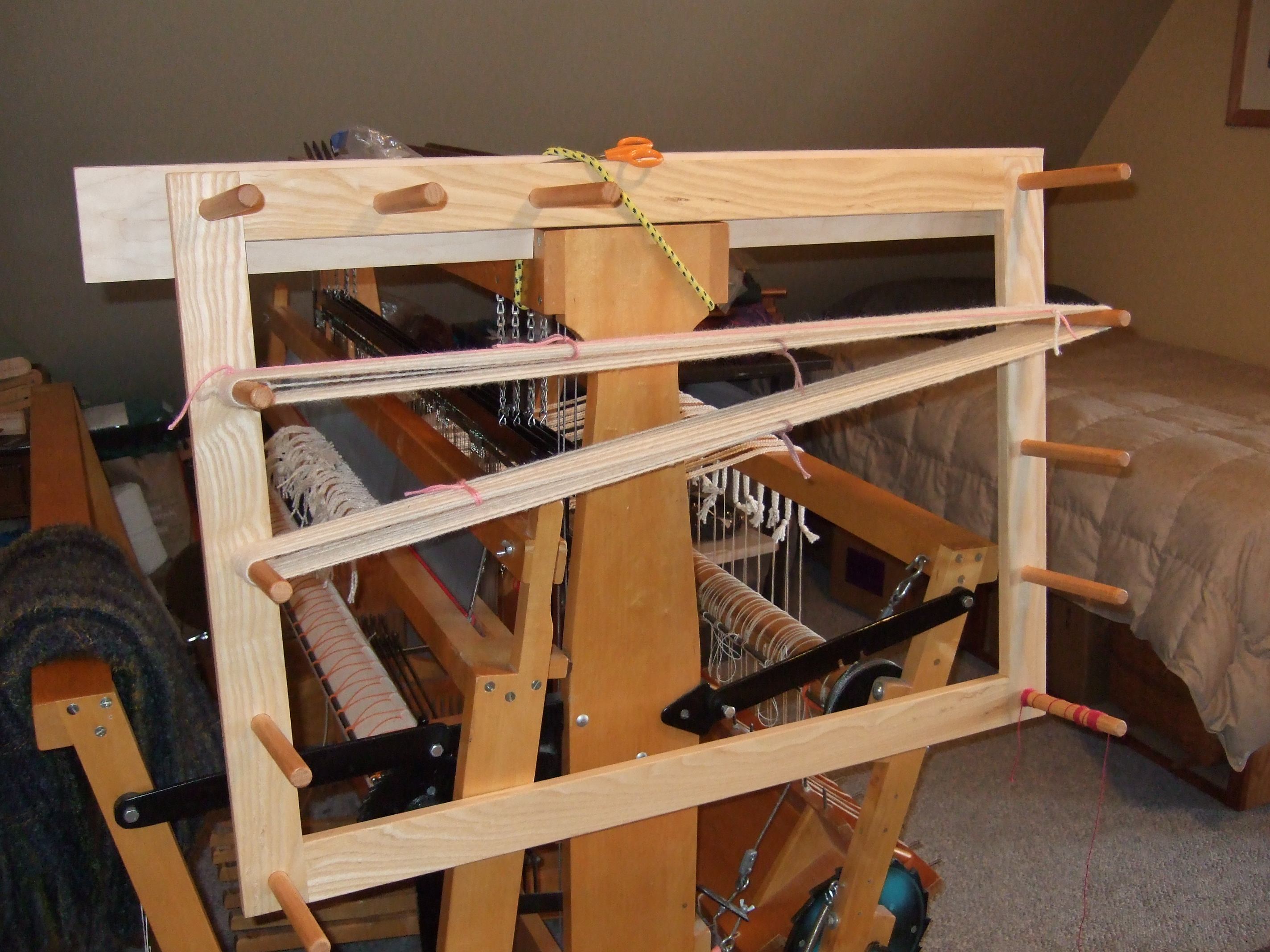
First I re-skeined them into 4-yard skeins (to fit the length of a 6-foot work table) using my warping board:

After soaking them in a vinegar solution, I laid them out on the table and applied dye.  Of course this is the fun part, and also the most challenging part for me.  How do I come up with 3 colors that will play well with each other?  I used some of my dyed samples from last summer’s workshop as a guide, and also just played around with some mixes, trying them out on coffee filters.  I was trying to just have fun and be a little loose about it (not easy for me sometimes) but I did make notes – on the coffee filters!! – about what worked, and what didn’t work as well.

dye applied from squeeze bottles

dyes blended with the roller

The roller came from a paint store and is meant for use in wallpapering.  It has a little texture to the plastic surface, and I would like to find something smoother but still OK with water and dye.  But basically, it did the job.

After steaming, they had to be washed and rinsed, hung to dry – then I re-skeined them yet again into the standard 2-yard skeins that is my standard put-up for handspun.  I plan to sell these at the guild sale this weekend.  Hardly a “money maker” after spinning, plying, washing, and doing all this process to dye it – but I can’t use everything I produce and this was basically a learning experience for me.

They did turn out OK – some better than others – I got more subtle results when I diluted the 1% dyestock solution with equal parts to 3 times as much water.  Major lesson, that.

the finished skeins

I enjoyed this approach so much that I think I will try it on some finer yarns wound for a warp, and maybe some rovings for spinning.

Six More Shawls

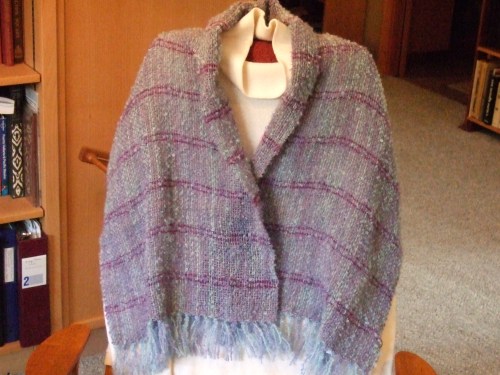
I’m heading into the home stretch, trying to build up some inventory for our annual guild sale next weekend.  I finished up six more shawls this week.  These are woven with handpainted boucle yarns from New Zealand for the warps, and none of them will be repeatable because the dyer sold her business and these colors have now been discontinued.  For the weft, I used various colors of wool or alpaca yarn, except the accent stripes are done with fine kid mohair/silk yarns.

Blue/mauve boucle with mauve wool weft

Blue/mauve boucle with pale lavender Shetland wool

blue+mauve 1

Blue/mauve boucle with mauve wool weft

Arctic+Paua black alpaca

Deep blues with black alpaca weft

Arctic+Paua brown alpaca

Deep blues with rich brown alpaca weft

Lollipop blue wool

"Lollipop" boucle with dark teal wool weft

Lollipop black alpaca

"Lollipop" boucle with black alpaca weft

As you can probably tell, I am getting two shawls from each warp put on the loom, but am mixing it up a little (and making it more interesting for me) by using different colors or fibers in the weft.  I’m also experimenting with making some shawl pins, since I like to wear these pinned shut at the front, leaving my arms free – sort of like wearing a vest.

Returned from Redlands

Well, let’s see – when last we met, I was off to my annual knitting retreat.  This was very fun, as expected, although getting there turned out to be a bit of an experience.  In fact, I almost titled this post “Katie & Diana’s Excellent Adventure.”  We drove over the North Cross Highway (Hwy 20 through the North Cascades National Park), which had recently received some new snow but was well plowed and an easy drive.  The mountains, with their fall color and new snow, were stunning.  We drove down Whidbey Island, intending to catch the 3:00 ferry across to Port Townsend – we even had a reservation!  Five minutes after we got in line, they announced the ferry had broken down and would be out of service until the next day.  Aargh!  We had to drive to the south end of Whidbey, cross to the mainland at Mukilteo, drive down to Edmonds (hello, Seattle-area traffic…) and cross back over the Sound to Kingston.  It was about 6 pm and dark by the time we passed through Port Gamble on our way to the Hood Canal Bridge.  What’s that flashing sign??  The bridge was open to let a barge through and there was another half hour wait. By this time we were laughing hysterically and I called Rick to fill him in… he said they were probably letting through the boat that had the part to fix the Keystone ferry.

On our way home we stopped in at The Artful Ewe in Port Gamble, where Heidi Parra has her beautiful hand-dyed yarns and spinning fibers (she carries no commercial lines, it is all her own stuff and it is fabulous).  Heidi has just opened a weaving studio two doors down from the yarn shop.  It has two Bergman looms and some others as well, and is decorated beautifully with items from her art and textile collections.

Artful weaving 1

Artful weaving 2

Heidi was pretty excited about this 16-harness AVL loom that she had recently purchased (used) and had just gotten hooked up to the computer:

Artful weaving 3

The woman is amazing.  She turns out the most beautiful dyed fibers and in such quantity.  Somehow she has more hours in her day then I can ever seem to find in mine!

Back in the valley, I wove 4 more shawls (pictures to come) and generally picked up the threads of normal life for a few days.  Then we were off to Redlands, CA for the weekend, to visit our good friends who are down there working in San Bernardino until the day they can return to Bainbridge Island.  They just bought a home in Redlands, a 1920’s era Spanish Revival, which is lovely, with gracious and generously sized rooms:

1920's Spanish Revival house

Redlands is quite a pretty town, with many wide palm-tree lined boulevards, and older neighborhoods chock full of huge Victorian and Craftsman style homes.  Here are just a couple I saw while out on a walk:

Redlands 1Redlands 2

Coming from the valley where winter is on the way, it was quite nice to experience temperatures in the 70’s again, sitting outside barefoot in the sun.  Thank you, dear friends!

SS new home

Off to Knitting Retreat!

Just a quick post today, as I am going off tomorrow for the knitting retreat at Fort Worden, near Port Townsend.  This is an event I have attended for over 20 years.  Now that we have moved away from Seattle, it is even more important to me to spend this time with some of my longtime friends, as well as other people who come from all over who I only see there once a year.  There are no classes, it’s just 5 days of knitting, talking, eating, going for walks into town or down to the beach, laughing and generally having a good time with like-minded souls.  Not to mention hitting all the local yarn shops!

I have been invited to a baby shower the first weekend of November, which I can’t attend as we are going to California for a quick visit with good friends.  But I did want to come up with a nice gift for this little one (we already know it is a girl) as we are friends with the parents, both sets of grandparents, an aunt and cousins.  I was rummaging around in one of the closets and discovered this:

Baby Surprise Jacket 1

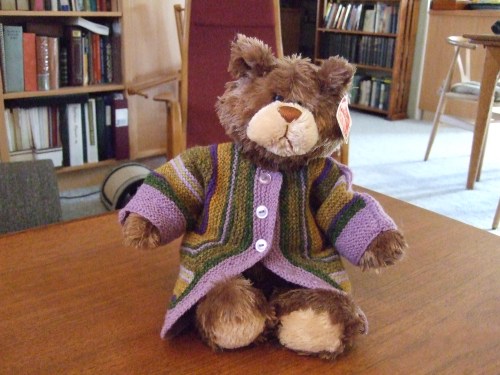
It’s a Baby Surprise Jacket that I knit maybe 3-4 years ago, using leftover bits of Shetland 2-ply wool.  It needed only a few ends darned in and the buttons sewn on to be done – DONE, I say!  This was the first of several I knit back then, and it came out a wee bit small, which means it can’t be worn by the intended recipient for very long.  Which is why I also had a Gund teddy bear ready to take over:

BSJ on bear 2

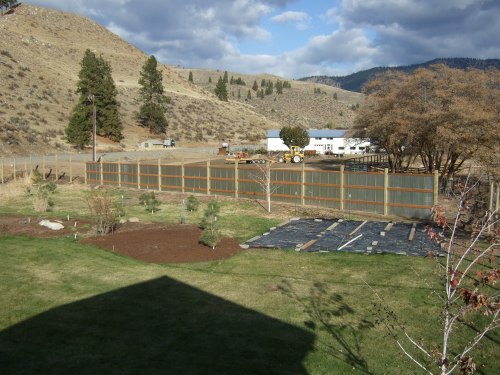
On the home front, the back fence is nearing completion:

back fence 10-27-09

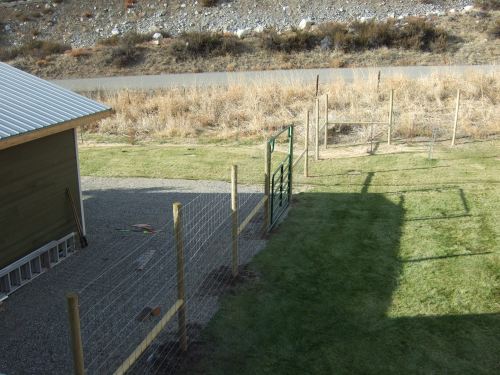
and our new deer fence is basically in, needing only the man-gates which they are making off site; when they come to install those they will also finish installing the green farm gate we bought to accomodate the tractor going in and out.  So it looks like our back yard will be deer-proof by winter!

deer fence 10-27-09

Tomten sleeve cap challenge

This will be a long, geeky knitting post, just as a warning to those of you in my small audience who could care less! Also, see update at bottom of post **

As mentioned earlier, I have been working on the Adult Tomten Jacket by Elizabeth Zimmermann, for me and using some of my handspun yarn.  This pattern can be found in several Zimmermann books:  The Opinionated Knitter, Knitting Without Tears, Knitting Workshop.  It started out as a baby jacket and therefore the adult version is rather large and boxy, with its signature feature perhaps being the very deeply set in sleeves.

I had found a nice discussion of modifications for a better fit on Jared Flood’s blog, “Brooklyn Tweed.”  He has a lot of excellent photos and some discussion, but not everything he did is spelled out – which is fine, he put a lot of work into that blog post as it was, and a knitter doesn’t have to give away every little secret!

I wanted to incorporate a shaped sleeve cap from the top down, as Jared had done.  The basic method is described in Barbara Walker’s excellent book Knitting from the Top, now back in print thanks to Meg Swansen (Elizabeth Zimmermann’s daughter and a prolific designer, teacher and writer herself) at Schoolhouse Press.

The problem that comes up in this instance is thus.  Normally, you figure out how big around you want the sleeve and therefore how many stitches you should have on the needle once you end the sleeve cap and have arrived at your upper arm.  Using the Zimmermann/Swansen EPS method, that means 35% to 40% of your body stitches for a good fit in that area.  So that is the number of stitches you would normally pick up around the armhole to begin the sleeve cap, after subtracting the number of stitches left on a holder for the underarm.  But this is a garter stitch jacket (garter stitch – knit on both sides, 2 rows makes a “ridge”).  Garter stitch has a compressed row gauge compared to stockinette stitch, so that the number of ridges per inch lengthwise is the same as the number of stitches per inch widthwise.  So you  have to pick up one stitch per ridge around the armhole or the sleeve fabric will not lie flat.  This means you will have way more stitches than you really want in your sleeve at the upper arm.

Using my gauge and my size, I have 152 body stitches so I would like to have 53 to 61 stitches at the upper arm.  I have 38 ridges on both sides of the armhole and will add one stitch for a “phoney seam” at the top of the sleeve.  I have left 8% of the body sts on holders for the underarm (12 sts).  So I will have to pick up 38 + 1 + 38 = 77 sts around the armhole.  Add the 12 underarm sts and I will have 89 sts in the sleeve at the outset of cap shaping.  So I need to get rid of a whopping 28 to 36 sts somehow while shaping the sleeve cap.

I study Jared Flood’s photos and observe:  (1) a line of paired decreases running down the top of the sleeve (this is the way the pattern is written, too), (2) it looks like he started those decreases up above the sleeve cap, in the top part of the sleeve that is so deeply set in that it is actually part of the body, and (3) there appears to be a little triangular gusset on both sides of the underarm area at the end of sleeve cap shaping.  Hmm, what’s that last thing?  Curious.

So I rip the first 13 ridges of the top of the sleeve back, and add 4 paired decreases every 3 ridges.  This takes out 8 stitches so I am down to 69 + 12 UA (underarm) sts at the beginning of cap shaping.  It also adds a shoulder slope which is always a good idea.  Now all of a sudden the reason for the triangular gusset becomes clear.  If done with short rows over 6 ridges, it can consume the rest of the underarm stitches (6 on each side), but the needed underarm space is still provided by the curve of the line along that gusset.  If I get rid of the 12 underarm stitches at this point, I am already down to 69 sts only at the beginning of cap shaping, and if I continue decreasing in pairs every 3 ridges while I knit the cap, it comes out just right at the end with 55 sts remaining.  Hooray!
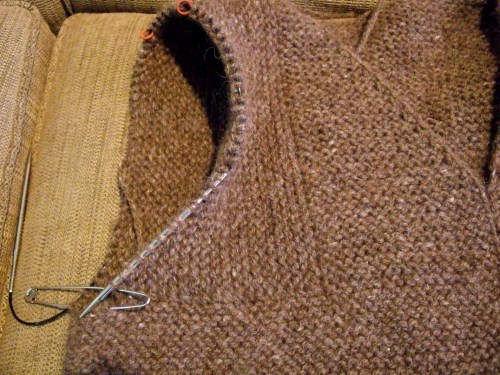
Sleeve top and one underarm gusset completed

Sleeve top and one underarm gusset completed

Here’s a low-tech drawing:
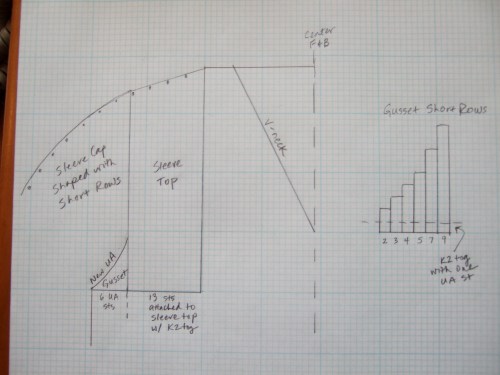
layout for underarm gusset and shaped sleeve cap

layout for underarm gusset and shaped sleeve cap

And here is the sleeve cap, shaped with short rows per Barbara Walker’s instructions:
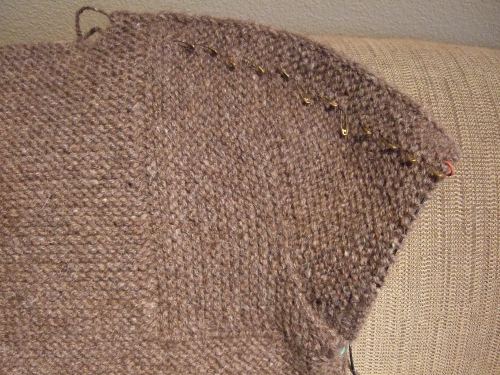
Finished sleeve cap
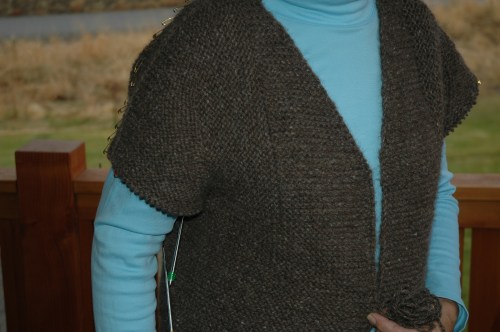
Finished sleeve cap

sleeve cap try-onAnd the try-on:  it fits beautifully and I am most pleased!

** Nov. 11, 2009 update:

I wrote to Jared Flood about a week before proceeding with the above, and bless the man’s heart, he did write back to me on Nov 5th.  He said he did not actually make an underarm gusset, but did shape some stitches next to the underarm stitches to try to mimic a set-in sleeve armhole rather than just leaving it square.  So it looks like I may have “unvented” something with the gusset, but I am still happy with that as another approach.