Feeds:
Posts
Comments

Fall Equinox

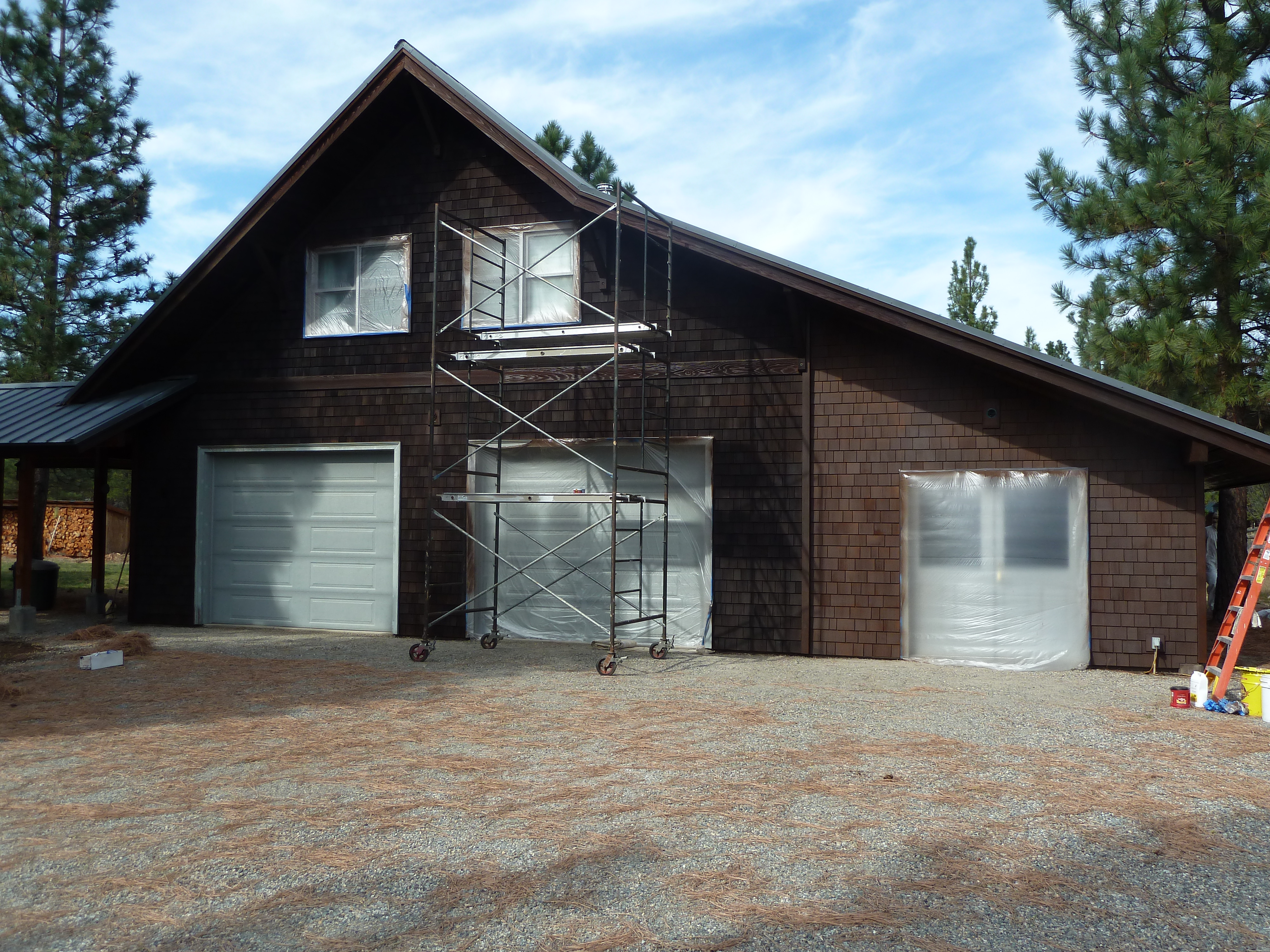
Today is the fall equinox, and we have been busy getting ready for winter.  The firewood is all split and stacked.  A big windstorm brought down lots of dead pine needles last week, and Rick has been raking them up and getting ready for a yard waste run to the dump.  And finally, after nearly three years, we are getting stain on the cedar shingle siding for the shop addition and carport!  The fellow doing the work also power-washed the original shingles and put new stain on them.  The color isn’t a complete match (since the same color was put over old weathered shingles and new shingles) but it sure looks a lot better than it did before.
shop stain Sep 2013 1

shop stain Sep 2013 2 - Copy

carport stain Sep 2013

Up in the studio, I put a new warp for plaited twill scarves on the big loom.  I haven’t done these for a couple of years now – how time flies!  I promised one to someone almost a year ago, and it has to be done by the end of October.  That seems like a long ways off, but since I will be gone so much in October, it really won’t be.  And it won’t hurt to do some of these for the upcoming guild sales and holiday season.
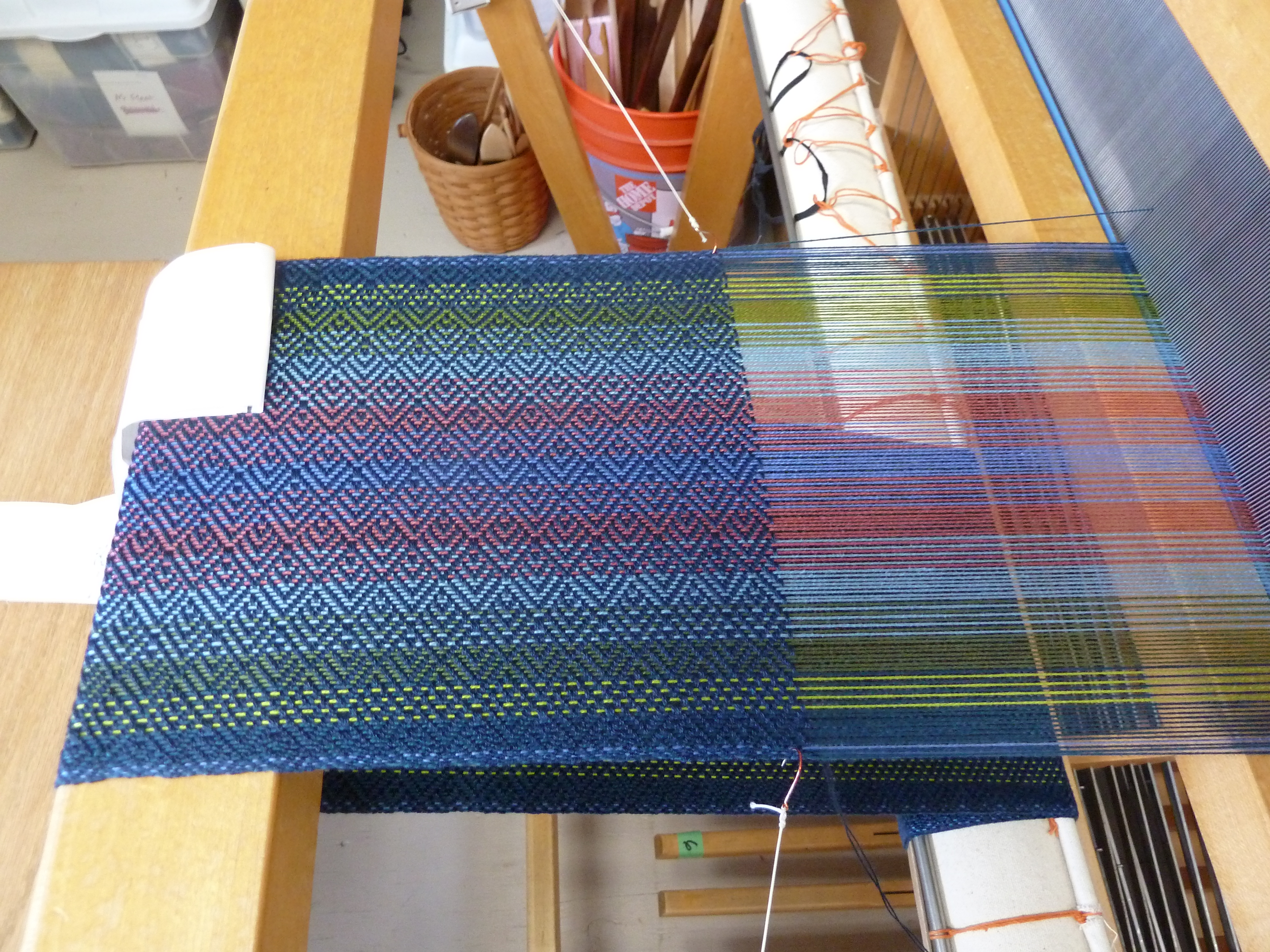
perle cotton warp and tencel weft

perle cotton warp and tencel weft

Part of the process was doing some loom upgrade and maintenance on the 48″ Macomber loom.  This is actually the first time I have used the 4 additional harnesses I added to this loom, and I needed to replace the chains that the original four heddle frames hung from off the jacks.  Now all the frames are hanging at the same (and correct) height.
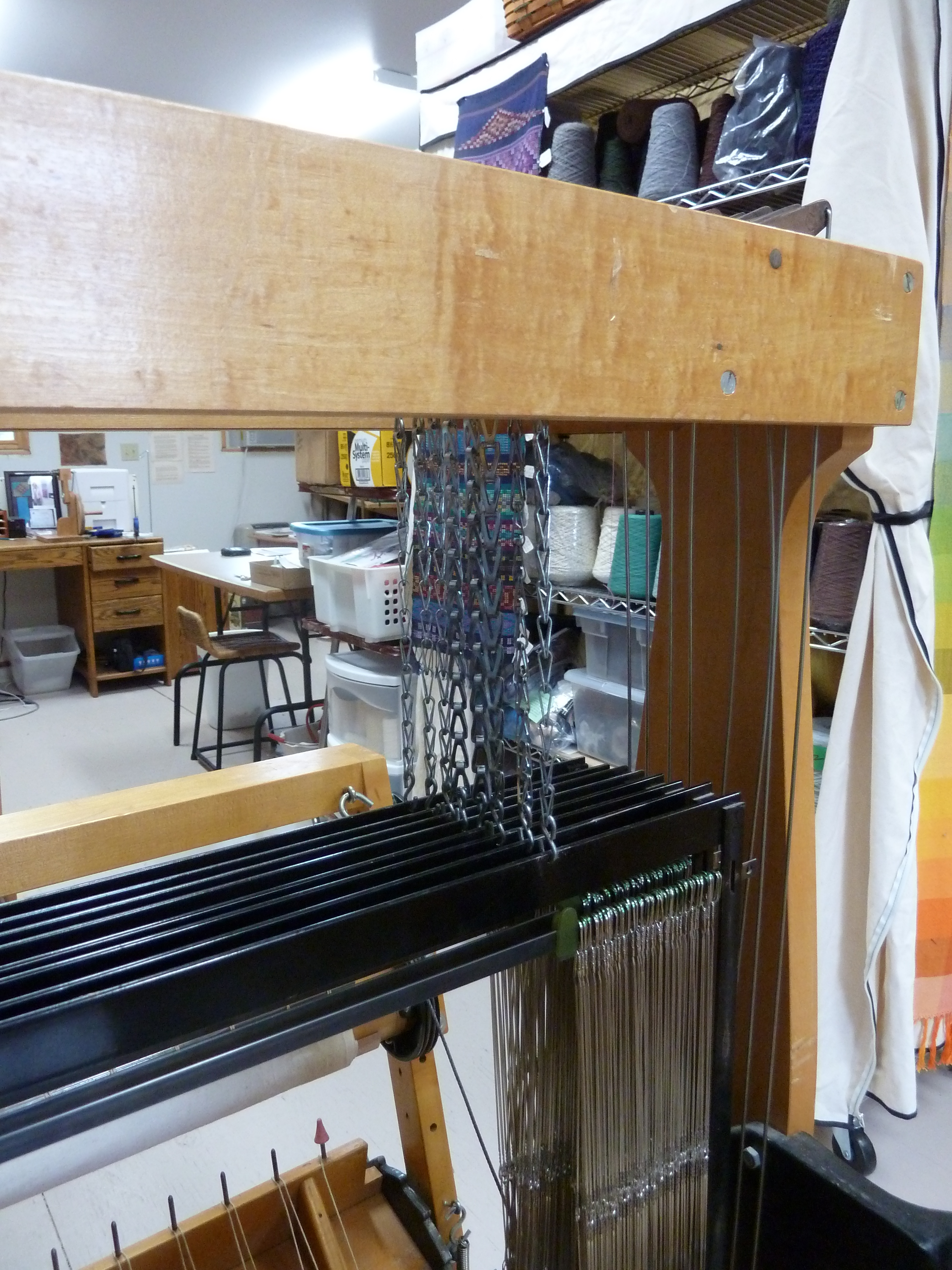
new chains hanging the heddle frames from the jacks

new chains hanging the heddle frames from the jacks

I also had a lot of trouble with the tie-up hooks popping off the lamms when I first started weaving the scarf.  Since it mostly seemed to be happening with harnesses 5-8, I knew it had something to do with using those for the first time.  My theory, which proved to be correct, was that the slots in the treadles were not completely smooth and were binding on the shafts of the “superhooks”, making them pop off the lamms.  (Don’t you love this weaving terminology?)

tie-up hooks connect the treadles to the lamms

tie-up hooks connect the treadles to the lamms

So I took the time to smooth down the slots in the treadles with sandpaper, then smear some paste wax inside each one with a thin stick.  Now it is all working as smooth as can be and I am a happy weaver, not having to get down and crawl around under the loom every 5 minutes reconnecting a hook or two.
Prayer Flags

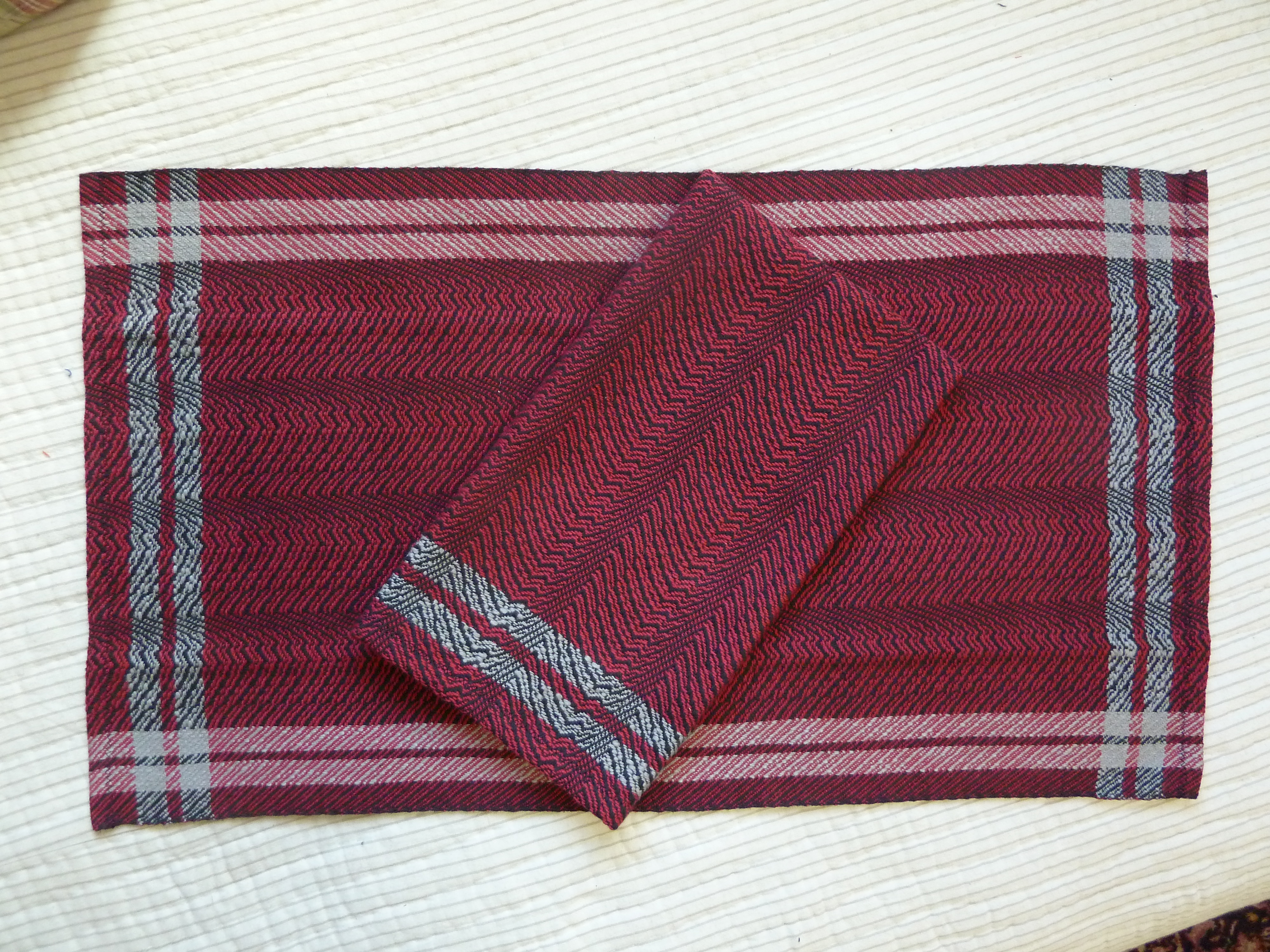
At the Chamber Music Festival last July, I ran into a woman who was interested in some of my undulating twill towels in “black and red” to go with her kitchen colors at their second home north of Winthrop.  I discovered I already had a cone of black 8/2 cotton, about 2 lbs so enough to put on a 12-yard warp.  So, even though I thought I was done with those towels, I tied on a new warp a couple of weeks ago, and on Monday of this week, finished them off.

I don’t remember where I got that black cotton, but it turned out to be a pain in the neck.  Quite “tender” so I had a lot of breakage problems.  I finally figured out how to coax it along – just the right amount of tension, don’t advance it too far so the fell line (where the beater hits the cloth) remains in a narrow area where the reed is vertical, etc.  But it was worth it!  I really like how these turned out – so much so that I have ordered more black 8/2 cotton from WEBS and it is on its way to me now.  It is their own line, Valley Yarns “Eight-Two”.   Good stuff, and a decent price if you order enough to get the 25% discount.


Here are two of the black and red ones:

undulating twill towels, black warp and red weft

undulating twill towels, black warp and red weft

I did 4 other colors:  banana yellow, turquoise green, elm green and madder brown.

tree bark black warp 5 colors

Also this week I was trying to respond to the final call from Confluence Gallery for submission to a show they will open the first part of November.  It is titled “Visions of Verse”.  They have 33 works from local poets and ask visual artists to respond to the written works.  I was really drawing a blank, and also couldn’t see how I could get anything significant and new, done in time, as I will be gone on and off for most of October.  But then it came to me – these new towels are perfect for a poem by Danica Kaufman titled Prayer Flags of Daily Life !  So there you have it.

Also working on some placemats at home:

new placemats underway

new placemats underway

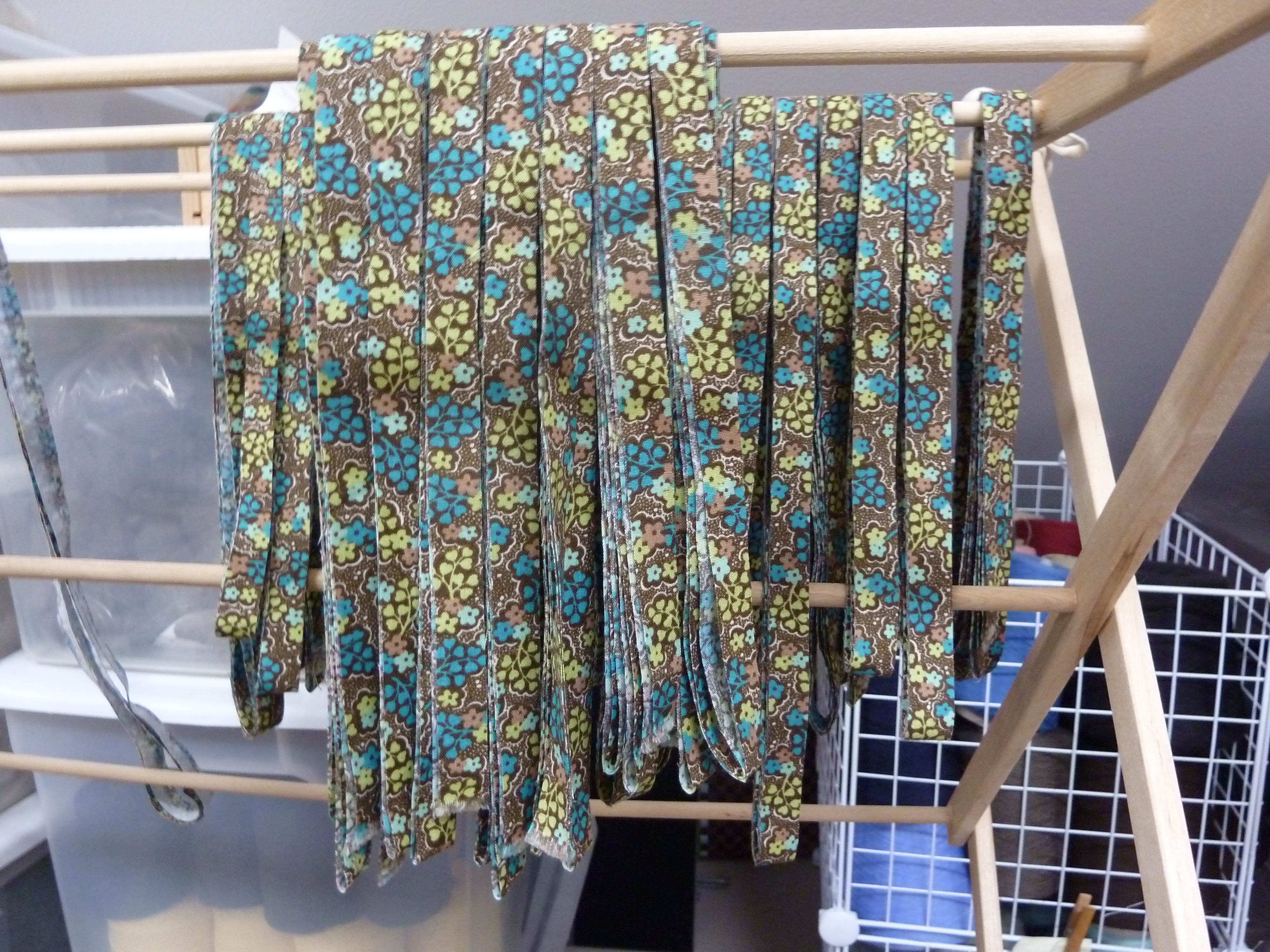
using this fabric!

using this fabric!


Tin Can Tourists in Town

This weekend brought the 38th Vintage Wheels Show to Winthrop.  Actually it used to be mainly a vintage car show, but this year they expanded it to include Antique Cars and Trucks – Vintage Motorcycles – Vintage Travel Trailers – Antique Tractors – Antique Bicycles with various venues around town.  The weather remained stormy through Friday night so we were really worried the parade yesterday would be “rained out”, but mother nature was kind!

We missed the parade,  but in the afternoon headed up to the Pine Near RV Park above Winthrop to see the vintage trailers.  This RV park is right next to the Shafer Historical Museum, which is where the antique tractors were.  The RV park is about 40 years old and had fallen on hard times – it was almost turned into a site for condominiums a few years back.  Then a local couple bought it in 2012 and have done a fabulous job on bringing it back to life.  New hookups, grass, all new shower and laundry facilities in the old log cabin, and they are building some camping cabins on a bench up above the main park.

It turns out the vintage trailer folks were mostly members of a group call the Tin Can Tourists.  I just found their website and we may join.  It has been around since 1919, but from a quick read it looks like it disbanded for a while, and was started up again in 1998 by a couple who had founded the Vintage Airstream Club, but wanted a group that was open to all – meaning  an all make and model vintage trailer and motor coach club.

Yesterday they had “open house” so we could wander around and even go into most of the trailers to see the interiors.  There were Airstreams, but also other aluminum vintage trailers, the names of which I have mostly forgotten.  Most of them were significantly older than our 1973 Overlander (sadly, still in Spokane waiting for a new blackwater tank to be shipped from Airstream).  But we got into some useful and informative conversations.

P1020964

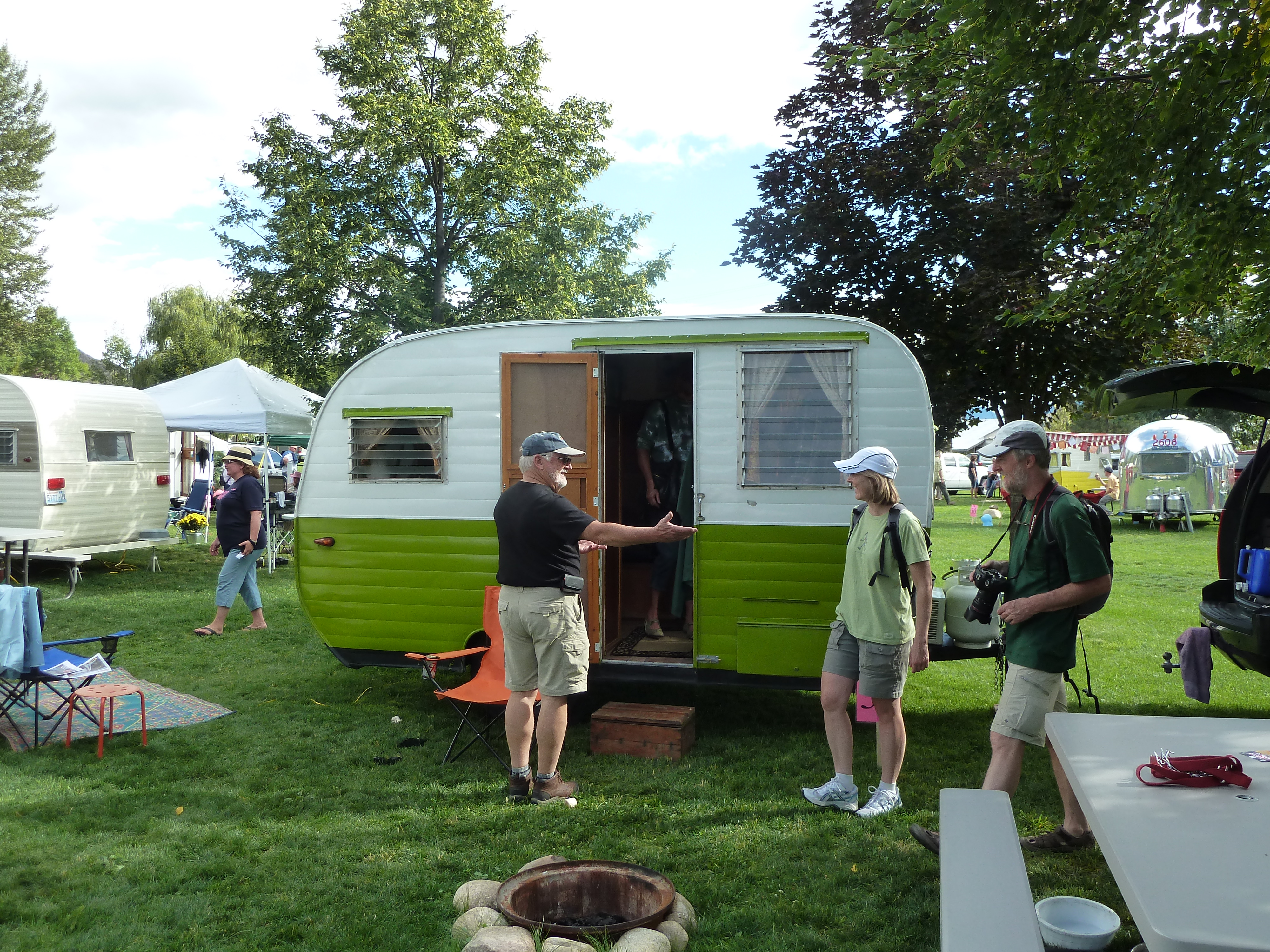
there were many of these type - a Shasta?

there were many of these type – a Shasta?

I think the one on the left is a Curtis Wright

I think the one on the left is a Curtis Wright

more vintage Airstreams!

more vintage Airstreams!

a Spartan - they had been on the road since April, going up to Alaska and northern Canada

a Spartan – they had been on the road since April, going up to Alaska and northern Canada

new interior woodwork in the Spartan

new interior woodwork in the Spartan

P1020974

To round out the day, we went down to the Twisp River Pub to catch the show by Vicci Martinez.  From Tacoma, she started performing when she was just 16 and used to play the Pub on Labor Day weekend on a regular basis.  In 2011 she competed in the TV “talent show” The Voice, and came in 3rd overall.  It looks like her career is taking off so we are probably lucky that she came back to our little valley to perform – may be the last time, who knows?

Vicci Martinez and her band

Vicci Martinez and her band

Rod Cook, the guitarist on the left in the photo, is also fabulous!


You be the judge

A few months ago I agreed to judge the knitting entries in the Home Economics department of the Okanogan County Fair.  So last Wednesday I headed over there to do my “jury duty” – the Fair is open Thursday-Sunday (Sept 5-8) and they want everything checked in and judged and given their ribbons before that.

It was kind of fun!  I had gone to a training session last month, and it is pretty straightforward (Really?? I can’t let my personal tastes influence my decisions?)  Most everything was well-made, clean etc so got a blue ribbon, even if they had a few minor problems.  Red ribbon just means “needs some improvement” and they would have to receive a preponderance of checks in that column to get a red.  White ribbon means “needs a lot of improvement” and nothing got that.  I made an effort to write comments on all the judging sheets, since I have entered in the Knitting division before and received no comments at all, which is always a little disappointing.  The training was helpful here – give both positive and negative comments, frame criticisms constructively, like how it could be done better – not just that it should be better.

There were a couple of really outstanding pieces, and those I gave the Grand Champion and Reserve Grand Champion ribbons at the end of the day.

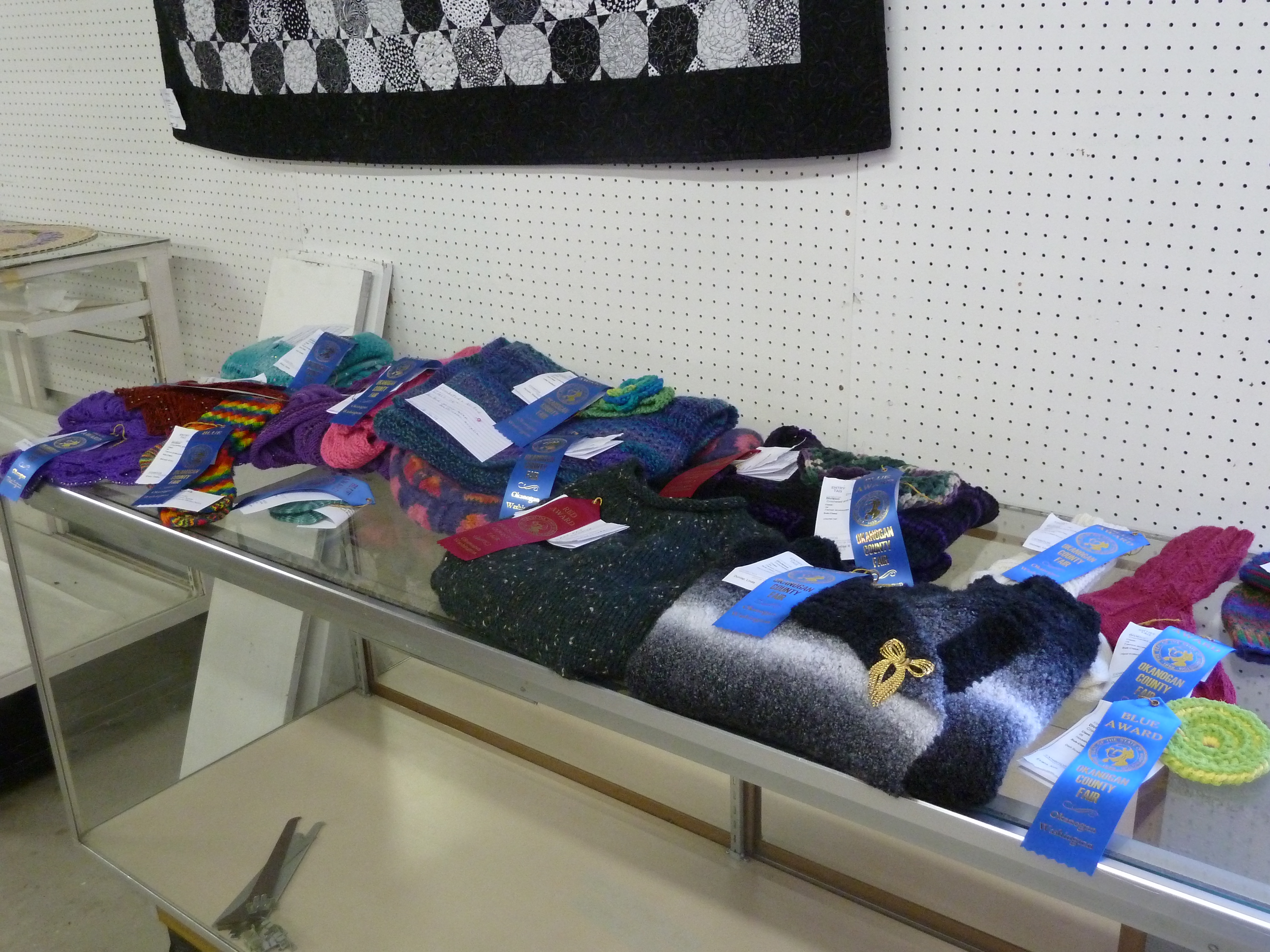
knitting entries to the Fair

knitting entries to the Fair

I had to be there until 8 pm (the cut-off time for bringing in entries) – which was a bit brutal, since it is over in Omak/Okanogan and an hour drive from my home.  But there were other women there judging the quilts, sewing, other needlework, etc. so it was a sociable setting.  When things slowed down in the afternoon, and I had to kill time waiting for more things to show up, I wandered around some of the other areas:

flowers

flowers

dahlias

dahlias

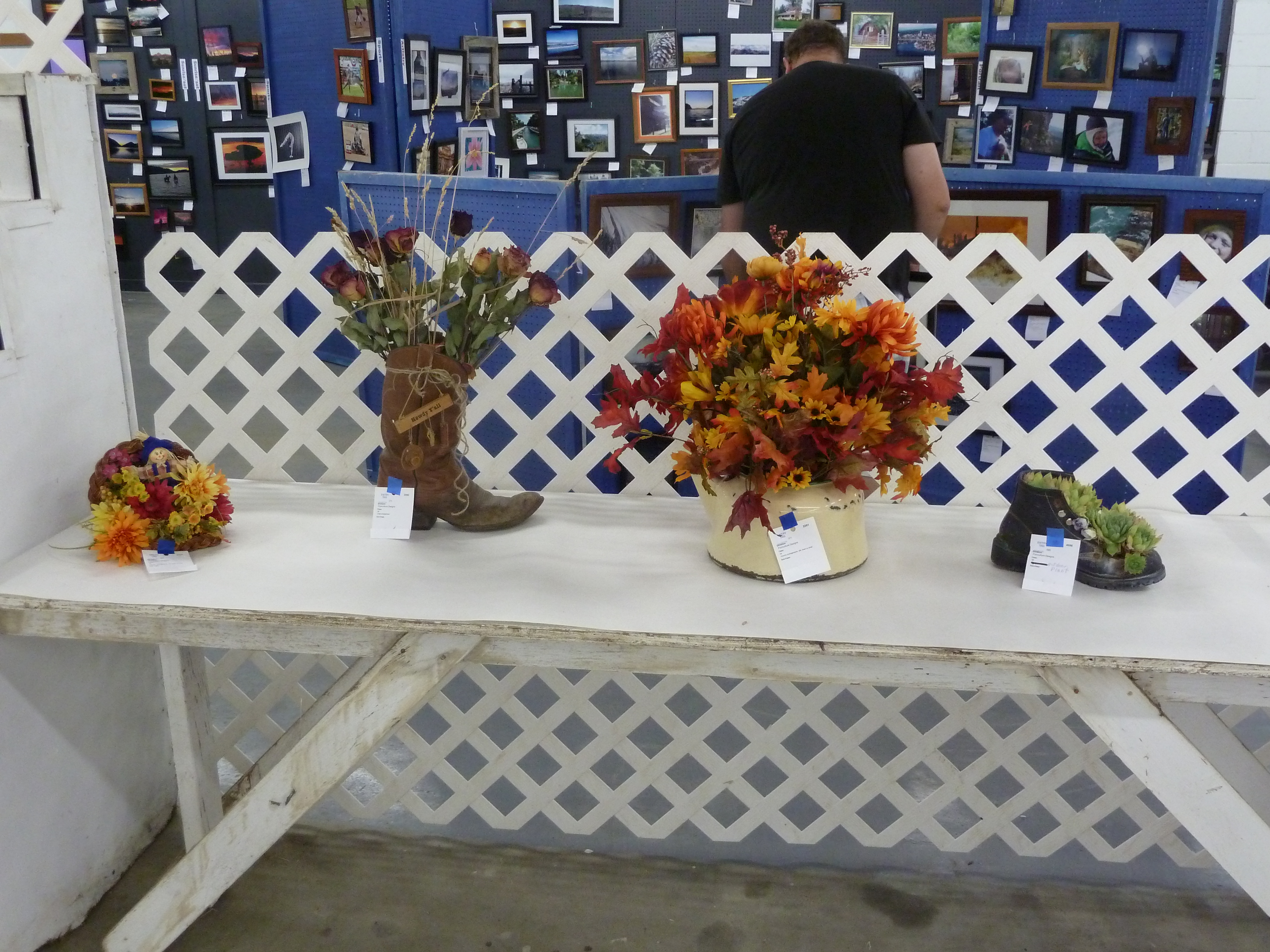
flower arranging!

flower arranging!

cupcakes, in the Junior Open division for baking

cupcakes, in the Junior Open division for baking

Speaking of baking, there was a group across the room from me judging all the baked goods.  And yes, they were tasting each one (except for decorated cakes, etc).  Now that looked like a Pepto Bismol moment if I ever saw one….

I brought in 7 submissions myself to the Arts & Crafts Dept (3 spinning, 4 weaving).  Here are some of the displays down at that end of the building:

a display of woven items from the Shear Creative Guild in Omak

a display of woven items from the Shear Creative Guild in Omak

a spinning project of various fiber types from Shear Creative Guild

a spinning project of various fiber types from Shear Creative Guild

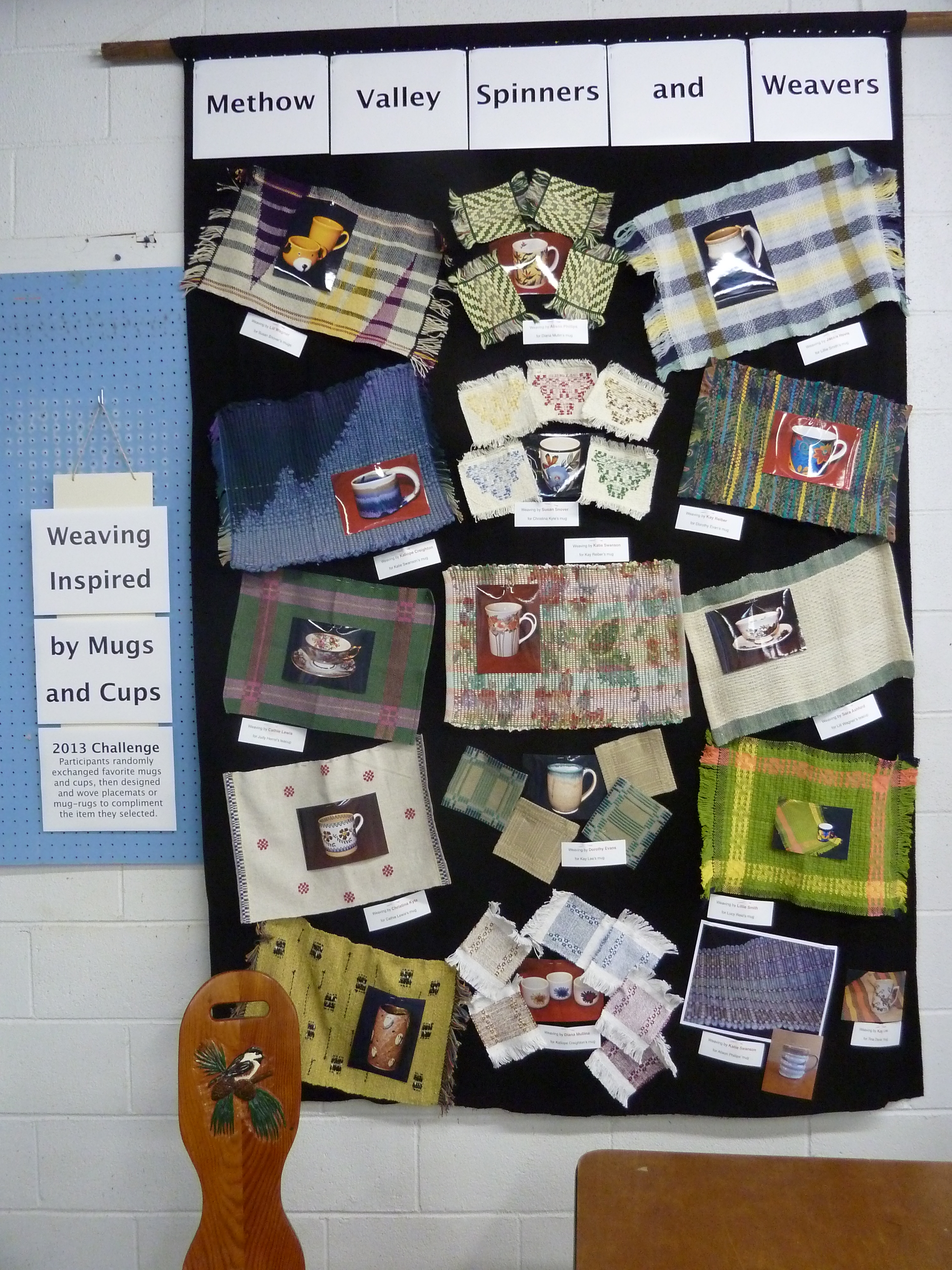
our guild display, based on our "challenge project" for this year

our guild display, based on our “challenge project” for this year

Rick and I will go back over on Sunday to see some of the animal exhibits, and pick up my entries when it closes at 3 pm.

STORMY WEATHER update:
Last night we had a fierce thunder and lightning storm, accompanied by torrential downpours.  We didn’t know it could rain that hard!!  The real fireworks started about 11 pm and lasted until 2 am.  Needless to say, we didn’t get much sleep last night.  It was just crash-boom-crash-boom and rain rain rain for 3 hours.  For a while we got up and just watched the display.  We could clearly see deer in the yard when there was a really bright flash.

And – they have closed the North Cascades Hwy again, due to mudslides and debris in the road.


Sotis Cloth Wrap-up

I decided that this past weekend was the time to finish off the warp on my portable “Baby Mac” loom.  This was what was left from the 3-day “Warp-Faced Weaves” workshop I took in June from Kay Faulkner at the ANWG Conference in Bellingham.  I had previously done a sampler and hoped I had enough warp left for 4 placemats.

I had also worked out various motifs for pick-up in the sotis areas, using Excel for a charting tool.  The plan was to do all the mats the same, except put a different pick-up motif in the 4 corners of each one.

Here’s the first one underway:

first pick-up pattern in sotis cloth areas

first pick-up pattern in sotis cloth areas

I also used, as a guide, Kay Faulkner’s article Sotis Cloth from West Timor in the March/April 2013 issue of Handwoven magazine.  At each end, I wove 1-1/2″ with a single weft in plain weave, to reduce bulk.  These were later turned under twice and sewn down for the final hems.  The body of the mat is woven with a doubled weft.

I only had enough warp to finish 3 mats of the same size, plus another small piece about half their size.  But that is OK, since these are a little wide for a typical placemat (I was stuck with the warp width I had put on, long story).

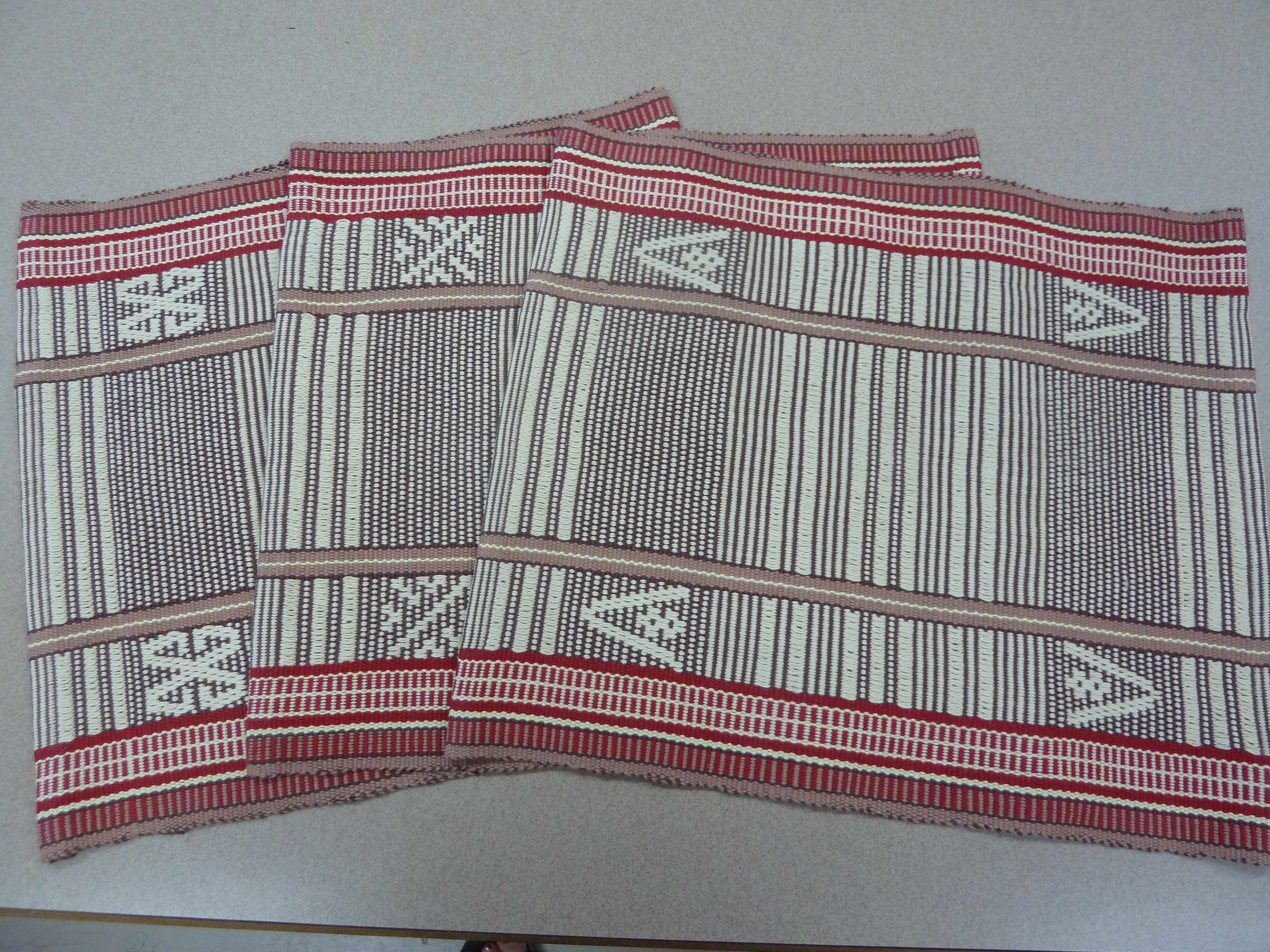
table mats


Will I do this again?  Actually, yes!  But next time, I will use mercerized cotton (for placemats).  For this workshop project, I used Valley Yarns 8/2 Cotton from WEBS, and it is lovely stuff – soft, smooth, strong, great colors.  But on washing, it didn’t so much shrink as “bloom”, especially in the sotis areas where 3 ends go through one heddle (alabaster, in this case) and a single end goes through the other heddle (brown, in this case).  The 3 ends that go together, kind of fluffed up and wound up obscuring the pattern in the wider stripes.  The brown “dots” in these wide stripes are much more visible in the first picture above, on the loom and before washing.


End of Rug Warp

Finally came to the end of the current rug warp – 30 rugs completed, of various sizes, in the last 2 months.  I have more Pendleton selvage material to use up, and things I want to try, but for now I am tired of weaving rugs and ready to do something else on that loom!  I actually started this late last December and have worked my way through two 50-yard warps, weaving 57 rugs and “ruglets” total.

At least they are selling reasonably well – five so far at the Confluence Gallery show, and six so far up at the Lost River Winery tasting room – plus a couple through Winthrop Gallery in the last 2 months.

These two were done in mid-July:

R163 - fiesta orange - sold at winery

R163 – fiesta orange – sold at winery

R164 - smooth red wool selvages - sold at winery

R164 – smooth red wool selvages – sold at winery

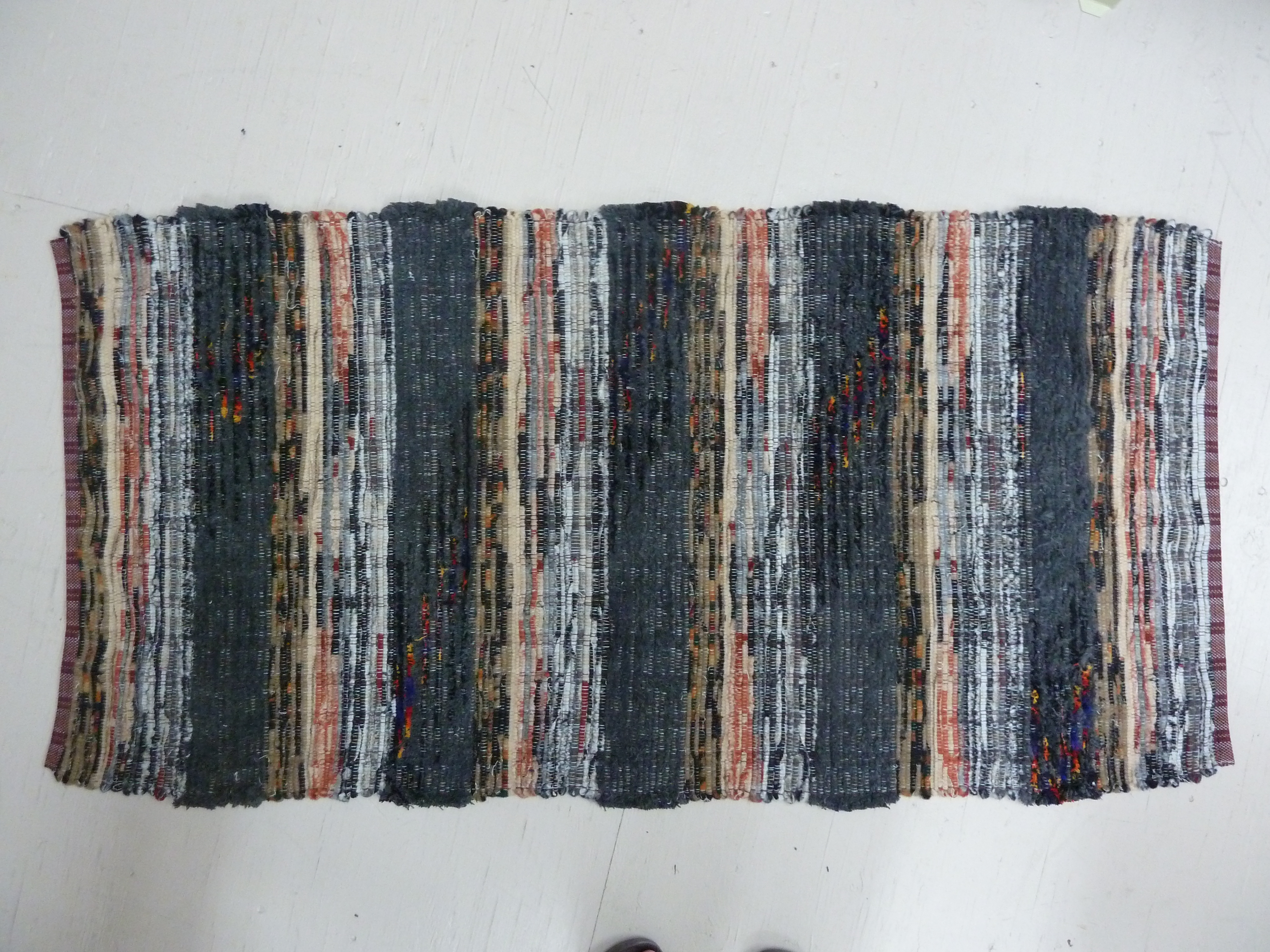
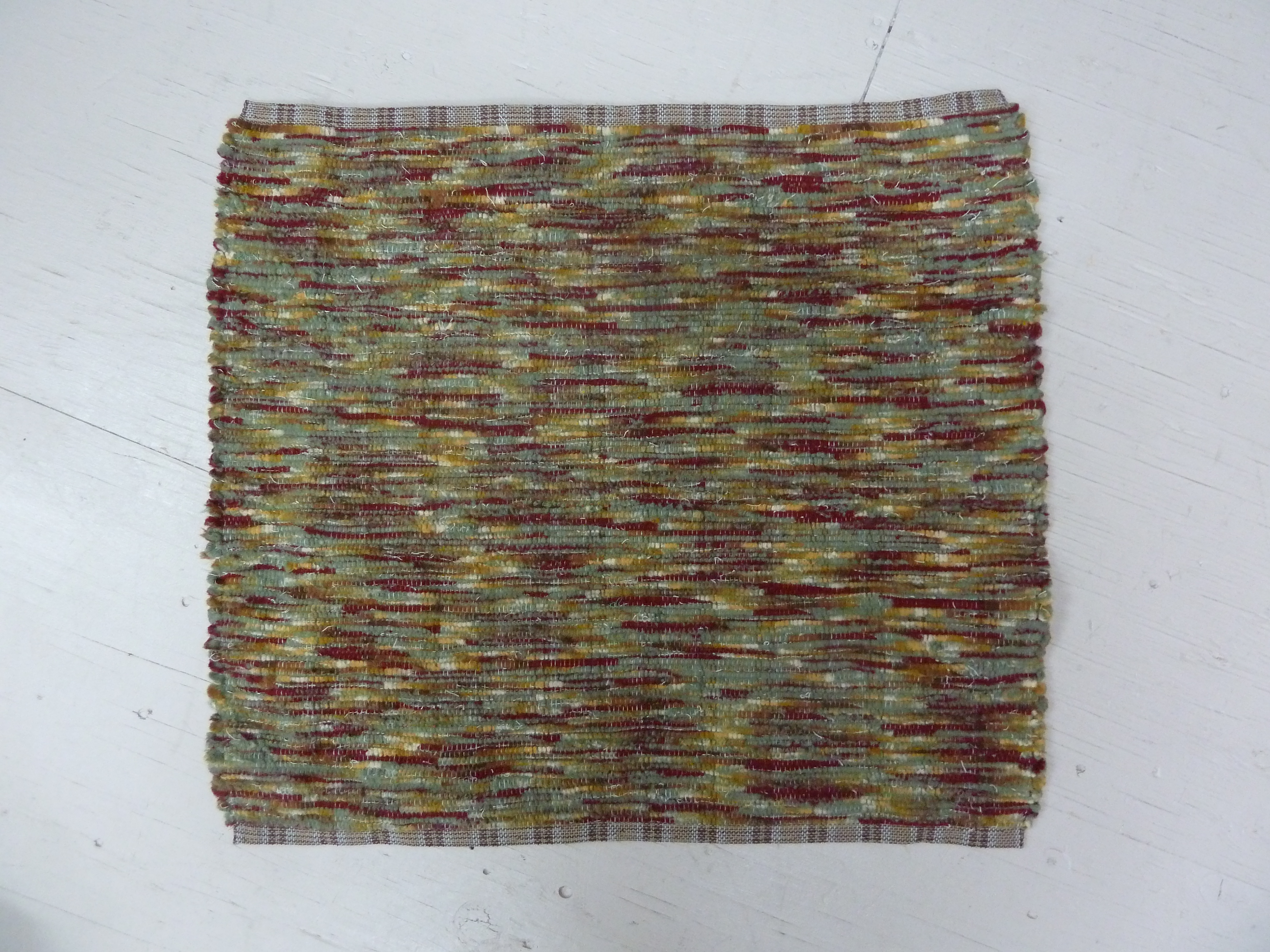
Then, with the Confluence Gallery show coming up, I got into what I call “mixed selvages” rugs.  I like to combine a variety of Pendleton blanket selvages, combining both colors and textures (smooth “worms” and the more fringe-like selvages).

R165 - for Confluence show, and sold

R165 – for Confluence show, and sold

R166 - for Confluence show, and sold

R166 – for Confluence show, and sold

I liked the above one so much, I made another for us to keep (always a slight variation as I use up materials, though):

R167 - kept this one!

R167 – kept this one!

R168 was a little “ruglet” and I didn’t get a picture.  These are a great way to use up small amounts of material from a bigger rug.

The rest of these were done in mid-August:

R169 - a new colorway of mixed selvages

R169 – a new colorway of mixed selvages

R170 - slight variant of R169 - I kept this one, too

R170 – slight variant of R169 – I kept this one, too

R171 - royal blue fringe alternating with colored worms

R171 – royal blue fringe alternating with colored worms

R172 - another one for Confluence Gallery, and sold

R172 – another one for Confluence Gallery, and sold

R173 - a third one of this type - for Confluence

R173 – a third one of this type – for Confluence

R174 - and END OF WARP!!

R174 – and END OF WARP!!

The Beat Goes On

It’s been a busy last 3 weeks, but it’s time to catch up the blog a bit.

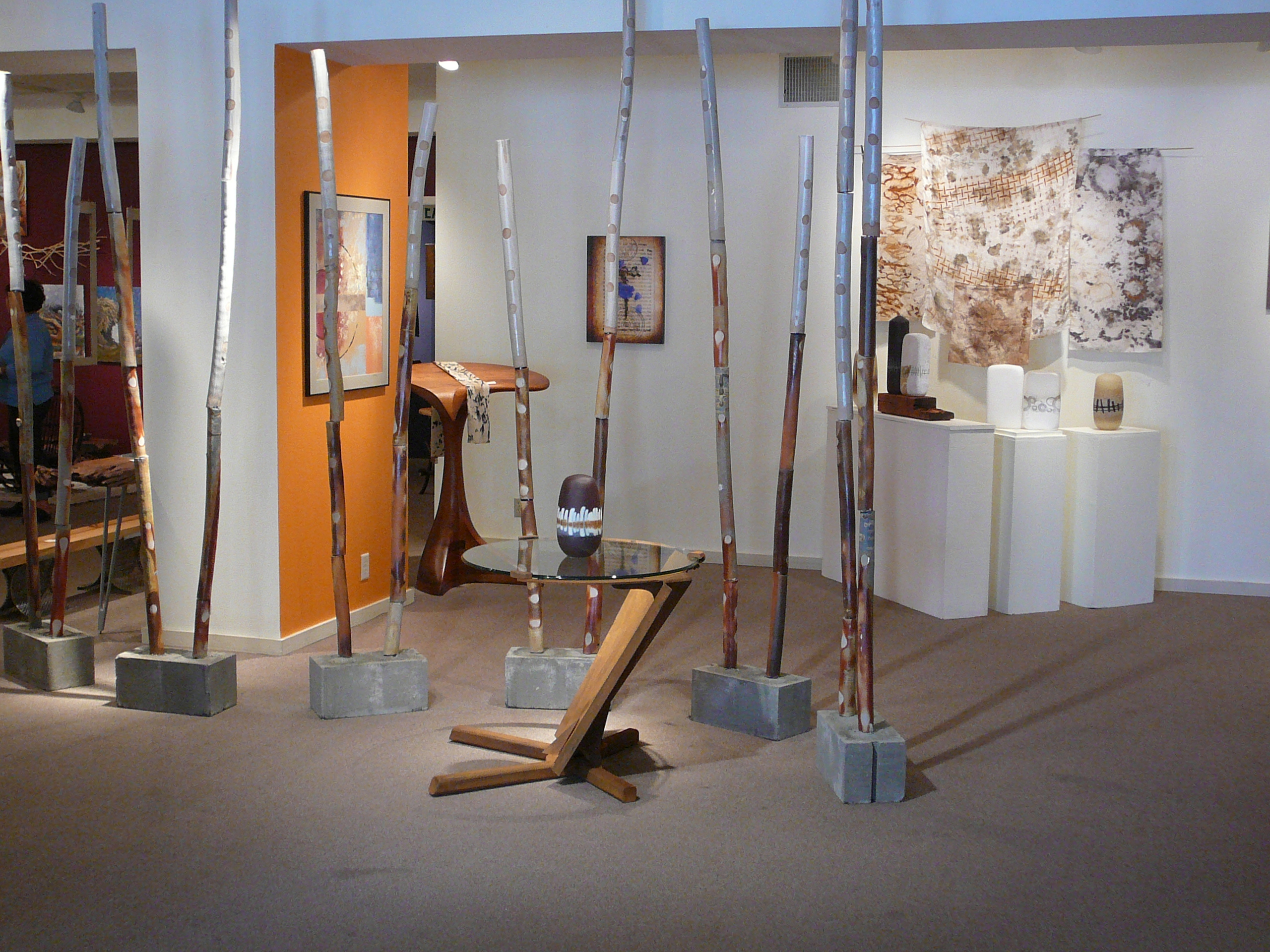
The “Inside Out” show opened at the Confluence Gallery in Twisp on Saturday, August 3.  My dad, brother and sister-in-law were still here for the last weekend of the chamber music festival, so we all went down to the gallery the day before to see the show before the official opening.  The actual opening was very well attended so it was a festive atmosphere!

Inside Out opening 8/3/13

Inside Out opening 8/3/13

P1020895

more folks at the opening

The following weekend, Rick’s sister and a friend of hers came over to see the Confluence Gallery show, our exhibit up at the Lost River Winery tasting room, and go on the annual Home Tour which is organized by the Confluence Gallery.  They request that people not take pictures of the homes on the tour, so I am afraid I have none to show.  The theme this year was “Eclectic Methow” (eclectic:  deriving ideas, style, or taste from a broad and diverse range of sources) and we did see some very interesting homes and sites.

Here are a few more pictures I took at the gallery:

P1030624

P1030626

P1030627b

one of my rugs on chair in background

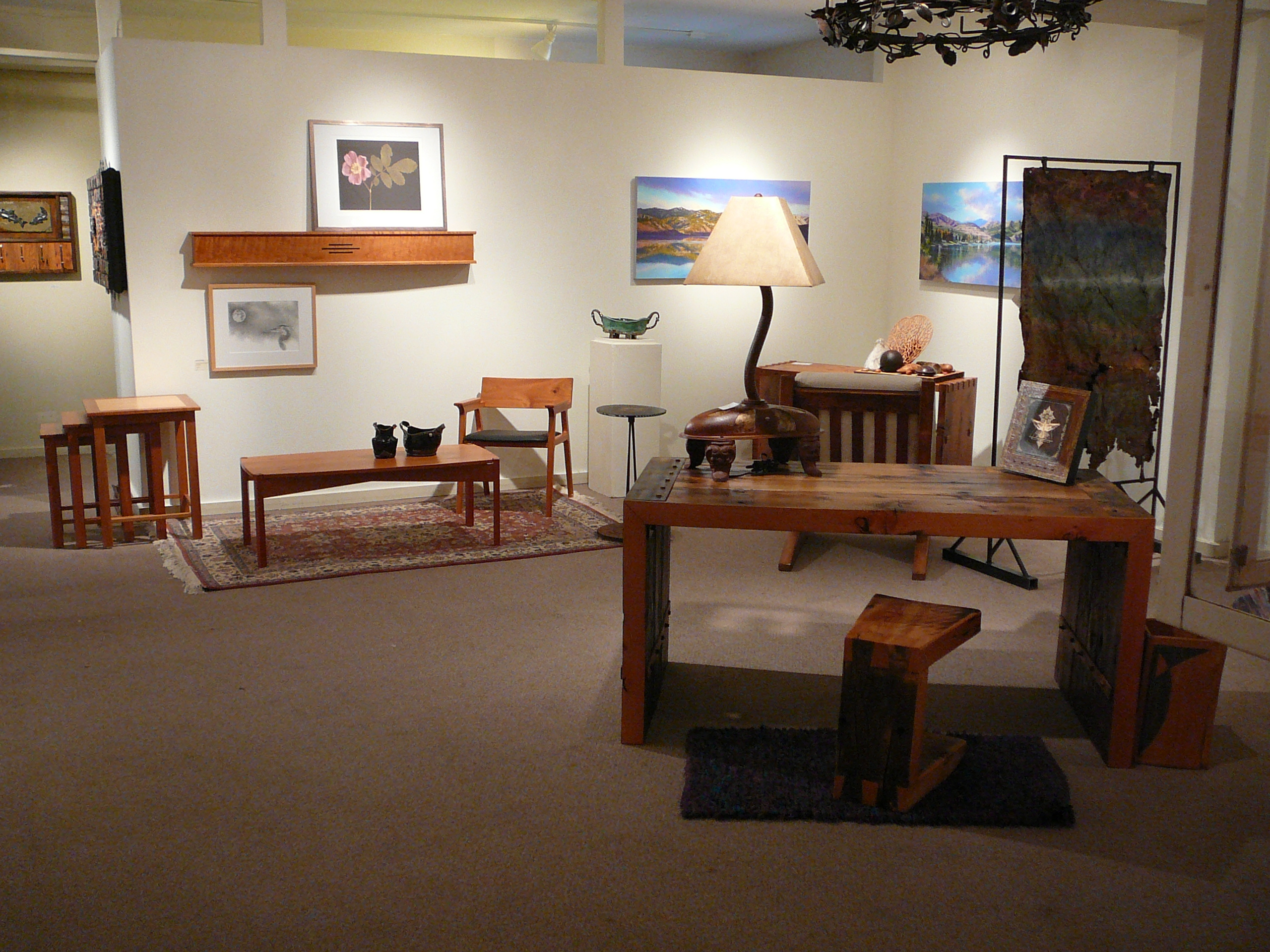
There must be some magic to having one of my rugs displayed on that chair – as of yesterday, I have sold three rugs off that chair!  I believe all of them were sold to people visiting the valley from out of town (I know one was shipped to California).

Summer Wednesdays mean jazz night in the beer garden at the Twisp River Pub.  Last week we went down for dinner and music with the Pasayten Quartet and Laura Love on vocals.  She not only has a great voice, she is a real entertainer!

P1020896

The weekend of the Home Tour (August 10-11) there were strong thunderstorms with wind and heavy rain at times, mostly at night.  We actually had a beautiful sunny day for the home tour itself, thank goodness.  But this resulted in major mudslides up in the North Cascades that shut down Highway 20 for a little over a week!    It is reported they had to remove 3000 dump truck loads of gooey mud and rocks, plus repair guard rails, set up new drainage systems, and repair damaged roadway.

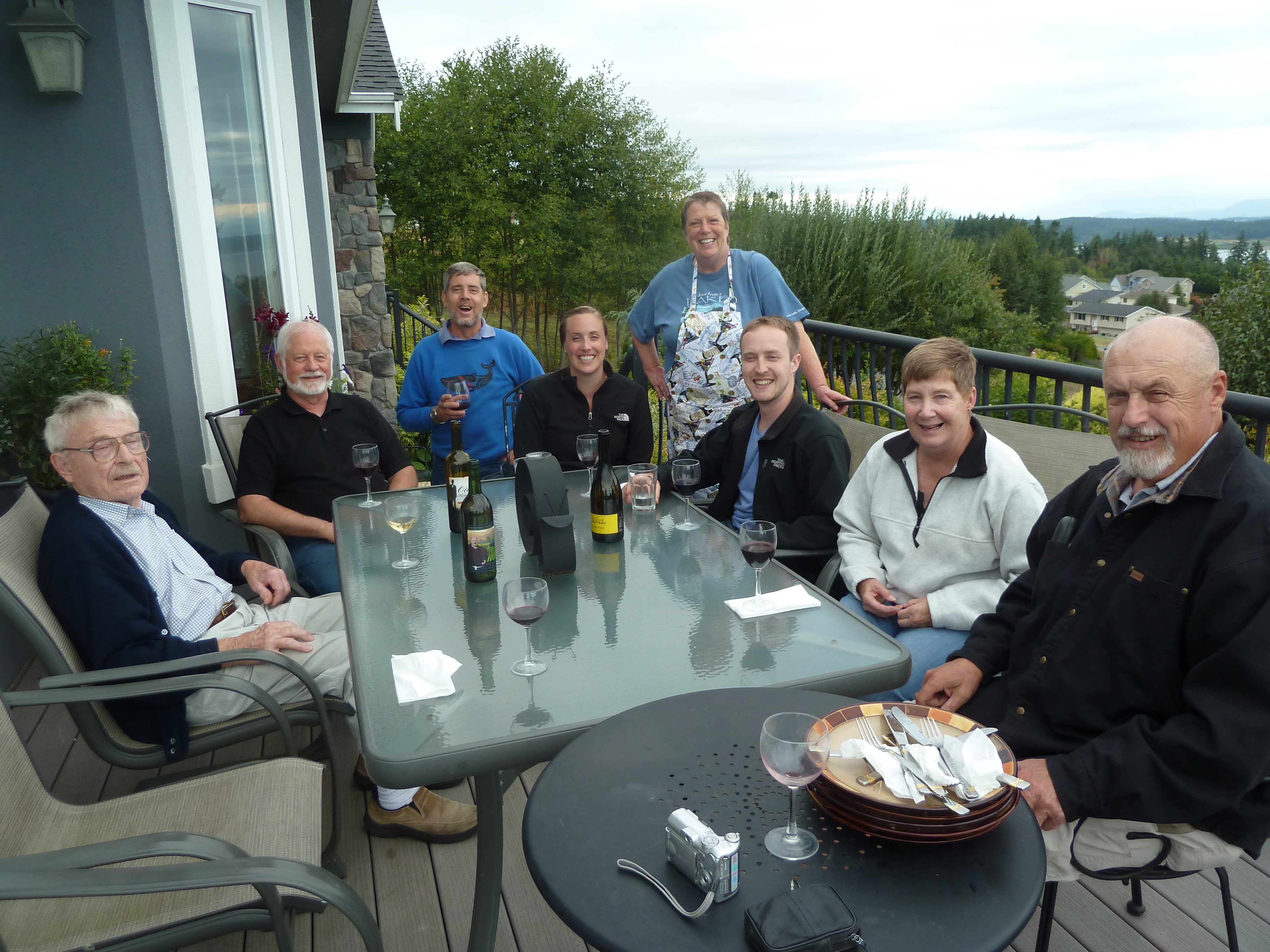
We drove over to the Coast on Sunday August 18th for a family gathering, and had to go over Stevens Pass, which was actually fine until we hit the little towns on the west side.  Between low speed limits and traffic signals, it got pretty clogged up.  But we made it to Camano Island to get together with my Dad, my two siblings and their spouses (sister and brother in law came from Colorado) and one of my nieces and her fiance, who had flown in from Texas.  It was totally worth the drive over to see everyone!

clan gathering 1

clan gathering 1

clan gathering 2

clan gathering 2

They re-opened the pass the next morning, so we were able to drive home over the “North Cross” highway.  The lakes behind the dams (power for Seattle City Light) were an amazing milky blue-green color, presumably due to all the silt in the water from the heavy rains.

Ross Lake - August 19, 2013

Ross Lake – August 19, 2013

Washington Pass Overlook

Washington Pass Overlook – headwaters of the Methow Valley

I have been weaving a lot of rugs, but will save those pictures for the next post.  It’s time to move on with my day!

Sociable Season

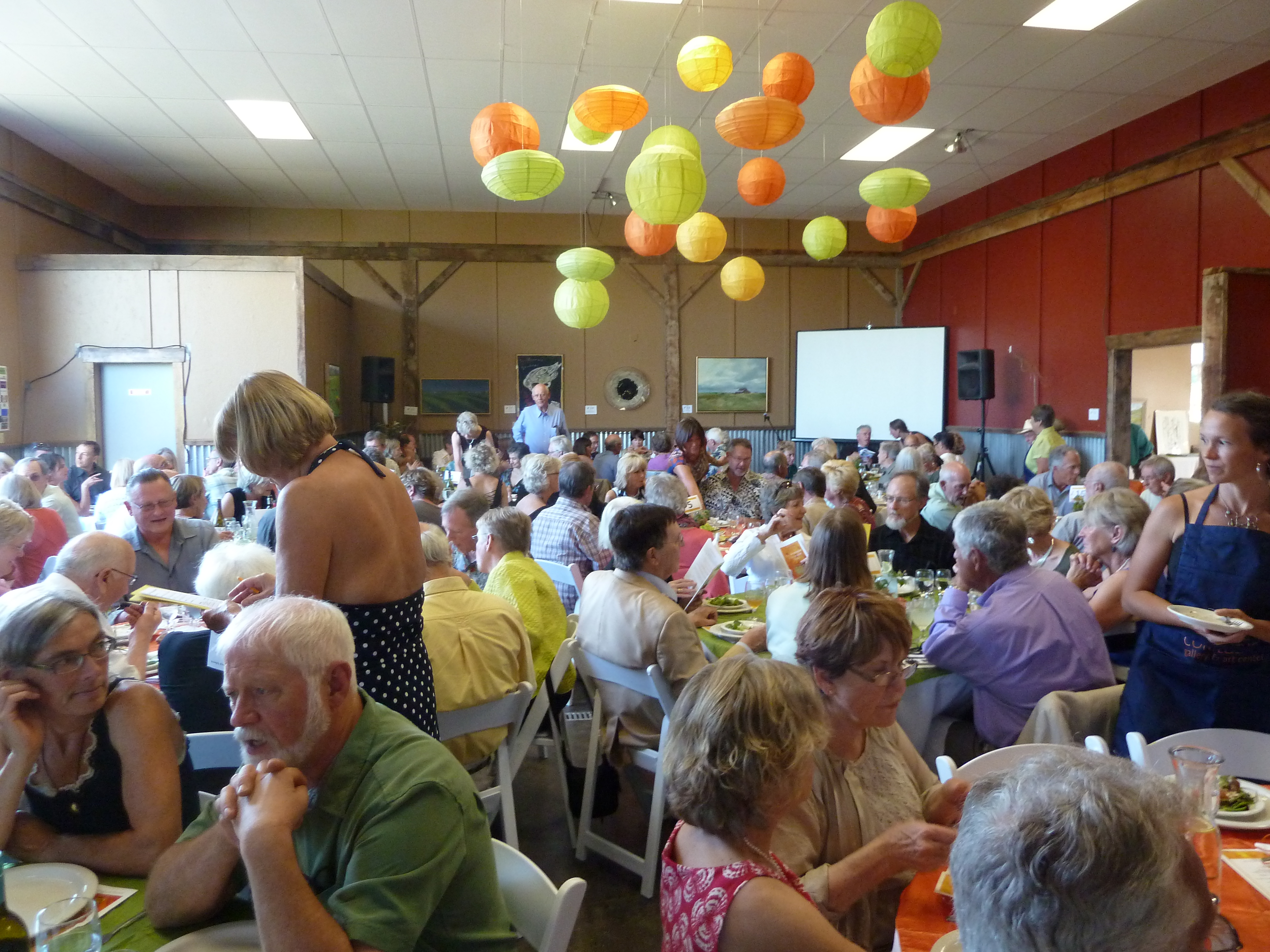
Summertime has brought us a number of social events.  A few weeks ago there was a fundraising dinner for Confluence Gallery & Art Center, held at Pipestone Canyon Ranch (over the hills east of Twisp).  With about 150 people in attendance, it was a lively and festive evening in a beautiful setting, with good food, good conversation, and both silent and live art auctions.

P1020838

P1020843

Some people may have gone home with something they didn’t absolutely need

P1020847but obviously folks were there to support Confluence on its 25th anniversary, and in fact I heard they raised over $25,000!

A week later we attended an outdoor dinner party, down by the Twisp River, that had grown from a guest list of 16 to over 40!  Unfortunately my pictures came out too blurry (not because of imbibing, but because of low light levels….honest!).  Hosted by Canadians, attended by Canadians and even a couple from England, and of course the local contingent.

This past week my family has been here for all 5 concerts of the Methow Valley Chamber Music Festival (July 25 – August 3).  My Dad drove over in his RV and is camped in the front yard.  Brother and sister-in-law are here as well and we have weathered 100 degree weather, turning to cool and thundershowers this week.

MV Chamber Music 2013 2

MV Chamber Music 2013 3

Tomorrow a new show opens at Confluence Gallery, and Rick has several pieces in it – me, a couple of new rugs.  The title of the show is Inside Out (“An exploration and celebration of designed interior and exterior space, and the objects and forms we use to define them..”) He helped with the setup this week and took a few pictures:

P1030621

P1030623

P1030629

Sorting Out Sotis

A few days ago I finally unfolded my Baby Mac workshop loom, got out my notes from Kay Faulkner’s 3-day workshop on Warp-Faced Weaves at the ANWG Conference in June, and went back to figuring out what to do with my 4-yard warp.  I last blogged about it in this post after the conference.  I hadn’t made it much farther than getting the warp on the loom.

My warp is threaded for a combination of plain weave sections alternated with the Sotis cloth (patterns from West Timor).  Kay’s notes are based on a nomenclature she came up with that makes sense to her, but isn’t terribly clear until you figure it out.  I also had her article from Handwoven Mar/Apr 2013, and studying the weaving pattern from that was a great help.  I wound up making my own notes about how to weave the 6 basic patterns she gave us.

Basic Sotis patterns 1-4

Basic Sotis patterns 1-4

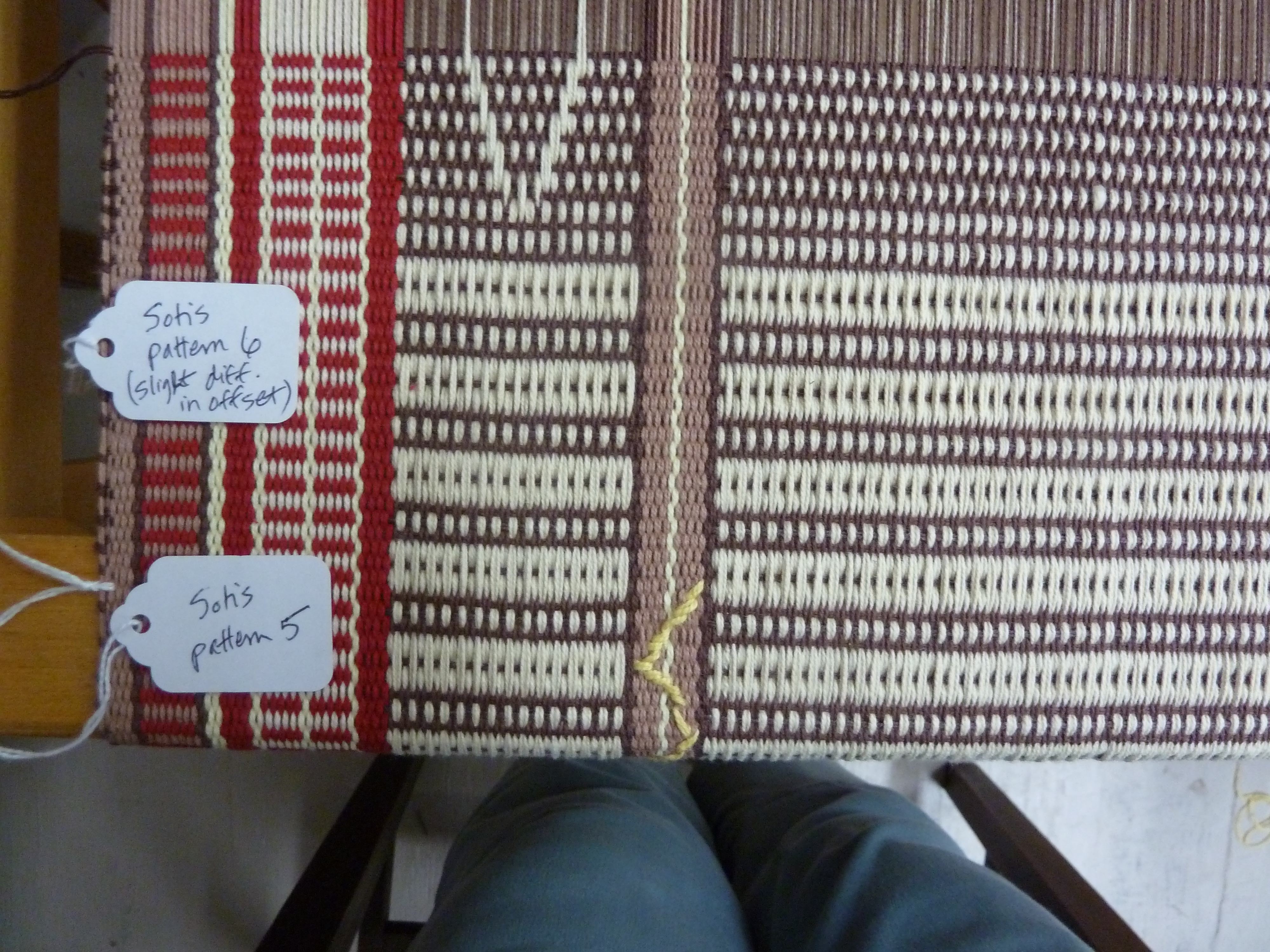
Basic Sotis patterns 5-6

Basic Sotis patterns 5-6

In the above photo, you can see where I was trying the “warp wrapping” with a banana yellow color, in one of the plain weave areas.  Not with a great deal of success.  However, I am not sure I want to use this technique in my project so may or may not follow up with more experimentation.

I was more interested in getting a pattern motif in the Sotis areas, which has to be done with manual pickup of threads for this simple threading.  After a first attempt, I was starting to understand how this works, and made a plan for a motif.

Sotis motif plan

Sotis motif plan

and what do you know – it worked!

Sotis pickup

Basically, this is done within the context of Basic Pattern 4.  In my sampler, of the 60 heddles threaded for each side section, 30 are threaded with a single dark brown thread (can be thought of as “tabby a” for the section) and the other 30 alternate heddles are threaded with 3 cream threads run together (can be thought of as “tabby b” for the section).  The ones with 3 threads are referred to as “heavy”, to alternate with the dark brown “fine” threads.  But, those 30 heavy threads can also be lifted in alternating groups of 15.  This is how you get some of the patterns.  The pickup motif is done on a ground of basic pattern 4, where one bar uses just heavy “a” and the next bar uses heavy “b”.

I may try out the “exposed weft” technique next, then move on to weaving some placemats using combinations of the basic patterns, and incorporating my little pickup motif.

I also now know why Kay does some of her more elaborate Sotis pieces on a 24-harness computer loom, where she can treadle the Sotif motifs and not use pickup!  It works, but is slow and for now at least, requires vigilant attention to detail.

The $11 Solution

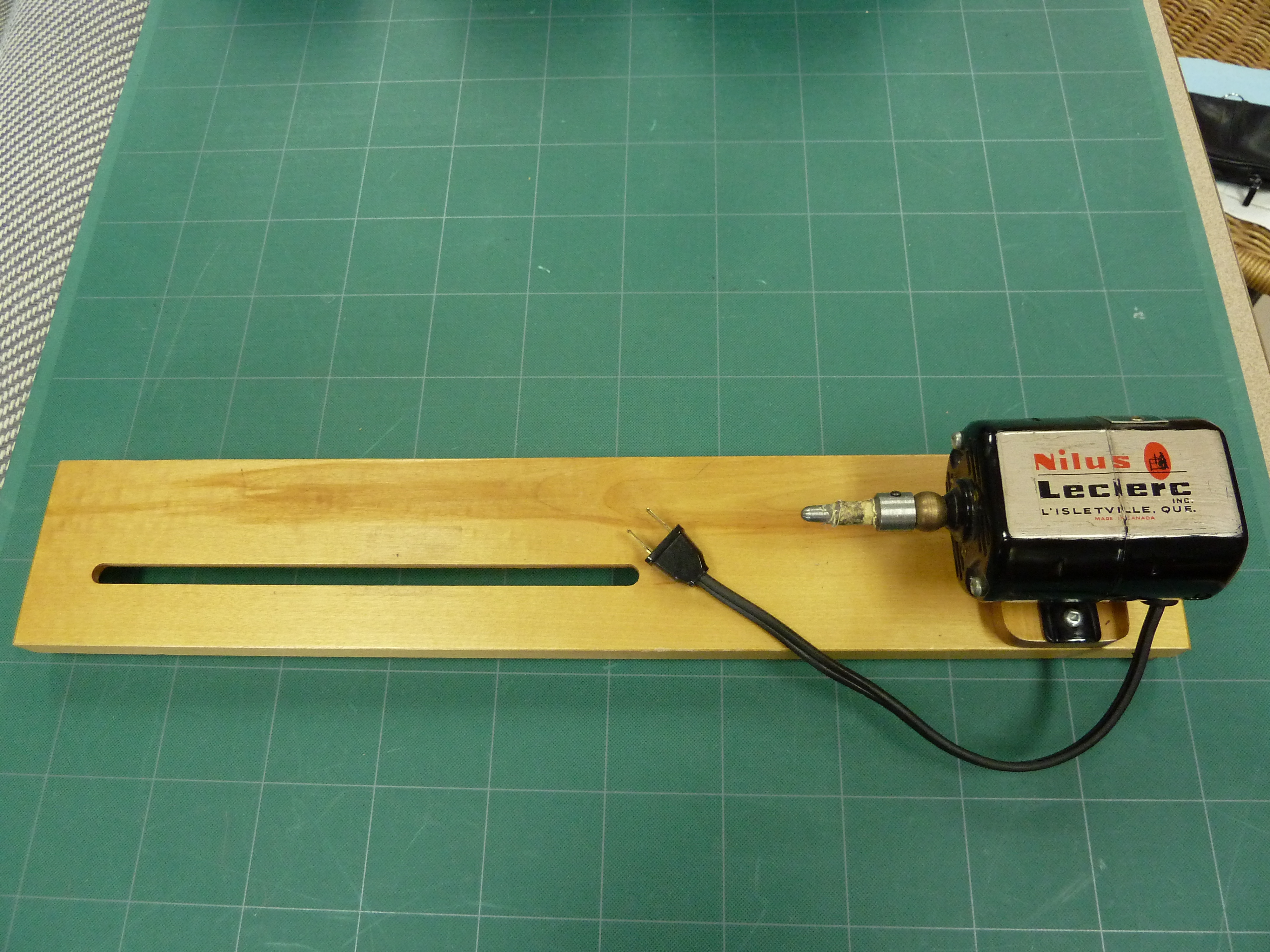
Several months ago someone gave me part of an older Nilus LeClerc double-ended electric bobbin winder.  She had gotten it years ago with a loom purchase, but “some of the parts didn’t make it into the box”.  Specifically, it was missing the end that slides in a groove, and the rheostat foot control.

Leclerc hybrid before fix

I tried to get the missing part but the people at LeClerc (in Quebec) said this was an older style and they don’t keep spare parts for older machines.  Studying the pictures on their website, I could see that the new ones have the spring mounted down in the groove, not on the shaft of the part that slides in the groove (which is what this one would have had).  So I figured I was out of luck.

At the ANWG conference at the end of June, someone was selling some old weaving equipment in one of the booths.  Among this was an older Nilus LeClerc double-ended winder.  So I took a chance and bought it.  I should have been more careful in checking it out, because when I got home the foot control (wrapped up and taped in paper) was broken.  However, I could get it fixed at a sewing machine shop in Wenatchee, although as it turns out Rick was able to take it apart, bend a flange back into place, and put it back together all cleaned up and oiled.  So now I had a working winder!  You can see how the spring is mounted in this picture.  The moving part is tightened down with wing nuts from below, once positioned in the groove for a particular bobbin length.

LeClerc winder from ANWG conf

In the meantime, I got to wondering if LeClerc couldn’t sell me a new base plate and moving end from their current model.  So after some back and forth with calls and emails, they agreed to this and it came last week.   Or at least, they sent the moving part and a spring – not the base with the groove!  I guess I didn’t communicate clearly what I was expecting.  However, I am fortunate to be married to a guy who is both handy and handsome (a Red Green Show reference).

He had to trim the wood that slides in the groove – very carefully, on the table saw, until it fit just right.  Then he had to re-position the motor so the two ends that hold the bobbin line up (in a brand new winder, the motor is a different model and is offset on one side).  He had to figure out how to mount the spring in the groove from below.  But in the end, it worked great!  Here is my hybrid winder:

LeClerc hybrid winder 1

new sliding part on left, old motor end (re-positioned) on right

LeClerc hybrid winder 2

I still have to get a foot control, but the sewing machine store in Wenatchee says they have a box full of old used sewing machine rheostat foot controls with plug for motor and light that I can get for $10-$15 (just like the one on the ANWG conference one, which I have been using for now).

Now I have been using it to wind off spun singles from my spinning wheel’s Woolee Winder bobbin onto plastic spools.  I learned this from Judith MacKenzie – spin all your fiber and put on plastic storage bobbins as you go, then ply from those bobbins.  Saves a ton of money on extra spinning wheel bobbins.

But the electric winder goes like a bat out of hell, and I had to just barely depress the foot pedal to keep it slow enough.  Otherwise the spun singles would break – they are a lot more “tender” than weaving yarns you would wind off a cone onto a bobbin.  It was hard to control the speed, and when I was done, the foot pedal itself was really hot.

So this is where we get to the $11 solution part.  I had picked up a tip from one of Peggy Osterkamp’s books that you could use a plug-in dimmer switch between the wall outlet and the foot control, as an extra rheostat.  But none of our local valley hardware stores had such an item – they just have the kind that are wired into a light switch on the wall.  So I went online and found this on Amazon:

lamp dimmer for winder

It totally solved the problem.  I plugged the dimmer into the outlet, plugged the foot control into the dimmer, then adjusted the sliding control until the winder was turning at a slowish speed with the pedal fully depressed.  The speed stayed nice and constant so I could concentrate on tensioning the yarn and filling the bobbin evenly.  The foot pedal wasn’t hot at all when I was done.  And this item only cost about $11!

So now I guess I will try to sell the one I got at the conference, and keep the “hybrid”.

Final note:  4 rugs finished this week.  The first three were an order from friends for their home at Lochaerie Resort on Lake Quinault – Chris picked the materials from my stash of Pendleton selvages when they were here last April.

R159 Lochaerie 1

R159 Lochaerie 1

R160 Lochaerie 2

R160 Lochaerie 2

R161 Lochaerie 3

R161 Lochaerie 3

R162 - fiesta time!

R162 – fiesta time!