Feeds:
Posts
Comments

Archive for the ‘home life’ Category

Fall is here.  I love this time of year.  We are still having temperatures in the mid-60’s during the day, low 30’s at night.  The trees are starting to turn.  We have been over to the coast twice, each of the last 2 weekends, and the drive over the mountains gets lovelier every time we cross over.  I am actually starting to wear sweaters in the evenings.

I can also tell it is Fall because all of a sudden I want to start knitting projects.  I bought a couple of pattern booklets at Weaving Works when in Seattle and have knit a hat using some of my handspun yarn:
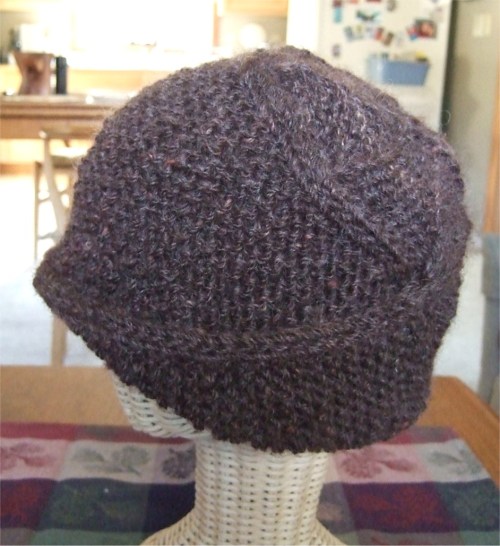
"Quincy" hat by Jared Flood

"Quincy" hat by Jared Flood

The pattern is by Jared Flood from his new book called “Made in Brooklyn”.  The yarn was a 3-ply I spun from a Lincoln x Romney cross (brown color) blended with a little mohair dyed orange.  I bought the batts from the breeder at a NW Regional Spinners conference a couple of years back.  My friend Carol fell in love with the hat last weekend so now it is hers!  It was a quick knit and I will definitely do another one, if not several more (p.s. you do need to know how to do a provisional cast on, and garter stitch grafting; the pickup of stitches for the crown, off the continuous edge of a Mobius strip, is a little unusual but not hard once you understand what is going on).

I have also started the classic Elizabeth Zimmerman pattern, Tomten Jacket, for me – also using handspun.  This is a garter stitch jacket with optional hood.  I am using a 3-ply yarn I spun from a “cleaning out the mill at the end of the season” blend I got from Stonehedge Fiber Mill about 4 years ago.  It is a blend of wool, alpaca and silk.  The above-mentioned Jared Flood blogged about his modifications for this jacket back in 2007, and I am going to use some of those suggestions to make it fit better.

And I am planning to start another sweater, Anhinga by Norah Gaughan, after seeing it on Teyani’s blog: Intrepid Fiber Wizard.  Thanks, Teyani!  It’s in Norah’s new book “Fly Away” – Collection No. 5.   I know I have yarn in my stash that will work with this pattern.  Just have to haul out all the boxes and rummage through them this weekend.

Back on the home front, they are starting to put in the fence posts across the back yard.
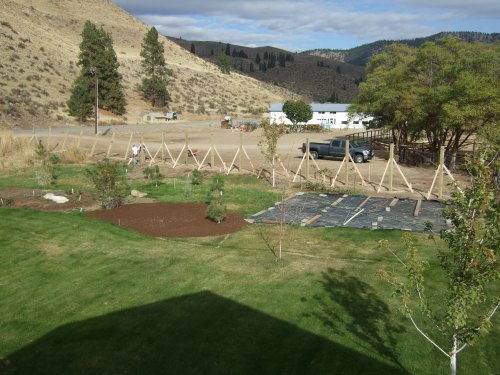
fence postsIt’s going to be even taller than we thought, starting out at 7 ft at the roadside and increasing to 9 ft on the right-hand end, due to the slope of the ground.  It will really provide a nice visual barrier, yes?  We also finished creating and mulching down another bed for the future perennial/shrub border to the lawn, and covered the area where we plan to have our vegetable garden next year with black plastic to (hopefully) keep the weeds down.
Read Full Post »

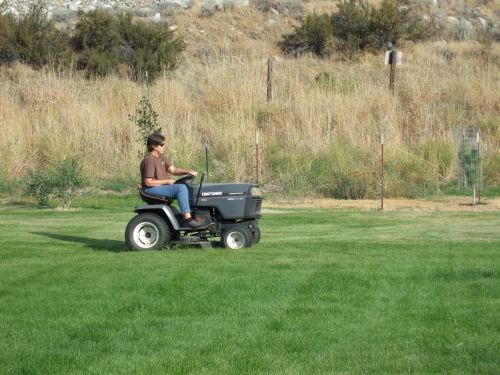
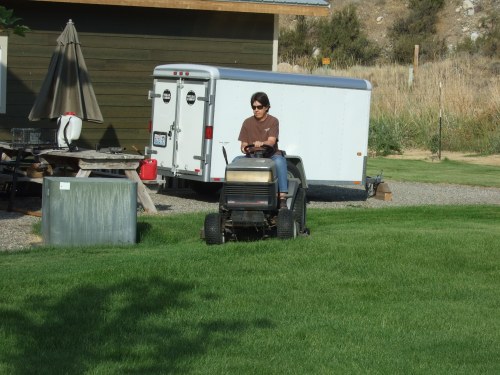
We went over to the coast last weekend for a variety of reasons, one of which was to pick up a garden tractor (riding lawnmower) from some friends who no longer need it.  It came with a large dump-cart to tow behind, that is going to be incredibly useful as well.  The little tractor needed some cleanup and a new battery, then fired right up.

It’s sort of like a cross between a go-cart and a lawnmower.  Yee-haw!!

Trusty 1

Cowboy Aberson Carr rides again

Cowboy Aberson Carr rides again

They also gave us some other great stuff, including some pavers that I will eventually use on a new entry walkway, and a ten-gallon hat.  Here it is on a very cute little kid who was visiting with his parents, from Bellingham:

Luka 1

More excitement this morning.  They are removing the concrete blocks and manure piles/compost heaps next door in further preparation for the fence!!

removing concrete blocks

When we came back into the valley last Sunday, there was a new forest fire to the east of us, that caused them to close Highway 20 over Loup Loup pass to Okanogan and Omak.  Evidently the power was out for 18 hours over the weekend, as they had to shut down the main line over the Loup because of the fire, which they have named the Oden Road Fire (the link is to InciWeb, which is a great resource for tracking wildfires).  It’s pretty much mopped up by now, though.

Yesterday I picked up the Methow Valley News at the PO Box and found out there was a big pot bust this week up near Sun Mountain Lodge.  We had noticed helicopters flying around last Tuesday but couldn’t figure out what was going on… read all about it here!  So wierd to think people are growing large quantities of pot in our national forests and this one so near to trails we use all the time.

So that’s the news from Twisp so far this week….

Read Full Post »

Loom tidbits and more

Holly asked about the sanding block for metal cleanup (I think, not the one for wood).  I just found it with Google under Bridge City Tools.  Specifically, it is called Sandflex Hand Block and comes in fine, medium and coarse or as a set of all 3.  There you go!

Over the weekend I was able to contact one of the previous owners of Mother Mary’s Loom.  The loom came with a copy of the Macomber catalog with their name and address on it.  A simple directory lookup gave me the phone number to try in North Bend, Washington. Very nice folks; the husband had obviously been quite fond of the loom and had made an effort to find out about it when they bought it.

The loom, built for Mother Mary in 1954,  had originally resided at Mt. Angel Seminary near Salem, Oregon.  There it had been used to weave priest’s vestments, etc.  At some point it was sold to a weaver in Puyallup, Washington.  This lady’s husband was the one who made the bench that came with the loom.  It’s a very pretty bench with some beautiful figured maple on the top.  She apparently developed some health issues that caused her to give up weaving, and she sold the loom to the folks in North Bend around the year 2000.  She has since moved to Florida and they lost track of her, so I can’t follow up that lead any further.  The folks in North Bend traded it to someone in Olympia (for a harp!) due to lack of space, and the fact that she had become fond of Leclerc looms and that is what she is using now.  The fellow in Port Orchard obtained the loom, 2-3 years ago, from the gal in Olympia also through a trade arranged through Craig’s List.

So there we have it.  I am owner number 5 since it left the Mt. Angel Seminary.

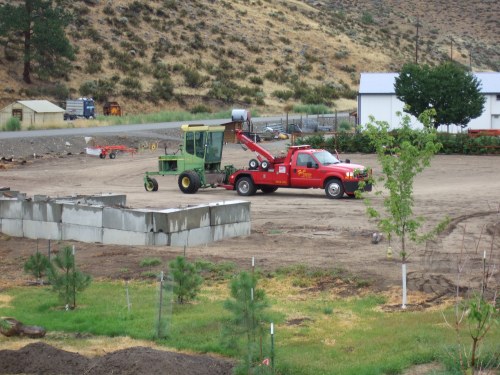
On another topic, we were very excited to see a tow truck show up next door and take away the dead car and the equally dead John Deere farm machinery (not a tractor; not sure what it was…).  They already hauled off the stock feeding stations.  They say the concrete blocks are next, and the fence will happen this year.  Keeping our fingers crossed!

bye bye John Deere thingy

bye bye John Deere thingy

Read Full Post »

Loom Restoration Project

I have to admit I was a little crestfallen when I first saw the loom in Port Orchard.  It was more dilapidated and rustier than I had expected.  However, Rick’s attitude was “nothing that can’t be fixed, let’s load it up and get a move on…” so off we went.

I am fortunate to be married to a man who is a professional woodworker and all-around handy guy, and who thought it would be “fun and interesting” to help me restore the loom (his words, not mine!), and learn more about how they work in the process.

Warning: this is a long post that may be totally boring if you aren’t interested in looms.

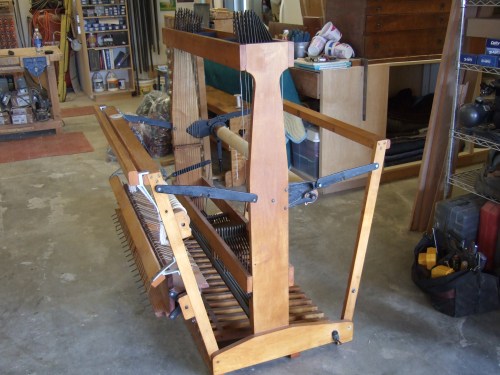
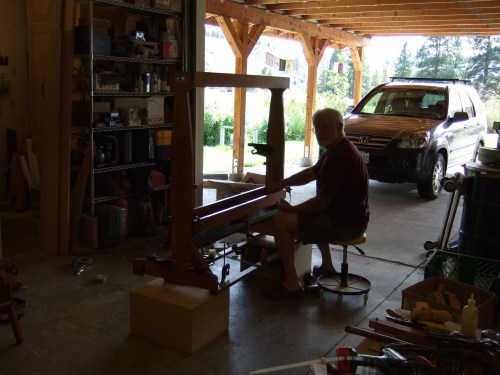
At home in the workshop:

in the shop

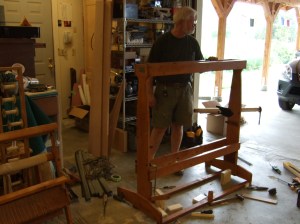
It was dirty and just about anything on it that could rust, had done so.  We decided it was best to just take it all apart, clean it up and then put it back together.  This meant removing the front and back beams, pedals and the jack mechanisms.

Dirty...

Dirty...

Rust on the steel parts of the lower jacks

Rust on the steel parts of the lower jacks

Disassembled

Disassembled

Over the course of the next 2 days, Rick worked on the frame and jack mechanisms.  All the bolt heads were rusted so he removed and replaced them, in the course of which he found that two of the bolts were broken off inside the frame.  We think the loom must have been dropped at some point, probably during a move, as wood was split as well.  But he managed to get the broken pieces of bolt out and put it all back together again with new bolts and brass screws.  Much sturdier now!  Also one of the treadles had a piece of wood splitting away on the bottom, but he glued that back together again no problem.  He went over the frame with a sanding sponge, which cleaned off the dirt and grime and made the original varnish finish smooth and nice looking.  The upper and lower jack mechanisms had a lot of rust to be sanded off, plus the chains and S-hooks were all rusted, but these were items that are readily available at the local hardware store so we were able to replace it all with new shiny metal.

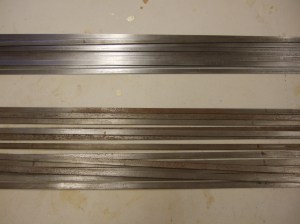
Meanwhile I worked on the rusted heddle bars, all 24 of them.  These fit into the harnesses or shafts, across the top and bottom and are what the heddles slide on (the heddles are what you thread each individual thread through, so they are raised with the harness they are threaded onto).  We developed a method for removing the rust:  first a sanding with a rough grit paper to remove the worst of it, then burnish with a wonderful little sanding sponge that is meant for cleaning metal (he got it years ago from Bridge City Tools).  Final cleanup with Tri-Flow (a rust remover and lubricant) and steel wool or fine grit paper.

Heddle bars, clean (above) and rusty (below)

Heddle bars, clean (above) and rusty (below)

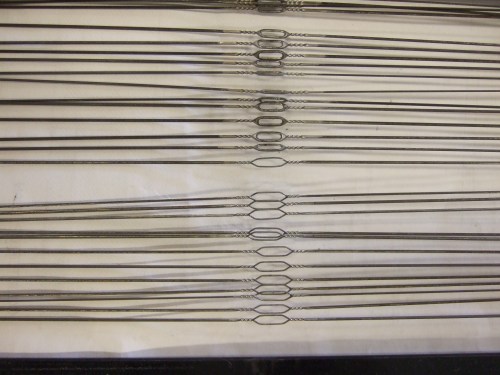
The heddles themselves must be the original ones.  I called and talked to Eddie at Macomber and they are lighter weight than the inserted-eye heddles they provide now, and they pre-date the flat steel heddles that they used for a while before changing to the inserted-eye ones.

Original heddles, lightweight inserted-eye and plain wire

Original heddles, lightweight inserted-eye and plain wire

There are about 800 of the inserted-eye heddles (with solder around the eye) and about 400 of the plain wire ones.  I found this out when I went to put them back onto the heddles bars and into the frames.  They too needed to be cleaned up, with some rust at the tops and bottoms where they slide on the bars.  I wound up using naval jelly, brushing it on liberally and then rinsing it off, drying them thoroughly, then spraying with clear silicone spray per the recommendation of Eddie at Macomber.

I also went over the 16 treadles with the sanding sponge, then put a coat of Profin on them.  Now they are pretty clean and new looking.

Reassembly of the loom:

Lower jacks all cleaned up and re-installed

Lower jacks all cleaned up and re-installed

Easier than sitting on the floor!

Easier than sitting on the floor!

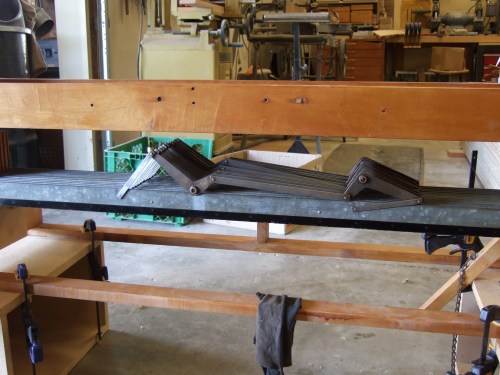
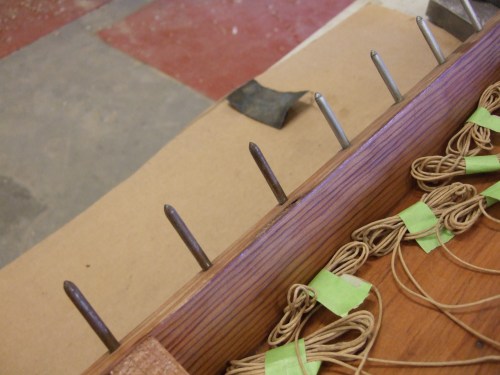
Yesterday I went to work on the sectional beam, which was (you guessed it) dirty and rusty.  I went over all the wood with the sanding sponge to clean it up, then worked down the rust on all 84 of the metal spikes that divide the sections (21 on each of 4 fins).  Grrr.  This one is a pain.

Rusty and clean sectional dividers

Rusty and clean sectional dividers

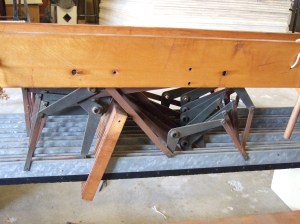
The cord on the sectional beam is shot so I have ordered a replacement kit from Macomber, along with new cloth aprons for the front and back beams.  Also the reed it came with is rusty and in my opinion, not salvageable, and somewhere along the way it lost most of the hooks that are used to connect the treadles to the lamms (see picture above, they are the crosspieces below the lower jacks) – there were only 8 hooks, and Eddie said they usually send 6 per harness, which would be 72. Fortunately, still available from Macomber.

So it won’t be all ready to go for another week or so, but we are getting there.  A labor of love.  It’s going to be worth it.

Read Full Post »

We have been moving along with the perennial beds out back.  Last week it was very hot (over 100) so it was difficult to get much done – outside by 7 am or earlier, work as fast as possible, give up by 9:30 or 10:00.  We had an 18-yard dump truck load of compost mulch delivered:

18 yds of compostthen proceeded to cart some of it over to the new planting bed in back with the tractor, and spread it out.  I went up to Wild Hearts Nursery near Winthrop and picked up some plants to make a start on the new perennial borders.  I had to plant something!  So they look a little lonely and forelorn, but hopefully all will survive and be nice big vigorous plants next year.  We have a couple of varieties of lavender, black-eyed susans and some other types of daisies, gaillardia, perennial geraniums, and some succulents around the rocks.
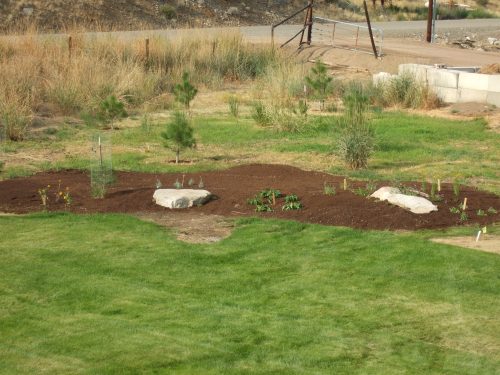
perennial bed Aug 2009

Our social event of the week was a big fund-raising dinner for Methow Conservancy on Wednesday night.  This event happens every 3 years and is hosted by Jim and Gaye Pigott and the Mocassin Lake Foundation.  This year they held it at the Shafer Museum up in Winthrop, our local historical museum and a pretty interesting place.  We had a nice time talking to old friends and meeting new folks too.

Best of the West 2009Off to Vancouver, WA today to install cabinets at our friends’  house.  I will also go by the Sock Summit at the Oregon Convention Center.  More on this next week!

Read Full Post »

Yesterday we went up to the vegetable garden for a while, to weed and prune and harvest.  I pruned the tomato plants back a lot, as they were sprawling all over the place and in a tangled mess.  We came home with beets, chard, carrots, small narrow green (mystery) peppers, yellow crook-neck squash, lettuce, Walla Walla sweet onions, two kinds of potatoes, and a whole lot of green cherry tomatoes that I couldn’t bear to throw away (they were on the pruned-off branches).

So dinner last night was mostly vegetables, with a modest portion of left-over steak for a bit of protein.  I cooked the beets, cut them in wedges and added a simple vinaigrette while they were still warm (olive oil, red and balsamic vinegars, salt & pepper).  We will eat these for a couple of days, delicious as a side vegetable or addition to a green salad.  We had a couple of the freshly dug red potatoes – it still amazes me how something so humble as a potato can taste that much better when it is fresh!

But the fun thing was a vegetable saute.  I used one of the yellow squash cut into chunks, a small sweet onion, 4 of the little peppers (which turned out to have some heat to them, although they are not jalapeno – we got the plants from someone and I don’t know what they are).  Also chard stalks cut into large dice, and some of the green cherry tomatoes.  Seasonings were dried basil, fresh garlic, salt & pepper.  It was delicious!  The peppers gave it a little heat but not too much.  The green tomatoes were hot but not bursting, a little acidic,  juicy and somewhat sweet.  They really added a lot of interest to the mix and were pretty to boot.

green tomatoes

Read Full Post »

« Newer Posts