Feeds:
Posts
Comments

Archive for the ‘weaving’ Category

Minus One

That was the temperature when we got up at 7 am – minus one degree F, or over 30 below freezing.  Yikes!  Well it stays warm in the shop and apartment so I guess we got this place insulated pretty well.  It has been clear and sunny and beautiful in the valley, although the continuing lack of snow is making us nervous.

The social event last weekend was the Confluence Gallery‘s annual holiday dinner up at The Barn in Winthrop.  Now that doesn’t sound too elegant, but they decorated it in a cabin theme and it was really quite charming.  The food was great, and this year they skipped the benefit auction so it was easier to socialize and mingle after dinner.  Most of the attendees are volunteers, patrons or artists (or all three) so we have a lot in common.  Rick and I had a great time and posed for our pictures in a sleigh:

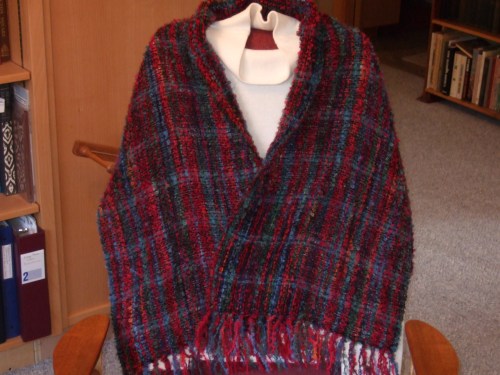
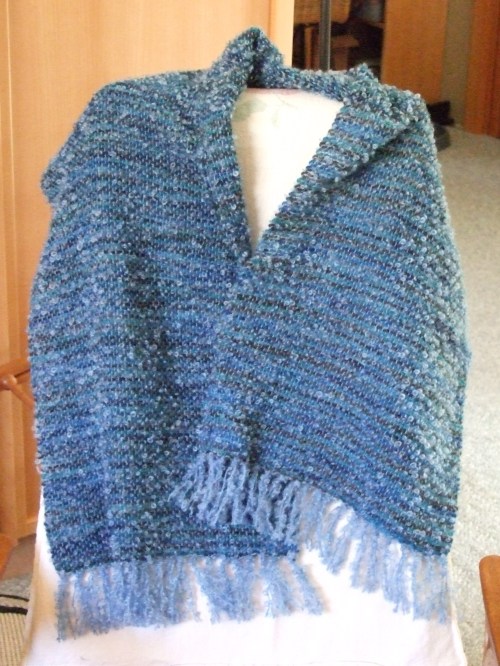
I have been weaving up a storm this week, having finished four shawls using a mohair boucle in colors that remind me of a parrot.  It is a handpainted yarn from New Zealand, and the dyer called it “Lollipop”.  It has proven to be a popular color, as I sold two at the weavers’ guild sale, and then two of these longer ones are on order.  So then I did two more to have some for stock.

I also finished a knitting project – it is a wool vest that I started around the first of November.  The pattern is “Veste Everest” by Veronik Avery, from the Fall 2005 Interweave Knits magazine.  I used some yarn I had in stash, a Karabella yarn called “Aurora Melange.”  It is a superwash extrafine merino in marled browns (or at least, I think “irrestringibile” means superwash…) and feels so soft and cushy and springy.  I was worried I wouldn’t have enough after comparing the yardage of what I had with the yardage of the recommended yarn, so even though it is supposed to be a short vest and I am long-waisted, I finished it to the shoulders as written.  At that point I had more than 2 balls of yarn left (out of eight) and it was really way too short.  So I ripped it back to the underarms and added two more repeats of the cable pattern, or another 4 inches, before finishing it again.  Now it is perfect on me, and I still had one whole ball left!  Curious, but there it is.

"Veste Everest" in Karabella "Aurora Melange"

The marled yarn somewhat obscures the cable pattern, but more so in the pictures than when you are looking at it in person.  Not sure why that is, but I took about 6 shots trying to get better light and definition, to no avail.
Read Full Post »

Off to The Coast

We’re off to Seattle (aka “The Coast”) for Thanksgiving with family and visits with friends.  The weather seems to be cooperating so we expect the drive over the passes to go without incident (or accident, that is).  The cats are going along since we will be gone for 5 nights – they usually tolerate the drive without too much complaint, and recognize the apartment once we get there.

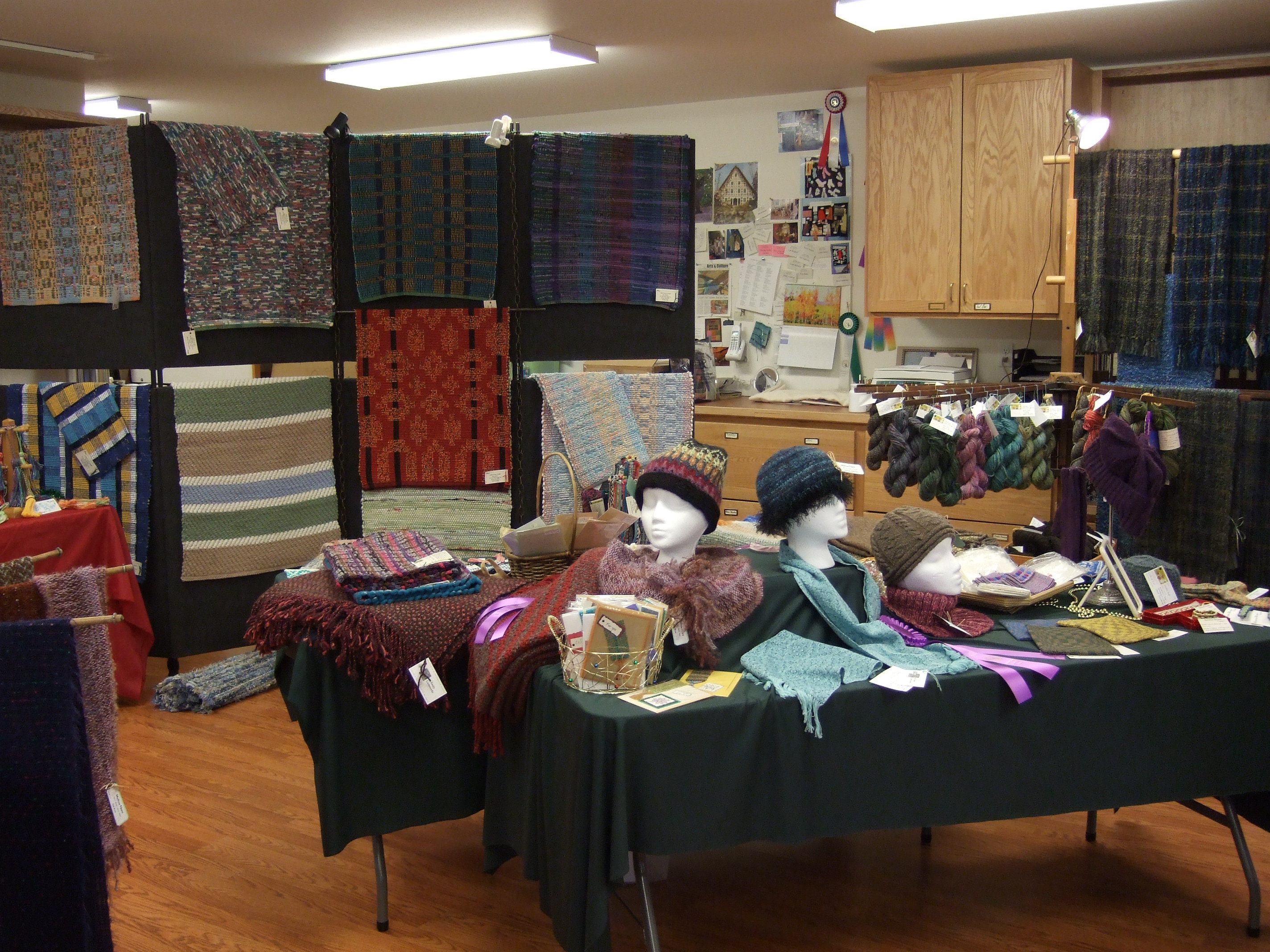
So I will leave you with some pictures of our guild meeting room set up for the sale (which went well), and a promise to resume blogging sometime next week.

We had many rugs on display all over the room

Kay Reiber's shawls displayed on loom

towels displayed on a 72-spool rack

the "tableware" table

Read Full Post »

Six More Shawls

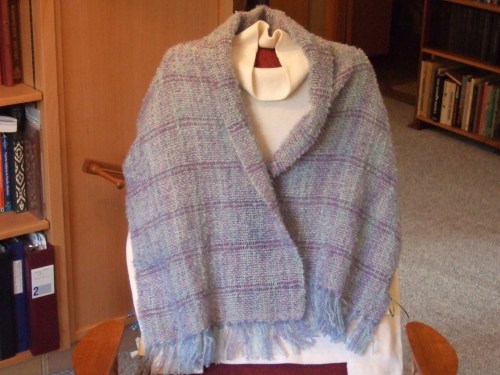
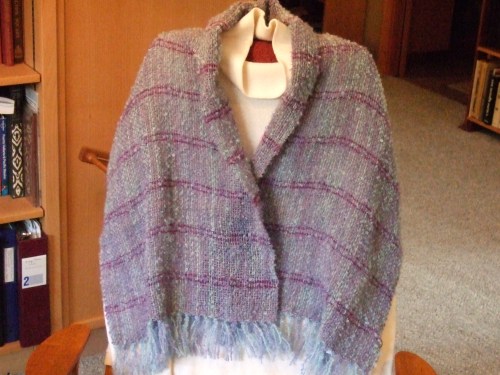
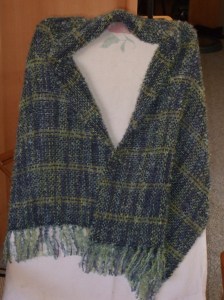
I’m heading into the home stretch, trying to build up some inventory for our annual guild sale next weekend.  I finished up six more shawls this week.  These are woven with handpainted boucle yarns from New Zealand for the warps, and none of them will be repeatable because the dyer sold her business and these colors have now been discontinued.  For the weft, I used various colors of wool or alpaca yarn, except the accent stripes are done with fine kid mohair/silk yarns.

Blue/mauve boucle with mauve wool weft

Blue/mauve boucle with pale lavender Shetland wool

blue+mauve 1

Blue/mauve boucle with mauve wool weft

Arctic+Paua black alpaca

Deep blues with black alpaca weft

Arctic+Paua brown alpaca

Deep blues with rich brown alpaca weft

Lollipop blue wool

"Lollipop" boucle with dark teal wool weft

Lollipop black alpaca

"Lollipop" boucle with black alpaca weft

As you can probably tell, I am getting two shawls from each warp put on the loom, but am mixing it up a little (and making it more interesting for me) by using different colors or fibers in the weft.  I’m also experimenting with making some shawl pins, since I like to wear these pinned shut at the front, leaving my arms free – sort of like wearing a vest.

Read Full Post »

Returned from Redlands

Well, let’s see – when last we met, I was off to my annual knitting retreat.  This was very fun, as expected, although getting there turned out to be a bit of an experience.  In fact, I almost titled this post “Katie & Diana’s Excellent Adventure.”  We drove over the North Cross Highway (Hwy 20 through the North Cascades National Park), which had recently received some new snow but was well plowed and an easy drive.  The mountains, with their fall color and new snow, were stunning.  We drove down Whidbey Island, intending to catch the 3:00 ferry across to Port Townsend – we even had a reservation!  Five minutes after we got in line, they announced the ferry had broken down and would be out of service until the next day.  Aargh!  We had to drive to the south end of Whidbey, cross to the mainland at Mukilteo, drive down to Edmonds (hello, Seattle-area traffic…) and cross back over the Sound to Kingston.  It was about 6 pm and dark by the time we passed through Port Gamble on our way to the Hood Canal Bridge.  What’s that flashing sign??  The bridge was open to let a barge through and there was another half hour wait. By this time we were laughing hysterically and I called Rick to fill him in… he said they were probably letting through the boat that had the part to fix the Keystone ferry.

On our way home we stopped in at The Artful Ewe in Port Gamble, where Heidi Parra has her beautiful hand-dyed yarns and spinning fibers (she carries no commercial lines, it is all her own stuff and it is fabulous).  Heidi has just opened a weaving studio two doors down from the yarn shop.  It has two Bergman looms and some others as well, and is decorated beautifully with items from her art and textile collections.

Artful weaving 1

Artful weaving 2

Heidi was pretty excited about this 16-harness AVL loom that she had recently purchased (used) and had just gotten hooked up to the computer:

Artful weaving 3

The woman is amazing.  She turns out the most beautiful dyed fibers and in such quantity.  Somehow she has more hours in her day then I can ever seem to find in mine!

Back in the valley, I wove 4 more shawls (pictures to come) and generally picked up the threads of normal life for a few days.  Then we were off to Redlands, CA for the weekend, to visit our good friends who are down there working in San Bernardino until the day they can return to Bainbridge Island.  They just bought a home in Redlands, a 1920’s era Spanish Revival, which is lovely, with gracious and generously sized rooms:

1920's Spanish Revival house

Redlands is quite a pretty town, with many wide palm-tree lined boulevards, and older neighborhoods chock full of huge Victorian and Craftsman style homes.  Here are just a couple I saw while out on a walk:

Redlands 1Redlands 2

Coming from the valley where winter is on the way, it was quite nice to experience temperatures in the 70’s again, sitting outside barefoot in the sun.  Thank you, dear friends!

SS new home

Read Full Post »

We drove across the North Cross Highway (North Cascades, Hwy 20) to Anacortes this week, to bring our camping trailer over for winter storage at my folks’ house, and have a nice visit with them.  It was a rainy day, but the colors were good up in the high country:

North Cross Fall 2009

Such a pretty picture, I have taken a bit of it for my new header image – the autumn theme.

It was heartening to see the colors, because the early freeze of a few weeks ago seems to have stopped most of the trees in our valley dead in their tracks.  They are mostly turning… brown.  No other word for it.  We usually have a lot more color this time of year.

I have finished up seven shawls and have warp prepared for six more.  I am experimenting with making more of a “shoulder shawl” – a little narrower and shorter than the previous series, and meant to be worn more like a vest with perhaps a shawl pin to hold it closed.

There are three alike from a sky blue mohair boucle woven with hand-dyed multi-colored wool in the weft:

Sky blue boucle with black alpaca, 3 alike

Sky blue boucle with hand-dyed wool, 3 alike

For another two I used a multi-colored mohair boucle, hand-dyed with mainly blues and greens -both have a greyish blue wool weft, but I used different colors of kid mohair/silk for the accent stripes:

Bluegrass with turq stripesBluegrass with pear stripes

And for these last two I used another hand-dyed mohair boucle, in a new colorway called “Schist” that has lovely tones of grey, gold and black.  For one I used the greyish blue wool for weft, with deep gold accent stripes.  For the other I used black alpaca for weft, with a dark bronze accent stripe.

Schist with blue woolSchist with black alpaca

These have been somewhat of an exercise in frustration, since it turns out the hand-dyed mohair boucle yarns I am using for the warps do not have consistent amounts of yarn in the skeins.  But after some trial and error I have concluded that getting the length right is what matters the most, and if they aren’t all the same width, then so be it.

I leave you with a picture of Teasel and Pushkin, who love to follow the sun around wherever it falls into the house during the course of the day:

Teasel Pushkin 10-24-09

Read Full Post »

Finished Projects

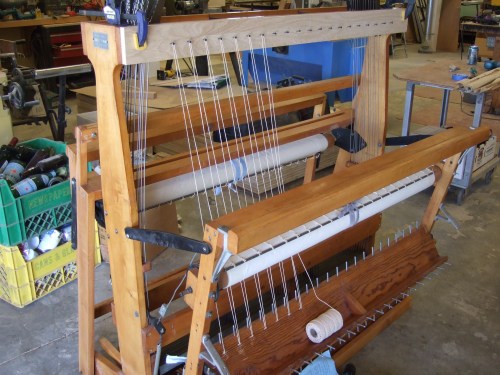
This was a good week for finishing projects.  My package finally came from Macomber with the things I needed to finish the restoration of Mother Mary’s loom.  We put the new cloth (canvas) aprons on the front beam and the plain warp beam in the back.  Then I re-strung the cords on the sectional warp beam using the materials they sent, and their instructions:

replacing sectional cords

Then we wrapped it up and put it in the cargo trailer and took it on up to its new home at the Methow Valley Spinners & Weavers guild room.  I also got 2 more reeds, a raddle and a bunch of the pedal hooks – there were only 8 pedal hooks when I got it, should be more like 64 for a loom with 16 pedals.

Now of course everyone in the guild wants to know what I am going to weave on it and if I will jump in with both feet and use all 12 harnesses on the first project… yikes!  no pressure, none at all.

I also finished 3 rugs and that was the end of the rug warp.  31 rugs since the beginning of May, and I have sold about half of them already..
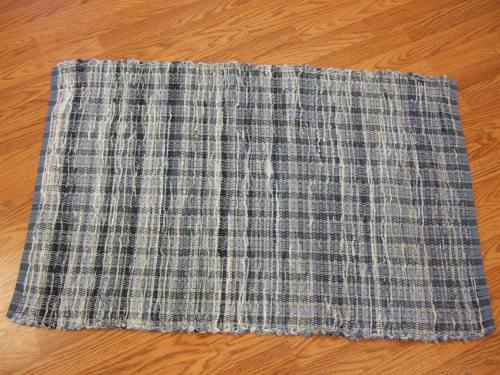
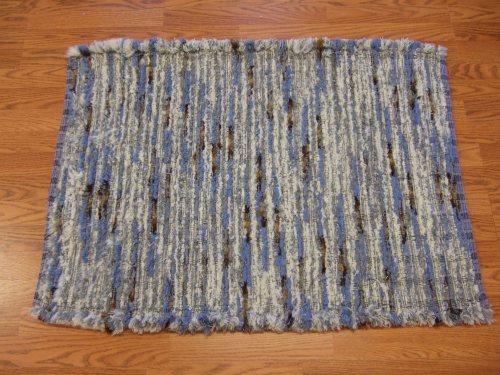
blue jeans denim rug, 28" x 41"

blue jeans denim rug, 28" x 41"

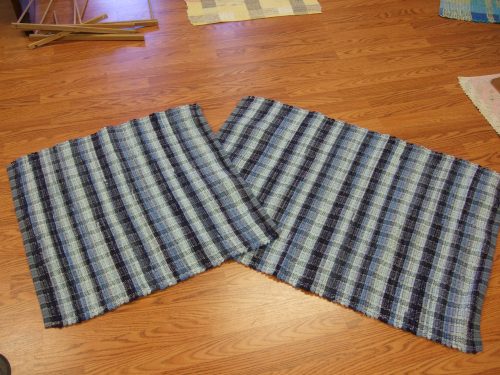
9 shades of blue cotton corduroy, 28" x 27" and 28" x 38"

9 shades of blue cotton corduroy, 28" x 27" and 28" x 38"

Yesterday I took 7 more rugs up to the Ashford Gallery in Winthrop, as they were running a little low.

I did some maintenance on my 48″ Macomber – replaced the flat steel heddles with new inserted-eye heddles I ordered a while back.  Then I gave it a thorough cleaning and lubricated the jacks.  I am planning to start another series of shawls, as they have sold all of the ones I had up at Ashford Gallery, and we have holiday sales coming up soon!

Read Full Post »

Recent Rugs #3

I have finished 12 more rag rugs in the past 2 months and thought it was time to put up a few pictures!  All of these are on the same 28″ wide warp.

Rust & tan fringed selvages, probably cotton, 42" long

Rust & tan fringed selvages, probably cotton, 42" long

Bronze, silver & chocolate fringed selvages, probably synthetics, 42" long

Bronze, silver & chocolate fringed selvages, probably synthetics, 42" long

Pendleton fringed wool selvage, 39" long (sold)

Pendleton fringed wool selvage, 39" long (sold)

The above rug was so thick and cushy (especially to bare feet!) that I decided to make another one.  I had quite a bit of that color left and just kept weaving until it was all gone.  It came out 76″ long after washing, and I think it will be great next to a bed, for example.  But I don’t have a picture of it.  I also failed to get a picture of the next rug I did after that one, which was the same thick, cushy Pendleton wool selvage material, but black with jewel tone flecks.  It came out 44″ long.

The rest of them evolved as I got into the boxes of denim and colored cotton corduroy strips.  For most of these, I pick out the colors I want to use (usually 6 or 7 colors), arrange them in a color progression I like and then sew the strips together in those repeating sequences before winding them onto the shuttles.  So the colors do repeat over and over, but not in stripes, since the length of the sequenced strips are not usually an exact match to the width of the rug.  If you get what I mean…

Green denims and corduroys, 36" long

Green denims and corduroys, 36" long

Green, teal and bright turquoise denim and corduroy, 51" long.  Reminds me of breakers coming on shore.

Green, teal and bright turquoise denim and corduroy, 51" long. Reminds me of breakers coming on shore.

Corduroy in shades of gray, arranged so there is some striping.  46" long.

Corduroy in shades of gray, also black denim, arranged so there is some striping. 46" long.

Mixed denims, dark blue through medium gray.  43" long.

Mixed denims, dark blue through medium gray. 43" long.

Now I started into the box with burgundy, brown, purple and a bright raspberry red, of which I had a lot:

Burgundy, brown, purple & raspberry denim & corduroy, 44" long.

Burgundy, brown, purple & raspberry denim & corduroy, 44" long.

Corduroy in 7 shades of purple, 36" long.

Corduroy in 7 shades of purple, 36" long.

"The leftovers" from the 2 above, lots more raspberry.  28" long.

"The leftovers" from the 2 above, lots more raspberry. 28" long.

I think I’m seeing the end of this rug warp – I have completed 28 rugs since the beginning of May and may have 5 or 6 to go, at a guess.  It’s been a blast but I am ready to do something else!

Read Full Post »

Loom tidbits and more

Holly asked about the sanding block for metal cleanup (I think, not the one for wood).  I just found it with Google under Bridge City Tools.  Specifically, it is called Sandflex Hand Block and comes in fine, medium and coarse or as a set of all 3.  There you go!

Over the weekend I was able to contact one of the previous owners of Mother Mary’s Loom.  The loom came with a copy of the Macomber catalog with their name and address on it.  A simple directory lookup gave me the phone number to try in North Bend, Washington. Very nice folks; the husband had obviously been quite fond of the loom and had made an effort to find out about it when they bought it.

The loom, built for Mother Mary in 1954,  had originally resided at Mt. Angel Seminary near Salem, Oregon.  There it had been used to weave priest’s vestments, etc.  At some point it was sold to a weaver in Puyallup, Washington.  This lady’s husband was the one who made the bench that came with the loom.  It’s a very pretty bench with some beautiful figured maple on the top.  She apparently developed some health issues that caused her to give up weaving, and she sold the loom to the folks in North Bend around the year 2000.  She has since moved to Florida and they lost track of her, so I can’t follow up that lead any further.  The folks in North Bend traded it to someone in Olympia (for a harp!) due to lack of space, and the fact that she had become fond of Leclerc looms and that is what she is using now.  The fellow in Port Orchard obtained the loom, 2-3 years ago, from the gal in Olympia also through a trade arranged through Craig’s List.

So there we have it.  I am owner number 5 since it left the Mt. Angel Seminary.

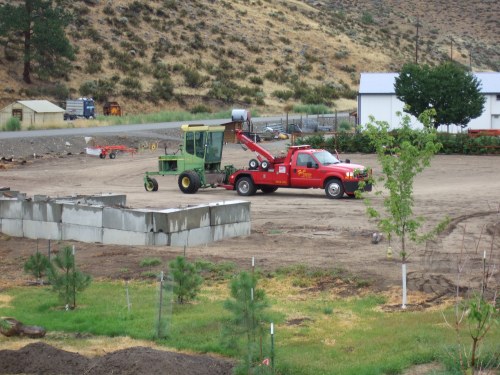
On another topic, we were very excited to see a tow truck show up next door and take away the dead car and the equally dead John Deere farm machinery (not a tractor; not sure what it was…).  They already hauled off the stock feeding stations.  They say the concrete blocks are next, and the fence will happen this year.  Keeping our fingers crossed!

bye bye John Deere thingy

bye bye John Deere thingy

Read Full Post »

Loom Restoration Project

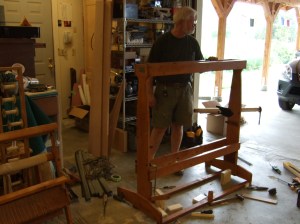
I have to admit I was a little crestfallen when I first saw the loom in Port Orchard.  It was more dilapidated and rustier than I had expected.  However, Rick’s attitude was “nothing that can’t be fixed, let’s load it up and get a move on…” so off we went.

I am fortunate to be married to a man who is a professional woodworker and all-around handy guy, and who thought it would be “fun and interesting” to help me restore the loom (his words, not mine!), and learn more about how they work in the process.

Warning: this is a long post that may be totally boring if you aren’t interested in looms.

At home in the workshop:

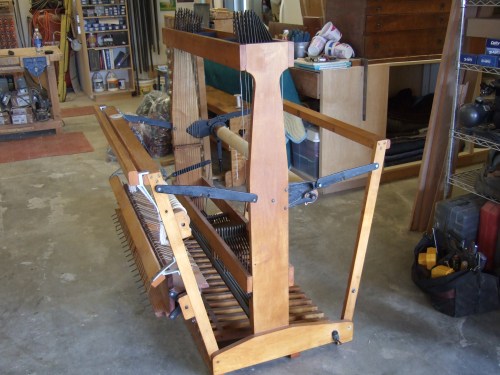
in the shop

It was dirty and just about anything on it that could rust, had done so.  We decided it was best to just take it all apart, clean it up and then put it back together.  This meant removing the front and back beams, pedals and the jack mechanisms.

Dirty...

Dirty...

Rust on the steel parts of the lower jacks

Rust on the steel parts of the lower jacks

Disassembled

Disassembled

Over the course of the next 2 days, Rick worked on the frame and jack mechanisms.  All the bolt heads were rusted so he removed and replaced them, in the course of which he found that two of the bolts were broken off inside the frame.  We think the loom must have been dropped at some point, probably during a move, as wood was split as well.  But he managed to get the broken pieces of bolt out and put it all back together again with new bolts and brass screws.  Much sturdier now!  Also one of the treadles had a piece of wood splitting away on the bottom, but he glued that back together again no problem.  He went over the frame with a sanding sponge, which cleaned off the dirt and grime and made the original varnish finish smooth and nice looking.  The upper and lower jack mechanisms had a lot of rust to be sanded off, plus the chains and S-hooks were all rusted, but these were items that are readily available at the local hardware store so we were able to replace it all with new shiny metal.

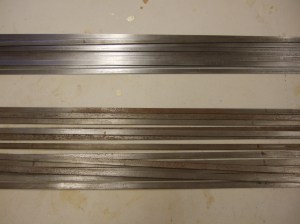
Meanwhile I worked on the rusted heddle bars, all 24 of them.  These fit into the harnesses or shafts, across the top and bottom and are what the heddles slide on (the heddles are what you thread each individual thread through, so they are raised with the harness they are threaded onto).  We developed a method for removing the rust:  first a sanding with a rough grit paper to remove the worst of it, then burnish with a wonderful little sanding sponge that is meant for cleaning metal (he got it years ago from Bridge City Tools).  Final cleanup with Tri-Flow (a rust remover and lubricant) and steel wool or fine grit paper.

Heddle bars, clean (above) and rusty (below)

Heddle bars, clean (above) and rusty (below)

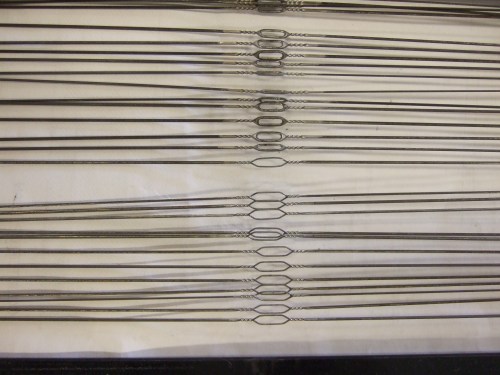
The heddles themselves must be the original ones.  I called and talked to Eddie at Macomber and they are lighter weight than the inserted-eye heddles they provide now, and they pre-date the flat steel heddles that they used for a while before changing to the inserted-eye ones.

Original heddles, lightweight inserted-eye and plain wire

Original heddles, lightweight inserted-eye and plain wire

There are about 800 of the inserted-eye heddles (with solder around the eye) and about 400 of the plain wire ones.  I found this out when I went to put them back onto the heddles bars and into the frames.  They too needed to be cleaned up, with some rust at the tops and bottoms where they slide on the bars.  I wound up using naval jelly, brushing it on liberally and then rinsing it off, drying them thoroughly, then spraying with clear silicone spray per the recommendation of Eddie at Macomber.

I also went over the 16 treadles with the sanding sponge, then put a coat of Profin on them.  Now they are pretty clean and new looking.

Reassembly of the loom:

Lower jacks all cleaned up and re-installed

Lower jacks all cleaned up and re-installed

Easier than sitting on the floor!

Easier than sitting on the floor!

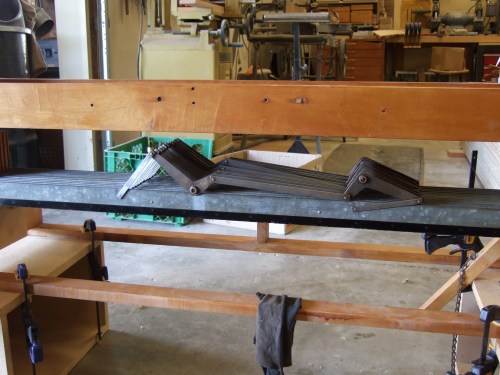
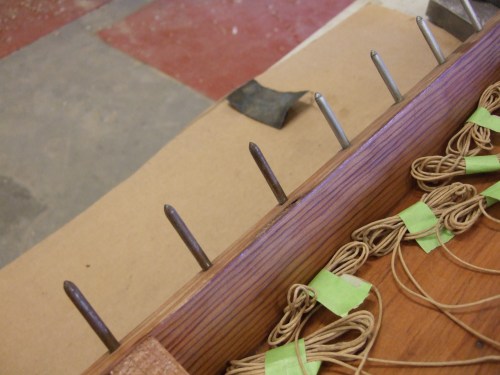
Yesterday I went to work on the sectional beam, which was (you guessed it) dirty and rusty.  I went over all the wood with the sanding sponge to clean it up, then worked down the rust on all 84 of the metal spikes that divide the sections (21 on each of 4 fins).  Grrr.  This one is a pain.

Rusty and clean sectional dividers

Rusty and clean sectional dividers

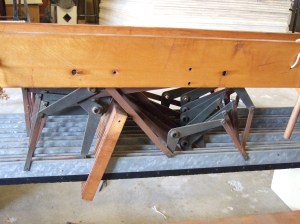
The cord on the sectional beam is shot so I have ordered a replacement kit from Macomber, along with new cloth aprons for the front and back beams.  Also the reed it came with is rusty and in my opinion, not salvageable, and somewhere along the way it lost most of the hooks that are used to connect the treadles to the lamms (see picture above, they are the crosspieces below the lower jacks) – there were only 8 hooks, and Eddie said they usually send 6 per harness, which would be 72. Fortunately, still available from Macomber.

So it won’t be all ready to go for another week or so, but we are getting there.  A labor of love.  It’s going to be worth it.

Read Full Post »

Mother Mary’s Loom

After spending a fair bit of time and effort cleaning up and trying out the Herald loom that is for sale up at our guild meeting room, I decided it just wasn’t what I was looking for, mainly because it turns out the brake mechanism isn’t original and I couldn’t get it to work properly (this is the mechanism that allows you to release the warp beam at the back to advance the warp).  Also, I am used to my Macomber loom here at home, which is so rock solid and sturdy.  So then I got to thinking, maybe I should just look for a smaller Macomber to keep up at the guild room as a “second loom.”

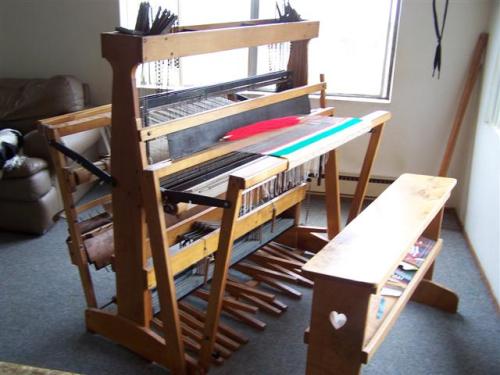
A friend had recently sent me the link for a Craig’s List search tool that lets you search all Craig’s lists within a specified mile radius of your zip code:  Search Tempest.  I was looking for a 32″ or 40″ Macomber.  There weren’t many, in fact the nearest one I found was in Colorado.  I was starting to promote a “vacation” trip to Colorado when all of a sudden a new one came up in Port Orchard, near Bremerton in western Washington.  It was a 40″ weaving width with 12 shafts (twelve!!) and 16 treadles, both a plain and sectional warp beam, a bench, a 72-spool rack and some other nice features.  Our “fearless leader” at the guild told me to GO FOR IT so I did.

The Macomber Loom company has been in business since 1936 and is still making looms back in York, Maine.  Don’t bother trying to find their website, because they don’t have one.  The closest thing you can get, and it is a good one, is the blog of a fiber artist in York, ME who is a big fan of their looms, and is also a sales rep for the company.  She lives practically next door to the workshop, and visits them frequently.  She has posted a lot of useful information and maintenance tips on her blog:  Macomber Looms and Me.  In fact, I think I will add this to my links in the sidebar.

But you can also call them directly to order parts, etc.  (207-363-2808).  They have records of just about every loom they ever made, because they are all identified with a model and serial number on a metal plate on the side of the loom.  So I called them to find out about B5-1046 before we went to Port Orchard.  Eddie there told me it was built in October 1954, the original buyer was “Mother Mary” (no record of location, though), and verified all of its original specifications – 40-inch, 12 harness, 16 treadle, sectional and plain beam, warp separator, etc.

So I am now the proud owner of Mother Mary’s loom, and in the next posts will show you how we spent this last week bringing the old girl back to life.

2009_0804Image0002

Read Full Post »

« Newer Posts - Older Posts »