Feeds:
Posts
Comments

Archive for the ‘fiberarts’ Category

Recent Rugs #3

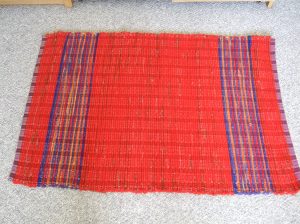
I have finished 12 more rag rugs in the past 2 months and thought it was time to put up a few pictures!  All of these are on the same 28″ wide warp.

Rust & tan fringed selvages, probably cotton, 42" long

Rust & tan fringed selvages, probably cotton, 42" long

Bronze, silver & chocolate fringed selvages, probably synthetics, 42" long

Bronze, silver & chocolate fringed selvages, probably synthetics, 42" long

Pendleton fringed wool selvage, 39" long (sold)

Pendleton fringed wool selvage, 39" long (sold)

The above rug was so thick and cushy (especially to bare feet!) that I decided to make another one.  I had quite a bit of that color left and just kept weaving until it was all gone.  It came out 76″ long after washing, and I think it will be great next to a bed, for example.  But I don’t have a picture of it.  I also failed to get a picture of the next rug I did after that one, which was the same thick, cushy Pendleton wool selvage material, but black with jewel tone flecks.  It came out 44″ long.

The rest of them evolved as I got into the boxes of denim and colored cotton corduroy strips.  For most of these, I pick out the colors I want to use (usually 6 or 7 colors), arrange them in a color progression I like and then sew the strips together in those repeating sequences before winding them onto the shuttles.  So the colors do repeat over and over, but not in stripes, since the length of the sequenced strips are not usually an exact match to the width of the rug.  If you get what I mean…

Green denims and corduroys, 36" long

Green denims and corduroys, 36" long

Green, teal and bright turquoise denim and corduroy, 51" long.  Reminds me of breakers coming on shore.

Green, teal and bright turquoise denim and corduroy, 51" long. Reminds me of breakers coming on shore.

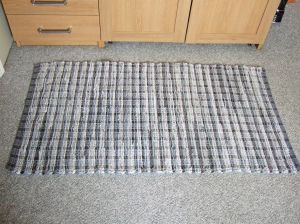
Corduroy in shades of gray, arranged so there is some striping.  46" long.

Corduroy in shades of gray, also black denim, arranged so there is some striping. 46" long.

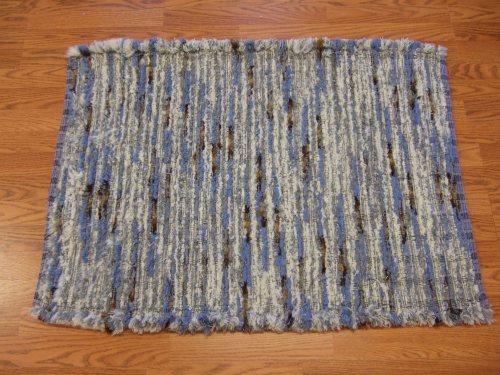
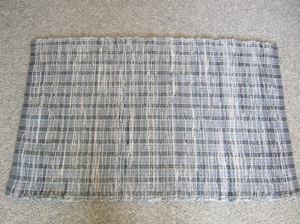
Mixed denims, dark blue through medium gray.  43" long.

Mixed denims, dark blue through medium gray. 43" long.

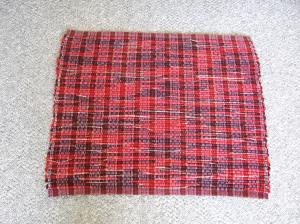
Now I started into the box with burgundy, brown, purple and a bright raspberry red, of which I had a lot:

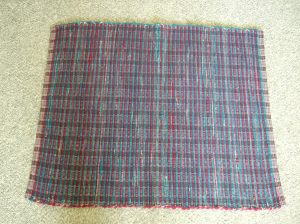
Burgundy, brown, purple & raspberry denim & corduroy, 44" long.

Burgundy, brown, purple & raspberry denim & corduroy, 44" long.

Corduroy in 7 shades of purple, 36" long.

Corduroy in 7 shades of purple, 36" long.

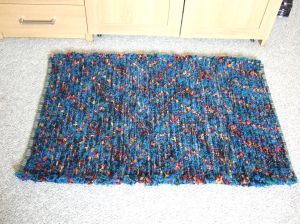
"The leftovers" from the 2 above, lots more raspberry.  28" long.

"The leftovers" from the 2 above, lots more raspberry. 28" long.

I think I’m seeing the end of this rug warp – I have completed 28 rugs since the beginning of May and may have 5 or 6 to go, at a guess.  It’s been a blast but I am ready to do something else!

Read Full Post »

Loom tidbits and more

Holly asked about the sanding block for metal cleanup (I think, not the one for wood).  I just found it with Google under Bridge City Tools.  Specifically, it is called Sandflex Hand Block and comes in fine, medium and coarse or as a set of all 3.  There you go!

Over the weekend I was able to contact one of the previous owners of Mother Mary’s Loom.  The loom came with a copy of the Macomber catalog with their name and address on it.  A simple directory lookup gave me the phone number to try in North Bend, Washington. Very nice folks; the husband had obviously been quite fond of the loom and had made an effort to find out about it when they bought it.

The loom, built for Mother Mary in 1954,  had originally resided at Mt. Angel Seminary near Salem, Oregon.  There it had been used to weave priest’s vestments, etc.  At some point it was sold to a weaver in Puyallup, Washington.  This lady’s husband was the one who made the bench that came with the loom.  It’s a very pretty bench with some beautiful figured maple on the top.  She apparently developed some health issues that caused her to give up weaving, and she sold the loom to the folks in North Bend around the year 2000.  She has since moved to Florida and they lost track of her, so I can’t follow up that lead any further.  The folks in North Bend traded it to someone in Olympia (for a harp!) due to lack of space, and the fact that she had become fond of Leclerc looms and that is what she is using now.  The fellow in Port Orchard obtained the loom, 2-3 years ago, from the gal in Olympia also through a trade arranged through Craig’s List.

So there we have it.  I am owner number 5 since it left the Mt. Angel Seminary.

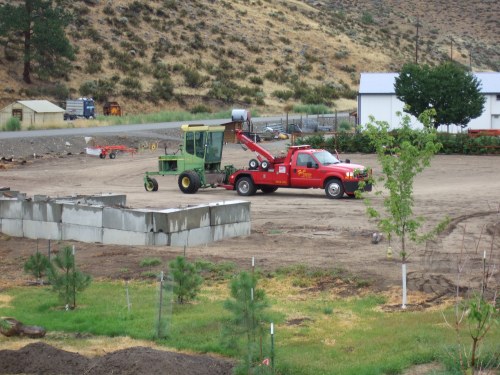
On another topic, we were very excited to see a tow truck show up next door and take away the dead car and the equally dead John Deere farm machinery (not a tractor; not sure what it was…).  They already hauled off the stock feeding stations.  They say the concrete blocks are next, and the fence will happen this year.  Keeping our fingers crossed!

bye bye John Deere thingy

bye bye John Deere thingy

Read Full Post »

Loom Restoration Project

I have to admit I was a little crestfallen when I first saw the loom in Port Orchard.  It was more dilapidated and rustier than I had expected.  However, Rick’s attitude was “nothing that can’t be fixed, let’s load it up and get a move on…” so off we went.

I am fortunate to be married to a man who is a professional woodworker and all-around handy guy, and who thought it would be “fun and interesting” to help me restore the loom (his words, not mine!), and learn more about how they work in the process.

Warning: this is a long post that may be totally boring if you aren’t interested in looms.

At home in the workshop:
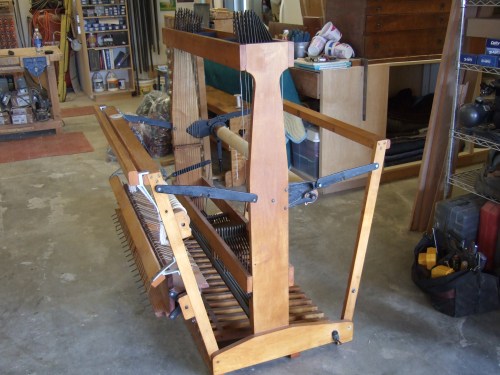
in the shop

It was dirty and just about anything on it that could rust, had done so.  We decided it was best to just take it all apart, clean it up and then put it back together.  This meant removing the front and back beams, pedals and the jack mechanisms.
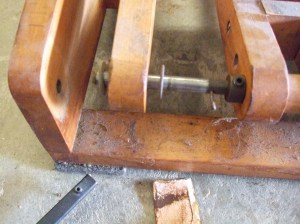
Dirty...
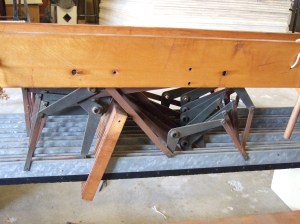
Dirty...

Rust on the steel parts of the lower jacks
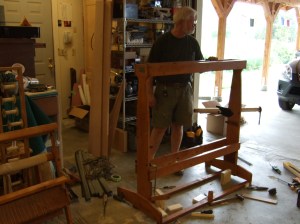
Rust on the steel parts of the lower jacks

Disassembled

Disassembled

Over the course of the next 2 days, Rick worked on the frame and jack mechanisms.  All the bolt heads were rusted so he removed and replaced them, in the course of which he found that two of the bolts were broken off inside the frame.  We think the loom must have been dropped at some point, probably during a move, as wood was split as well.  But he managed to get the broken pieces of bolt out and put it all back together again with new bolts and brass screws.  Much sturdier now!  Also one of the treadles had a piece of wood splitting away on the bottom, but he glued that back together again no problem.  He went over the frame with a sanding sponge, which cleaned off the dirt and grime and made the original varnish finish smooth and nice looking.  The upper and lower jack mechanisms had a lot of rust to be sanded off, plus the chains and S-hooks were all rusted, but these were items that are readily available at the local hardware store so we were able to replace it all with new shiny metal.

Meanwhile I worked on the rusted heddle bars, all 24 of them.  These fit into the harnesses or shafts, across the top and bottom and are what the heddles slide on (the heddles are what you thread each individual thread through, so they are raised with the harness they are threaded onto).  We developed a method for removing the rust:  first a sanding with a rough grit paper to remove the worst of it, then burnish with a wonderful little sanding sponge that is meant for cleaning metal (he got it years ago from Bridge City Tools).  Final cleanup with Tri-Flow (a rust remover and lubricant) and steel wool or fine grit paper.
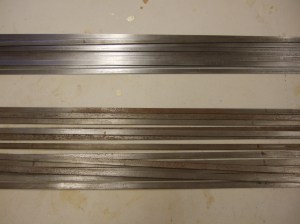
Heddle bars, clean (above) and rusty (below)

Heddle bars, clean (above) and rusty (below)

The heddles themselves must be the original ones.  I called and talked to Eddie at Macomber and they are lighter weight than the inserted-eye heddles they provide now, and they pre-date the flat steel heddles that they used for a while before changing to the inserted-eye ones.
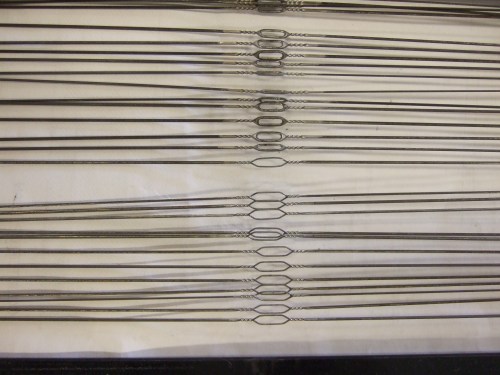
Original heddles, lightweight inserted-eye and plain wire

Original heddles, lightweight inserted-eye and plain wire

There are about 800 of the inserted-eye heddles (with solder around the eye) and about 400 of the plain wire ones.  I found this out when I went to put them back onto the heddles bars and into the frames.  They too needed to be cleaned up, with some rust at the tops and bottoms where they slide on the bars.  I wound up using naval jelly, brushing it on liberally and then rinsing it off, drying them thoroughly, then spraying with clear silicone spray per the recommendation of Eddie at Macomber.

I also went over the 16 treadles with the sanding sponge, then put a coat of Profin on them.  Now they are pretty clean and new looking.

Reassembly of the loom:
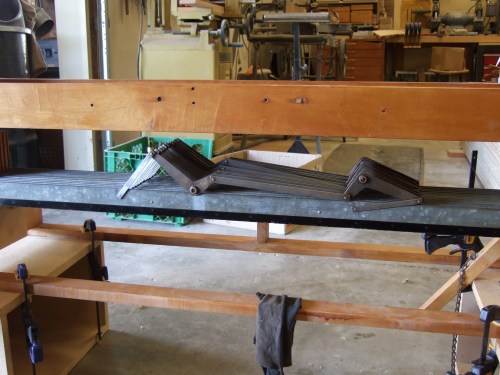
Lower jacks all cleaned up and re-installed
Lower jacks all cleaned up and re-installed

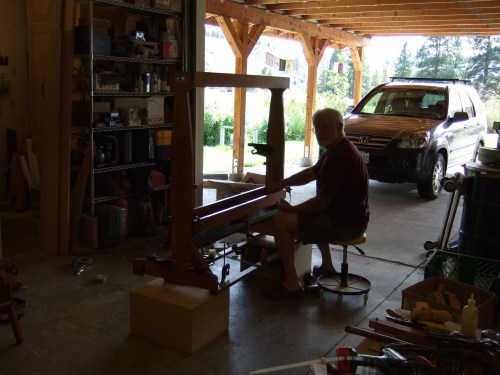
Easier than sitting on the floor!

Easier than sitting on the floor!

Yesterday I went to work on the sectional beam, which was (you guessed it) dirty and rusty.  I went over all the wood with the sanding sponge to clean it up, then worked down the rust on all 84 of the metal spikes that divide the sections (21 on each of 4 fins).  Grrr.  This one is a pain.
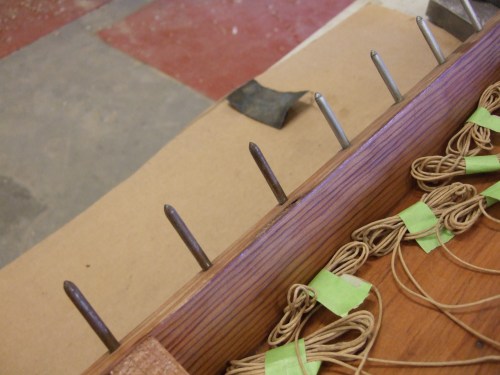
Rusty and clean sectional dividers

Rusty and clean sectional dividers

The cord on the sectional beam is shot so I have ordered a replacement kit from Macomber, along with new cloth aprons for the front and back beams.  Also the reed it came with is rusty and in my opinion, not salvageable, and somewhere along the way it lost most of the hooks that are used to connect the treadles to the lamms (see picture above, they are the crosspieces below the lower jacks) – there were only 8 hooks, and Eddie said they usually send 6 per harness, which would be 72. Fortunately, still available from Macomber.

So it won’t be all ready to go for another week or so, but we are getting there.  A labor of love.  It’s going to be worth it.

Read Full Post »

Mother Mary’s Loom

After spending a fair bit of time and effort cleaning up and trying out the Herald loom that is for sale up at our guild meeting room, I decided it just wasn’t what I was looking for, mainly because it turns out the brake mechanism isn’t original and I couldn’t get it to work properly (this is the mechanism that allows you to release the warp beam at the back to advance the warp).  Also, I am used to my Macomber loom here at home, which is so rock solid and sturdy.  So then I got to thinking, maybe I should just look for a smaller Macomber to keep up at the guild room as a “second loom.”

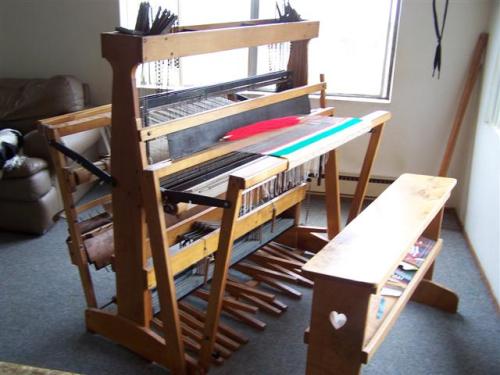
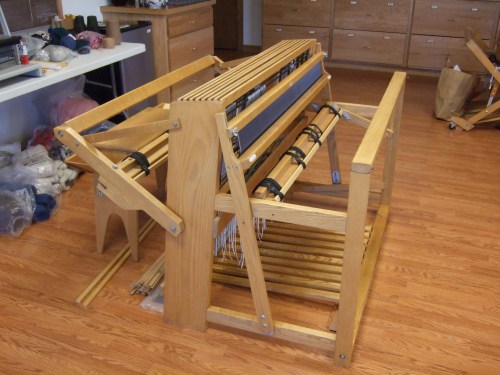
A friend had recently sent me the link for a Craig’s List search tool that lets you search all Craig’s lists within a specified mile radius of your zip code:  Search Tempest.  I was looking for a 32″ or 40″ Macomber.  There weren’t many, in fact the nearest one I found was in Colorado.  I was starting to promote a “vacation” trip to Colorado when all of a sudden a new one came up in Port Orchard, near Bremerton in western Washington.  It was a 40″ weaving width with 12 shafts (twelve!!) and 16 treadles, both a plain and sectional warp beam, a bench, a 72-spool rack and some other nice features.  Our “fearless leader” at the guild told me to GO FOR IT so I did.

The Macomber Loom company has been in business since 1936 and is still making looms back in York, Maine.  Don’t bother trying to find their website, because they don’t have one.  The closest thing you can get, and it is a good one, is the blog of a fiber artist in York, ME who is a big fan of their looms, and is also a sales rep for the company.  She lives practically next door to the workshop, and visits them frequently.  She has posted a lot of useful information and maintenance tips on her blog:  Macomber Looms and Me.  In fact, I think I will add this to my links in the sidebar.

But you can also call them directly to order parts, etc.  (207-363-2808).  They have records of just about every loom they ever made, because they are all identified with a model and serial number on a metal plate on the side of the loom.  So I called them to find out about B5-1046 before we went to Port Orchard.  Eddie there told me it was built in October 1954, the original buyer was “Mother Mary” (no record of location, though), and verified all of its original specifications – 40-inch, 12 harness, 16 treadle, sectional and plain beam, warp separator, etc.

So I am now the proud owner of Mother Mary’s loom, and in the next posts will show you how we spent this last week bringing the old girl back to life.

2009_0804Image0002

Read Full Post »

Blogging is lagging behind the actual living of life, this week.  It’s been a busy one.  I will try to catch up over the weekend!

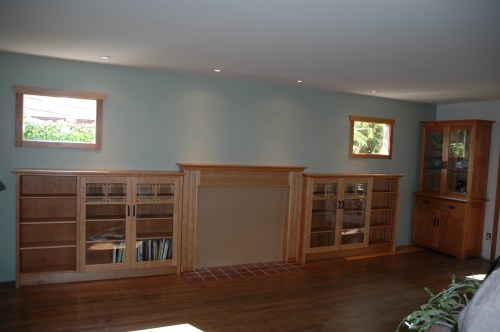
A week ago we went down to Vancouver, WA towing the new cargo trailer with cabinets for our friends’ living room remodel.  Rick spent much of the weekend installing cabinets and trimming out windows and doors:

DSC_0179

Here’s a shot from before the remodel – quite a difference, eh?

P7260002

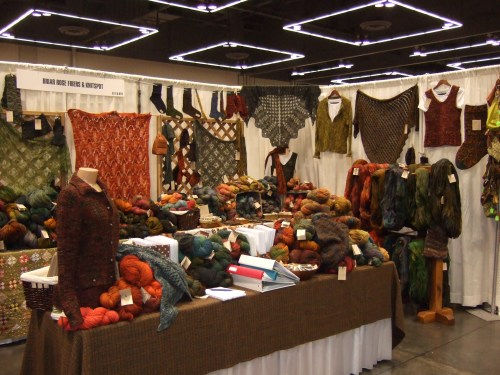
Meanwhile, I went off to Portland, OR on both Saturday and Sunday to visit the Sock Summit at the Oregon Convention Center.  A lot of my Seattle friends were there, and one from Omak too!  This thing was huge and featured many famous names in the worlds of knitting, spinning and dyeing including some who rarely, if ever, come to conferences of this size (Barbara Walker, Meg Swansen, Priscilla Gibson-Roberts, Anna Zilboorg).  I had not pre-registered and did not take any classes, but just wandered happily around the marketplace with 150 vendors, many of whom were small dye houses with beautiful and unusual yarns and spinning fibers.  I also attended the Luminary Panel at the end of the day on Sunday, which was a not-to-be-missed opportunity to hear commentary and reminiscences from nine fabulous women who have certainly been inspirations to me over the past 25 years.

Brier Rose

Brier Rose

Sock Summit Market - tip of the iceberg

Sock Summit Market - tip of the iceberg

The Sanguine Gryphon

The Sanguine Gryphon

Too big to take pictures of really!

On the way home on Monday, being blessed with an empty cargo trailer, we stopped in Port Orchard where I bought a new (old, actually) loom which I found on Craig’s List last week.  More on this in a later post!

Read Full Post »

Dye Days in Preston

Last weekend I went over to the coast for a fiber dyeing workshop out in Preston.  The goal was to create a notebook of dye samples using Judith MacKenzie McCuin’s dyes (“Mother MacKenzie’s Miracle Dyes”).  These are professional quality acid dyes used to dye protein fibers – “acid” means they require a slightly acidic solution to work, not that they are acidic themselves.  Once in solution, they have no demonstrated health risks and require only common household vinegar and no other additive chemicals to work.  So these are the dyes I have been using myself, but faced with bottles of stock solution of the 9 basic colors, it is often hard to figure out how to get started in creating the colors I want for a particular project.

The idea was for each workshop participant to choose a selection of 3 of the 9 colors and then dye 36 samples with ratios of each color varying in increments of 10%.  This would show the range of colors possible using those 3 dyes, and as a bonus each of those colors seem to work well with each other, so it makes it easy to set up a palette for a dye project.

The leader of the workshop was extremely organized and had our workstations set up with fiber ready to dye, the stock solutions all mixed up, and any other tools we needed besides the bowl we each brought to mix colors in.  We had a chart that showed the 36 combinations and how much dye to measure out for colors A, B and C for each combination (plus water and vinegar) for the amount of fiber in each bundle.

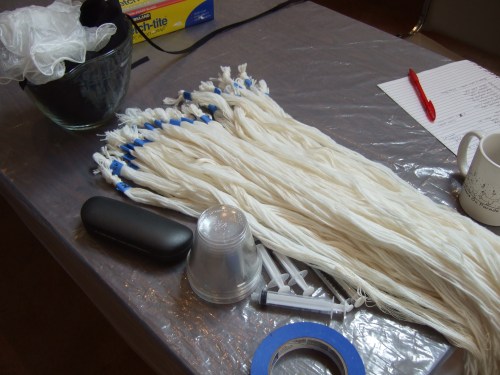
dye sample skeinsThe fiber bundles contained 12 strands each of Cascade 220 (a basic wool knitting yarn), a laceweight wool/silk and a fine spun silk.  Each type of fiber takes up the dye a little differently.

Here we are spending the first day measuring out dye, water and vinegar, immersing our little bundles and mushing them around, wrapping them in plastic wrap ready to be steamed (the heat sets the dye).

dyeing the samplesAfter the bundles were steamed and cooled, we had to unwrap them and rinse them 3 times, then hang them to dry.

dye samples dryingYou think that was a repetitive task?  But wait, there’s more!  The next day we spent taking apart each bundle and tying 3 strands (one wool, one silk/wool and one spun silk) of each color onto 10 pre-printed cards.

dye samples pagesThis was a task that did not get finished.  I have some here at home that I am still working on, but eventually we will all get the finished cards with everyone’s samples.
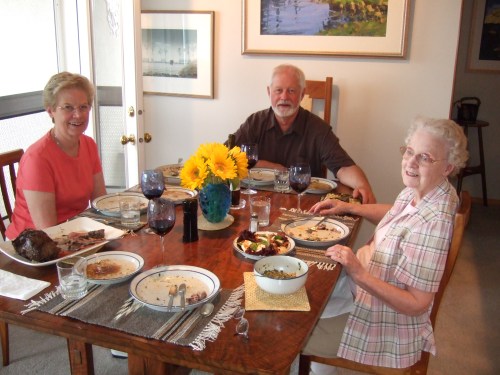
Its was a great group of women, some of whom I have known for years, so as we sat there muttering “2.7 cc’s cyan, 0.5 cc’s magenta, 3.6 cc’s prime yellow” or the equivalent, we also enjoyed wide ranging conversations and lots of laughter.  Plus delicious potluck lunches.  And cookies.

Read Full Post »

We had a 4-day, 3-night visit to The Coast last weekend, a busy and sociable visit.  On the way over on Friday, we had dinner with old friends from Seattle who have built a new home at Suncadia, a planned development and resort near Roslyn on the east side of Snoqualmie Pass.  Their home is beautiful, particularly the tile work in the kitchen and bathrooms which they did themselves – it’s very individualistic and professional looking.

On Saturday we shopped for the dinner I was cooking that evening, which was a joint birthday celebration for Rick and his sister (they are 4 years and 4 days apart in age).  Here they are after having done justice to the roast lamb and accompaniments, including a lot of veggies from our own garden this year:

Kathy's 65th bday

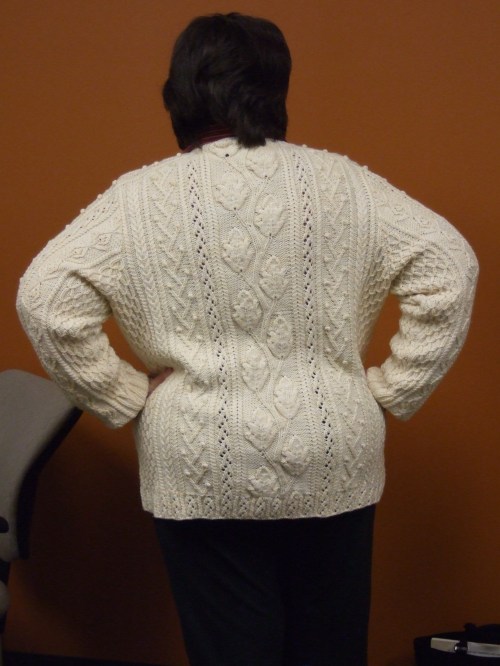
Sunday was for knitting (for me anyway) with a group of friends who meet once a month.  I haven’t made it for the last 2 months, so it was great to see everyone.  Sarah had finished a beautiful Aran cardigan which she designed herself:

Sarah's Aran 2

Later that day I delivered 2 of my rag rugs to someone who had ordered them for her kitchen and then we dashed to the ferry to Bainbridge Island to have dinner with our friends who have just come up for summer break from southern California.  They keep a sailboat at the Eagle Harbor marina and live aboard when they are up in the Northwest.

Monday was for errands and business meetings, then lunch at Seattle’s Uwajimaya and a bit of book shopping at Kinokuniya Bookstore (Japan’s largest bookstore chain specializing in Asian language books).   I found a book I was looking for with interesting, rather free-form clothing that could be adaptable to handwoven fabrics – of course it is all in Japanese, but the schematics are good and it includes the patterns in an insert.

Then we were off homeward in the afternoon, arriving about 7 pm, back in the valley again.  Always glad to be home!

Read Full Post »

Recent Rugs #2

I’ve been trying to weave 3 rugs a week on average, otherwise I will have that rug warp on the Macomber forever!  So here is the recent output.  In all cases, I am indicating the weft material in the captions (the warp, which runs lengthwise through the rug, is mostly covered by the weft, which is what I am weaving with).  This round was all wool, but some were woven from strips I cut from fabric remnants, and others were the selvages that Pendleton calls “worms”.  These appear to have been a kind of rolled edge, and are trimmed off the sides of Pendleton blankets before they sew on the final edge trim.  So they have all the colors of the blanket as they appeared lengthwise.  When I get these they are all in a jumble and often dirty and dusty as well – sorting them out is a big and dirty job!

Pendleton wool fabric, cream/tan/black

Pendleton wool fabric, cream/tan/black

Pendleton blanket edge selvage ("worms") - made 2 alike

Pendleton blanket edge selvage ("worms") - made 2 alike

Pendleton wool fabric: "Vintage Cabin" print

Pendleton wool fabric: "Vintage Cabin" print

Pendleton wool fabric: rich brown/ red/green vintage print

Pendleton wool fabric: rich brown/ red/green vintage print

Pendleton blanket edge selvage, brick reds, made two alike

Pendleton blanket edge selvage, brick reds, made two alike

Read Full Post »

Under consideration

For some reason, I haven’t been taking too many pictures lately.  On the other hand, a lot of what we have been spending time on doesn’t seem really picture or blog worthy.  I mean, how interesting could it be to see a picture of us mowing the (very big) lawn, planting shrubs, watering the field, or weeding the garden?

However, I am considering buying another loom, so here is a picture:

Herald loomIt’s a Herald loom – they were built in Lodi, Ohio and the company is no longer in business.  I haven’t been able to find out too much about them on the internet.  The current owner lives up the Twisp River, and she bought it from someone on Whidbey Island.  It is a 48″ wide, 8-harness jack loom and some of the other women in my guild have given it good marks.  Apparently it has some features in common with Gilmore looms.  It is currently residing at our guild room, and if I do buy it that is where it will have to stay, as I certainly have no room for another large object here!  It needs some TLC – last week I made 80 new tie-up cords out of Texsolv for the treadles, and have started giving it a good cleaning and waxing.  I hope to get a warp on it by next week and see what it feels like to treadle, how good a shed it makes (the space you need to throw the shuttle through), etc.
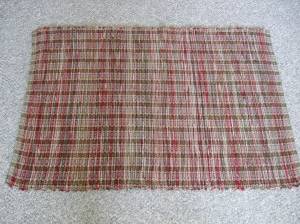
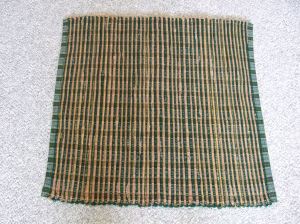
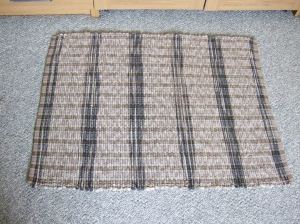
Here at home on the Macomber, I have been steadily weaving away on “rag rugs”, trying to build up some inventory and work my way through the large amount of fabric and mill-end selvage material I bought with the loom 2 years ago.  So, a gallery of recent rugs:

wool blanket cut into strips

wool blanket cut into strips

wool blanket, each side a different color, cut in strips

wool blanket, each side a different color, cut in strips

wool blanket, each side a different color, cut in strips

wool blanket, each side a different color, cut in strips

wool flannel, purple and red

wool flannel, purple and red

bright red wool blanket and accent stripes

bright red wool blanket and accent stripes

Blue jeans denim

Blue jeans denim; that's a shadow, not dirt (I hope)

5 shades of denim in repeating sequence

5 shades of denim in repeating sequence

Pendleton blanket fringed selvage

Pendleton blanket fringed selvage

Read Full Post »

Weaving with Judith

Here’s what I was doing for 5 days last week:

weaving at Suzanne's

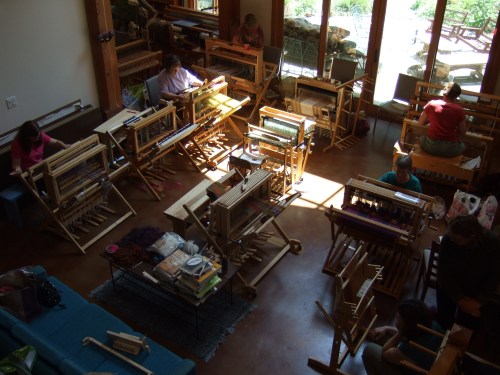
A weaving workshop with Judith MacKenzie McCuin and 10 other lucky souls.  This was my second year and I was pleased to find how much I have learned in the past year and how much better I was able to absorb new information.  That’s my little portable “Baby Mac” out in the middle of the floor with the sunshine falling on it (Macomber model CP, 20″ weaving width and 8 harnesses).  I chose a 4-color shadow weave project this year, and there were plenty of challenges and mistakes along the way – we call these “learning opportunities”!

The format is quite open.  Everyone does their own thing and gets Judith’s help with whatever that is.  So we can all learn from each other’s challenges and mistakes… er, learning opportunities.

Along the way, we learned a neat way to wind a warp from novelty and leftover yarns, Judith gave us a lecture on “Towel 101” (bath towels, not kitchen towels), and she always has some dye pots going in the back yard, so people were out there dyeing warps and whatever else came to hand.  Lots of fun!

Yes, it would have been nice to have more than a week between this and the conference in Spokane.  But there was no way I was going to miss this one… no way!

Lisa's waffle weave towels in natural colored cotton

Lisa's waffle weave towels in natural colored cotton

Batsy's double-sided rug for her new kitchen

Batsy's double-sided rug for her new kitchen

Robin's color-and-weave towels

Robin's color-and-weave towels

Linda's "Hempathy" (hemp-blend) towels

Linda's "Hempathy" (hemp-blend) towels

Read Full Post »

« Newer Posts - Older Posts »