Feeds:
Posts
Comments

Archive for the ‘fiberarts’ Category

Six More Shawls

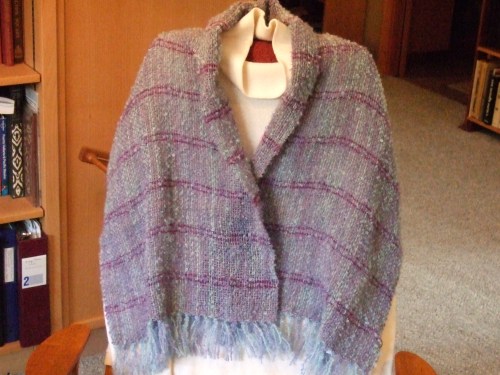
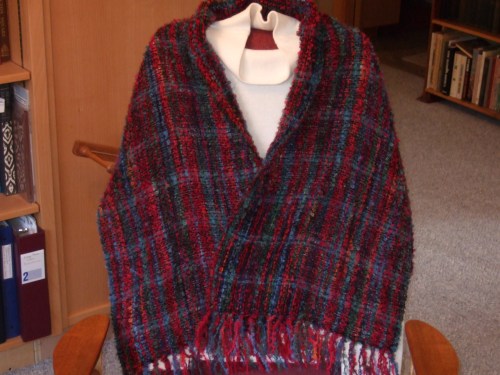
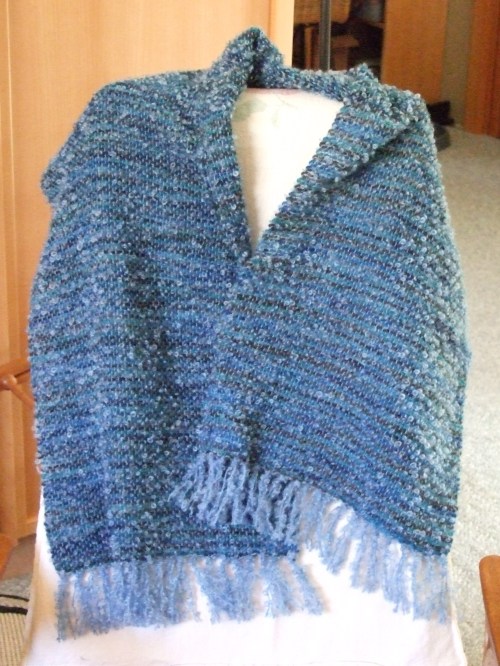
I’m heading into the home stretch, trying to build up some inventory for our annual guild sale next weekend.  I finished up six more shawls this week.  These are woven with handpainted boucle yarns from New Zealand for the warps, and none of them will be repeatable because the dyer sold her business and these colors have now been discontinued.  For the weft, I used various colors of wool or alpaca yarn, except the accent stripes are done with fine kid mohair/silk yarns.

Blue/mauve boucle with mauve wool weft

Blue/mauve boucle with pale lavender Shetland wool

blue+mauve 1

Blue/mauve boucle with mauve wool weft

Arctic+Paua black alpaca

Deep blues with black alpaca weft

Arctic+Paua brown alpaca

Deep blues with rich brown alpaca weft

Lollipop blue wool

"Lollipop" boucle with dark teal wool weft

Lollipop black alpaca

"Lollipop" boucle with black alpaca weft

As you can probably tell, I am getting two shawls from each warp put on the loom, but am mixing it up a little (and making it more interesting for me) by using different colors or fibers in the weft.  I’m also experimenting with making some shawl pins, since I like to wear these pinned shut at the front, leaving my arms free – sort of like wearing a vest.

Read Full Post »

Returned from Redlands

Well, let’s see – when last we met, I was off to my annual knitting retreat.  This was very fun, as expected, although getting there turned out to be a bit of an experience.  In fact, I almost titled this post “Katie & Diana’s Excellent Adventure.”  We drove over the North Cross Highway (Hwy 20 through the North Cascades National Park), which had recently received some new snow but was well plowed and an easy drive.  The mountains, with their fall color and new snow, were stunning.  We drove down Whidbey Island, intending to catch the 3:00 ferry across to Port Townsend – we even had a reservation!  Five minutes after we got in line, they announced the ferry had broken down and would be out of service until the next day.  Aargh!  We had to drive to the south end of Whidbey, cross to the mainland at Mukilteo, drive down to Edmonds (hello, Seattle-area traffic…) and cross back over the Sound to Kingston.  It was about 6 pm and dark by the time we passed through Port Gamble on our way to the Hood Canal Bridge.  What’s that flashing sign??  The bridge was open to let a barge through and there was another half hour wait. By this time we were laughing hysterically and I called Rick to fill him in… he said they were probably letting through the boat that had the part to fix the Keystone ferry.

On our way home we stopped in at The Artful Ewe in Port Gamble, where Heidi Parra has her beautiful hand-dyed yarns and spinning fibers (she carries no commercial lines, it is all her own stuff and it is fabulous).  Heidi has just opened a weaving studio two doors down from the yarn shop.  It has two Bergman looms and some others as well, and is decorated beautifully with items from her art and textile collections.

Artful weaving 1

Artful weaving 2

Heidi was pretty excited about this 16-harness AVL loom that she had recently purchased (used) and had just gotten hooked up to the computer:

Artful weaving 3

The woman is amazing.  She turns out the most beautiful dyed fibers and in such quantity.  Somehow she has more hours in her day then I can ever seem to find in mine!

Back in the valley, I wove 4 more shawls (pictures to come) and generally picked up the threads of normal life for a few days.  Then we were off to Redlands, CA for the weekend, to visit our good friends who are down there working in San Bernardino until the day they can return to Bainbridge Island.  They just bought a home in Redlands, a 1920’s era Spanish Revival, which is lovely, with gracious and generously sized rooms:

1920's Spanish Revival house

Redlands is quite a pretty town, with many wide palm-tree lined boulevards, and older neighborhoods chock full of huge Victorian and Craftsman style homes.  Here are just a couple I saw while out on a walk:

Redlands 1Redlands 2

Coming from the valley where winter is on the way, it was quite nice to experience temperatures in the 70’s again, sitting outside barefoot in the sun.  Thank you, dear friends!

SS new home

Read Full Post »

Off to Knitting Retreat!

Just a quick post today, as I am going off tomorrow for the knitting retreat at Fort Worden, near Port Townsend.  This is an event I have attended for over 20 years.  Now that we have moved away from Seattle, it is even more important to me to spend this time with some of my longtime friends, as well as other people who come from all over who I only see there once a year.  There are no classes, it’s just 5 days of knitting, talking, eating, going for walks into town or down to the beach, laughing and generally having a good time with like-minded souls.  Not to mention hitting all the local yarn shops!

I have been invited to a baby shower the first weekend of November, which I can’t attend as we are going to California for a quick visit with good friends.  But I did want to come up with a nice gift for this little one (we already know it is a girl) as we are friends with the parents, both sets of grandparents, an aunt and cousins.  I was rummaging around in one of the closets and discovered this:

Baby Surprise Jacket 1

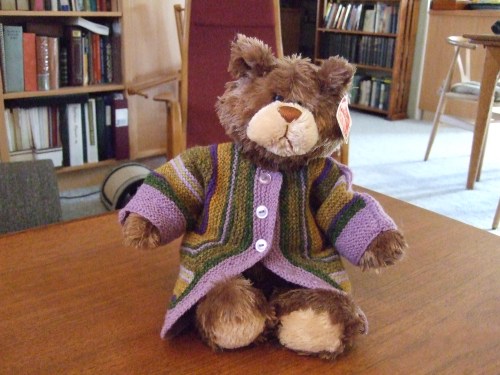
It’s a Baby Surprise Jacket that I knit maybe 3-4 years ago, using leftover bits of Shetland 2-ply wool.  It needed only a few ends darned in and the buttons sewn on to be done – DONE, I say!  This was the first of several I knit back then, and it came out a wee bit small, which means it can’t be worn by the intended recipient for very long.  Which is why I also had a Gund teddy bear ready to take over:

BSJ on bear 2

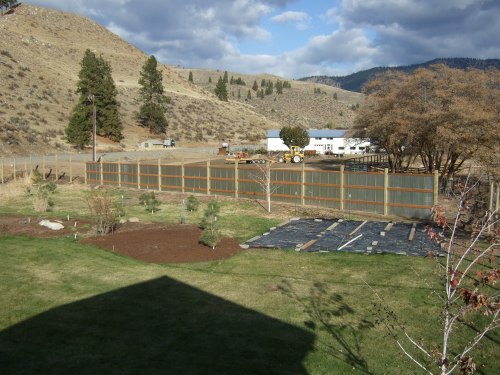
On the home front, the back fence is nearing completion:

back fence 10-27-09

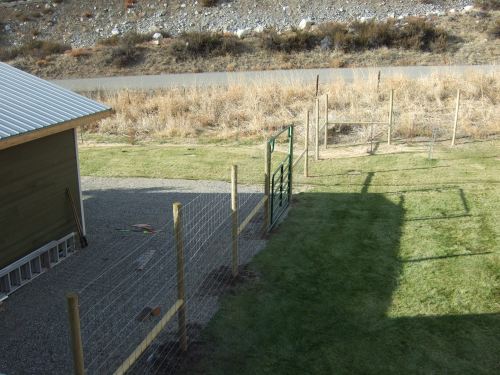
and our new deer fence is basically in, needing only the man-gates which they are making off site; when they come to install those they will also finish installing the green farm gate we bought to accomodate the tractor going in and out.  So it looks like our back yard will be deer-proof by winter!

deer fence 10-27-09

Read Full Post »

Tomten sleeve cap challenge

This will be a long, geeky knitting post, just as a warning to those of you in my small audience who could care less! Also, see update at bottom of post **

As mentioned earlier, I have been working on the Adult Tomten Jacket by Elizabeth Zimmermann, for me and using some of my handspun yarn.  This pattern can be found in several Zimmermann books:  The Opinionated Knitter, Knitting Without Tears, Knitting Workshop.  It started out as a baby jacket and therefore the adult version is rather large and boxy, with its signature feature perhaps being the very deeply set in sleeves.

I had found a nice discussion of modifications for a better fit on Jared Flood’s blog, “Brooklyn Tweed.”  He has a lot of excellent photos and some discussion, but not everything he did is spelled out – which is fine, he put a lot of work into that blog post as it was, and a knitter doesn’t have to give away every little secret!

I wanted to incorporate a shaped sleeve cap from the top down, as Jared had done.  The basic method is described in Barbara Walker’s excellent book Knitting from the Top, now back in print thanks to Meg Swansen (Elizabeth Zimmermann’s daughter and a prolific designer, teacher and writer herself) at Schoolhouse Press.

The problem that comes up in this instance is thus.  Normally, you figure out how big around you want the sleeve and therefore how many stitches you should have on the needle once you end the sleeve cap and have arrived at your upper arm.  Using the Zimmermann/Swansen EPS method, that means 35% to 40% of your body stitches for a good fit in that area.  So that is the number of stitches you would normally pick up around the armhole to begin the sleeve cap, after subtracting the number of stitches left on a holder for the underarm.  But this is a garter stitch jacket (garter stitch – knit on both sides, 2 rows makes a “ridge”).  Garter stitch has a compressed row gauge compared to stockinette stitch, so that the number of ridges per inch lengthwise is the same as the number of stitches per inch widthwise.  So you  have to pick up one stitch per ridge around the armhole or the sleeve fabric will not lie flat.  This means you will have way more stitches than you really want in your sleeve at the upper arm.

Using my gauge and my size, I have 152 body stitches so I would like to have 53 to 61 stitches at the upper arm.  I have 38 ridges on both sides of the armhole and will add one stitch for a “phoney seam” at the top of the sleeve.  I have left 8% of the body sts on holders for the underarm (12 sts).  So I will have to pick up 38 + 1 + 38 = 77 sts around the armhole.  Add the 12 underarm sts and I will have 89 sts in the sleeve at the outset of cap shaping.  So I need to get rid of a whopping 28 to 36 sts somehow while shaping the sleeve cap.

I study Jared Flood’s photos and observe:  (1) a line of paired decreases running down the top of the sleeve (this is the way the pattern is written, too), (2) it looks like he started those decreases up above the sleeve cap, in the top part of the sleeve that is so deeply set in that it is actually part of the body, and (3) there appears to be a little triangular gusset on both sides of the underarm area at the end of sleeve cap shaping.  Hmm, what’s that last thing?  Curious.

So I rip the first 13 ridges of the top of the sleeve back, and add 4 paired decreases every 3 ridges.  This takes out 8 stitches so I am down to 69 + 12 UA (underarm) sts at the beginning of cap shaping.  It also adds a shoulder slope which is always a good idea.  Now all of a sudden the reason for the triangular gusset becomes clear.  If done with short rows over 6 ridges, it can consume the rest of the underarm stitches (6 on each side), but the needed underarm space is still provided by the curve of the line along that gusset.  If I get rid of the 12 underarm stitches at this point, I am already down to 69 sts only at the beginning of cap shaping, and if I continue decreasing in pairs every 3 ridges while I knit the cap, it comes out just right at the end with 55 sts remaining.  Hooray!
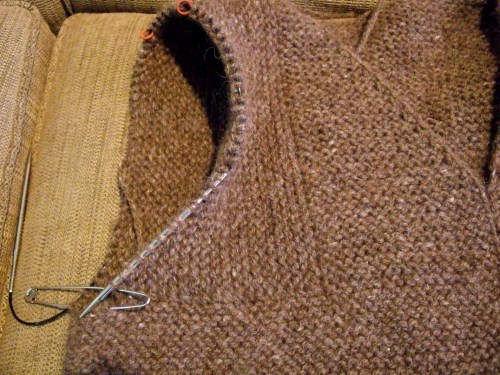
Sleeve top and one underarm gusset completed

Sleeve top and one underarm gusset completed

Here’s a low-tech drawing:
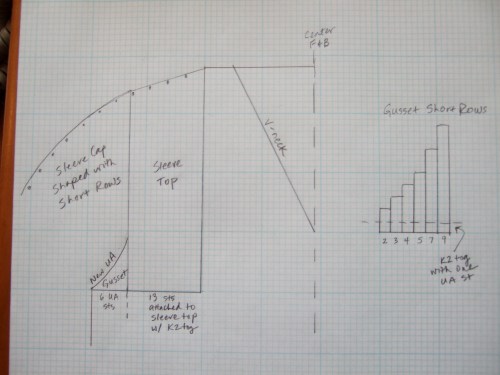
layout for underarm gusset and shaped sleeve cap

layout for underarm gusset and shaped sleeve cap

And here is the sleeve cap, shaped with short rows per Barbara Walker’s instructions:
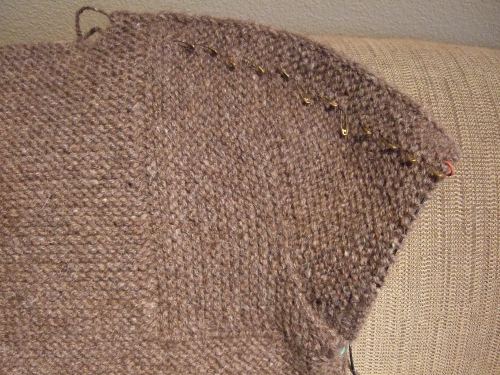
Finished sleeve cap
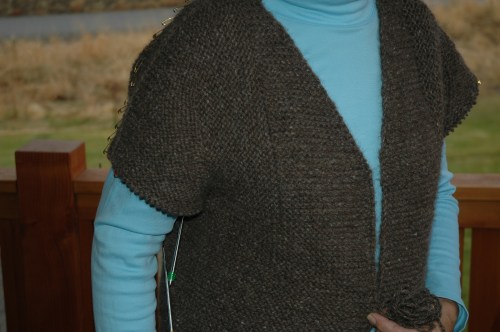
Finished sleeve cap

sleeve cap try-onAnd the try-on:  it fits beautifully and I am most pleased!

** Nov. 11, 2009 update:

I wrote to Jared Flood about a week before proceeding with the above, and bless the man’s heart, he did write back to me on Nov 5th.  He said he did not actually make an underarm gusset, but did shape some stitches next to the underarm stitches to try to mimic a set-in sleeve armhole rather than just leaving it square.  So it looks like I may have “unvented” something with the gusset, but I am still happy with that as another approach.

Read Full Post »
We drove across the North Cross Highway (North Cascades, Hwy 20) to Anacortes this week, to bring our camping trailer over for winter storage at my folks’ house, and have a nice visit with them.  It was a rainy day, but the colors were good up in the high country:

North Cross Fall 2009

Such a pretty picture, I have taken a bit of it for my new header image – the autumn theme.

It was heartening to see the colors, because the early freeze of a few weeks ago seems to have stopped most of the trees in our valley dead in their tracks.  They are mostly turning… brown.  No other word for it.  We usually have a lot more color this time of year.

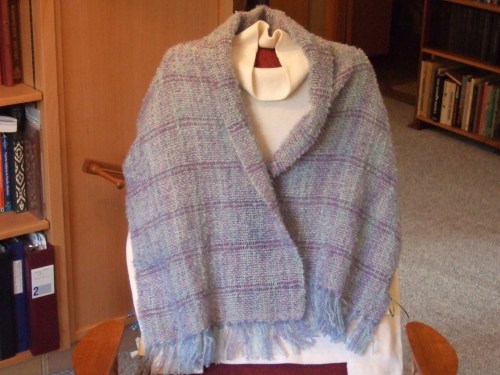
I have finished up seven shawls and have warp prepared for six more.  I am experimenting with making more of a “shoulder shawl” – a little narrower and shorter than the previous series, and meant to be worn more like a vest with perhaps a shawl pin to hold it closed.

There are three alike from a sky blue mohair boucle woven with hand-dyed multi-colored wool in the weft:

Sky blue boucle with black alpaca, 3 alike

Sky blue boucle with hand-dyed wool, 3 alike

For another two I used a multi-colored mohair boucle, hand-dyed with mainly blues and greens -both have a greyish blue wool weft, but I used different colors of kid mohair/silk for the accent stripes:

Bluegrass with turq stripesBluegrass with pear stripes

And for these last two I used another hand-dyed mohair boucle, in a new colorway called “Schist” that has lovely tones of grey, gold and black.  For one I used the greyish blue wool for weft, with deep gold accent stripes.  For the other I used black alpaca for weft, with a dark bronze accent stripe.

Schist with blue woolSchist with black alpaca

These have been somewhat of an exercise in frustration, since it turns out the hand-dyed mohair boucle yarns I am using for the warps do not have consistent amounts of yarn in the skeins.  But after some trial and error I have concluded that getting the length right is what matters the most, and if they aren’t all the same width, then so be it.

I leave you with a picture of Teasel and Pushkin, who love to follow the sun around wherever it falls into the house during the course of the day:

Teasel Pushkin 10-24-09

Read Full Post »

Fall is here.  I love this time of year.  We are still having temperatures in the mid-60’s during the day, low 30’s at night.  The trees are starting to turn.  We have been over to the coast twice, each of the last 2 weekends, and the drive over the mountains gets lovelier every time we cross over.  I am actually starting to wear sweaters in the evenings.

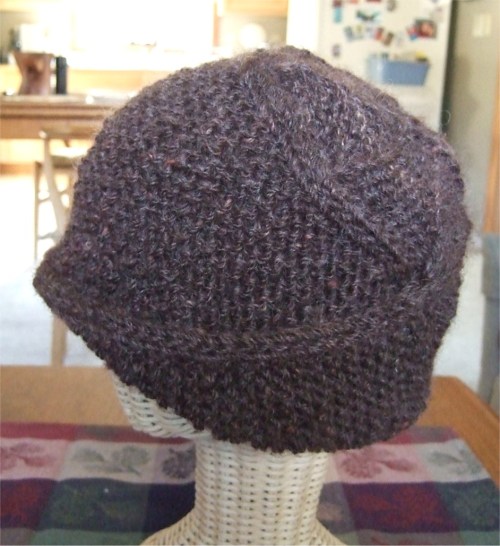
I can also tell it is Fall because all of a sudden I want to start knitting projects.  I bought a couple of pattern booklets at Weaving Works when in Seattle and have knit a hat using some of my handspun yarn:

"Quincy" hat by Jared Flood

"Quincy" hat by Jared Flood

The pattern is by Jared Flood from his new book called “Made in Brooklyn”.  The yarn was a 3-ply I spun from a Lincoln x Romney cross (brown color) blended with a little mohair dyed orange.  I bought the batts from the breeder at a NW Regional Spinners conference a couple of years back.  My friend Carol fell in love with the hat last weekend so now it is hers!  It was a quick knit and I will definitely do another one, if not several more (p.s. you do need to know how to do a provisional cast on, and garter stitch grafting; the pickup of stitches for the crown, off the continuous edge of a Mobius strip, is a little unusual but not hard once you understand what is going on).

I have also started the classic Elizabeth Zimmerman pattern, Tomten Jacket, for me – also using handspun.  This is a garter stitch jacket with optional hood.  I am using a 3-ply yarn I spun from a “cleaning out the mill at the end of the season” blend I got from Stonehedge Fiber Mill about 4 years ago.  It is a blend of wool, alpaca and silk.  The above-mentioned Jared Flood blogged about his modifications for this jacket back in 2007, and I am going to use some of those suggestions to make it fit better.

And I am planning to start another sweater, Anhinga by Norah Gaughan, after seeing it on Teyani’s blog: Intrepid Fiber Wizard.  Thanks, Teyani!  It’s in Norah’s new book “Fly Away” – Collection No. 5.   I know I have yarn in my stash that will work with this pattern.  Just have to haul out all the boxes and rummage through them this weekend.

Back on the home front, they are starting to put in the fence posts across the back yard.

fence postsIt’s going to be even taller than we thought, starting out at 7 ft at the roadside and increasing to 9 ft on the right-hand end, due to the slope of the ground.  It will really provide a nice visual barrier, yes?  We also finished creating and mulching down another bed for the future perennial/shrub border to the lawn, and covered the area where we plan to have our vegetable garden next year with black plastic to (hopefully) keep the weeds down.

Read Full Post »

Completely batty

I have so many ideas in my head about things I want to try, and/or a queue of projects I am trying to get to, that it sometimes almost seems like a random choice as far as what to dive into next.

However, I had so much fun dyeing those shawls a week ago – and Sara at Ashford Gallery in Winthrop keeps asking me for spinning fiber (you can tell fall is on its way – knitting and spinning are coming back into people’s minds around here) – that I decided the fiberarts project for this week was to dye up some fleece and drumcard some spinning/felting batts.

I used about 3 lbs of a white Romney fleece I bought last year from The Pines Farm in Maple Valley, WA.  The Schwiders raise white and natural colored Romney sheep, and Angora goats.  They are well-respected breeders and also chief organizers of the Shepherds’ Extravaganza held each April at the Puyallup Fairgrounds.  Judith MacKenzie McCuin recommended them to me for a fiber source.

I dyed 4 colors using Judith’s dyes (Mother MacKenzie’s) in various combinations of Blue, Magenta and Violet.  I used the dye samples from the workshop in Preston this past summer as a guide, and am happy to report that the colors came out quite similar even though it was fleece and not yarn.

3 colors destined to be carded together into layered batts:

3 colors all using Blue-Magenta-Violet

3 colors all using Blue-Magenta-Violet

The 4th color was a similar to the color on the right above, only a little more purple, so I used it by itself and then added a “frosting” of dyed kid mohair locks on the second pass:

4th color carded on first pass

4th color carded on first pass

after adding dyed kid mohair locks

after adding dyed kid mohair locks

I got eight 2-oz. batts from this color plus the kid mohair.

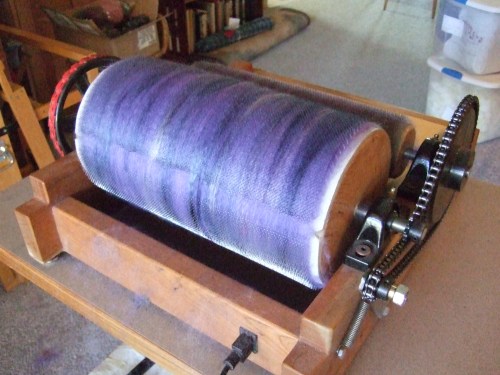
Here’s the drumcarder in action.  Love this tool!  It was built by Judith’s husband, Nick McCuin.

drumcarder in action

I failed to take pictures at some point.  This blogging is very demanding.  The 3 colors shown above were put on the carder in layers:  blueberry, most of the fuchsia color, then the violet, then a light frosting of the fuchsia again.  I got 16  batts, each 2-oz. of fiber.

After taking 10 batts up to the gallery this morning, I still have this nice box full of lovely batts, ready to spin or sell at the holiday sales coming up in November.  I know, I won’t get rich doing it- but every time I do a project like this I get more confident about what I am doing, and it is really a blast!

Box full of spinning batts

Box full of spinning batts

Read Full Post »

Finished Projects

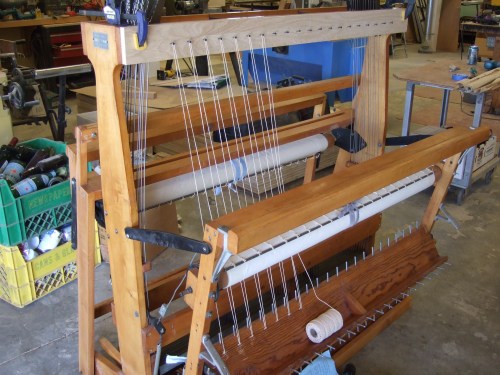
This was a good week for finishing projects.  My package finally came from Macomber with the things I needed to finish the restoration of Mother Mary’s loom.  We put the new cloth (canvas) aprons on the front beam and the plain warp beam in the back.  Then I re-strung the cords on the sectional warp beam using the materials they sent, and their instructions:

replacing sectional cords

Then we wrapped it up and put it in the cargo trailer and took it on up to its new home at the Methow Valley Spinners & Weavers guild room.  I also got 2 more reeds, a raddle and a bunch of the pedal hooks – there were only 8 pedal hooks when I got it, should be more like 64 for a loom with 16 pedals.

Now of course everyone in the guild wants to know what I am going to weave on it and if I will jump in with both feet and use all 12 harnesses on the first project… yikes!  no pressure, none at all.

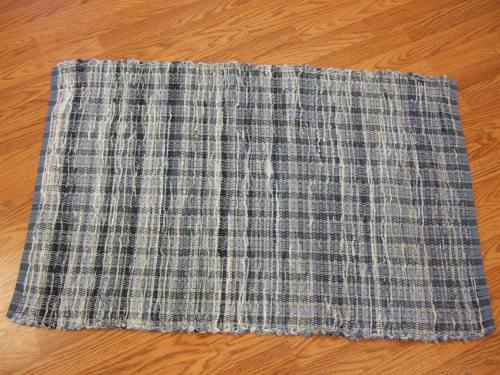
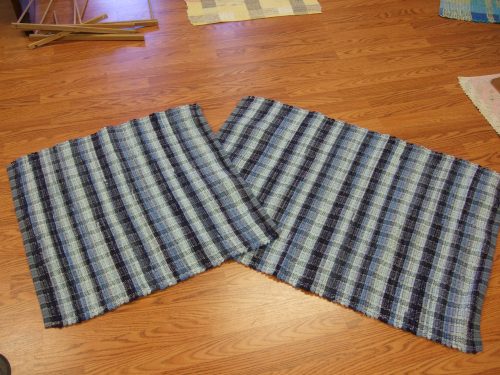
I also finished 3 rugs and that was the end of the rug warp.  31 rugs since the beginning of May, and I have sold about half of them already..

blue jeans denim rug, 28" x 41"

blue jeans denim rug, 28" x 41"

9 shades of blue cotton corduroy, 28" x 27" and 28" x 38"

9 shades of blue cotton corduroy, 28" x 27" and 28" x 38"

Yesterday I took 7 more rugs up to the Ashford Gallery in Winthrop, as they were running a little low.

I did some maintenance on my 48″ Macomber – replaced the flat steel heddles with new inserted-eye heddles I ordered a while back.  Then I gave it a thorough cleaning and lubricated the jacks.  I am planning to start another series of shawls, as they have sold all of the ones I had up at Ashford Gallery, and we have holiday sales coming up soon!

Read Full Post »

Market and Fair

I participated in the Twisp Saturday Market again the last 2 weeks.  I got up there extra early the Labor Day weekend, as this is easily the biggest market of the year, in terms of numbers of participants and (hopefully) shoppers.  Our valley has a robust tourist economy and Labor Day weekend marks the end of summer season.

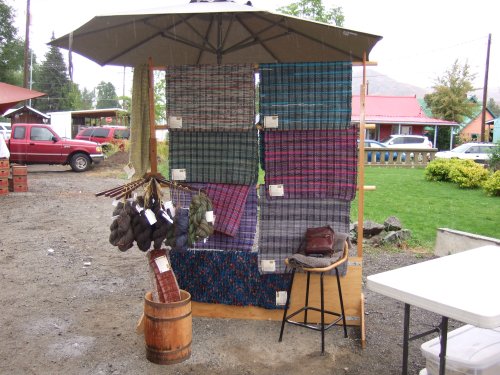
Well, rain was forecast, which was accurate, unfortunately!  It turned into a soggy affair.  Some vendors folded shop and simply left early.  Hardy souls squelched by with rain jackets and umbrellas.  I managed to get most of my display, plus myself, under the cover of my large patio umbrella:

Labor Day market 2009and felt lucky to sell 3 rugs over the course of the morning.

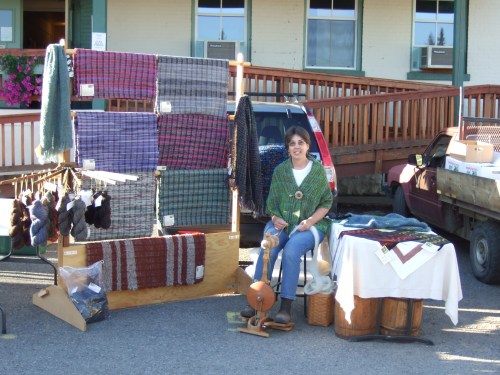
Last weekend was a different story, weather-wise.  We are having clear blue skies and temperatures in the 80’s.  I brought one of my spinning wheels up and sat spinning some wool that my sister sent me from California.  This was fun and productive for me, and seemed to be interesting to a lot of the passers-by.

market 9-11-09

I also submitted some items last week for judging at the Okanogan County Fair.  First time I have entered a county fair in my life.  We went over to Omak on Sunday afternoon to look around the fair exhibits and the animal barns, and pick up my entries at the end of the day.

Judging is done using a modified Danish System, in which entries are evaluated against a set of standards and not against the other entries in the same division and class.  At this fair they also place exhibitors into age groups, which I think is what makes it a “modified” Danish System.  The awards are Blue (excellent, exceeds standard), Red (good, meets expected standard), White (fair, falls below expected standard) or no award if the entry is disqualified for some reason.  They also may award Grand Champion and Reserve Champion (sort of like first and second place amongst all the blue ribbons in the class).  But they don’t necessarily award these and I haven’t yet figured out what the circumstances are for this to happen – it isn’t explained in the Fair entry book.

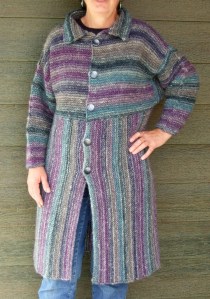
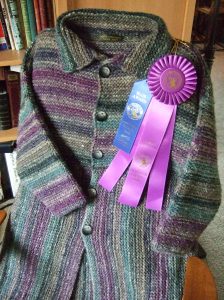
I entered two knitted pieces in the Knitting class under the Home Economics – Sewing & Needlework department.  My Einstein Coat, which I completed last fall (pre-blog) got a blue ribbon and Grand Champion award.  Holy cow!  This pattern is found in Sally Melville’s book The Knit Stitch.  I used a discontinued Noro yarn, wool/silk/alpaca, picked up on sale somewhere a couple of years back.

Einstein Coat

Einstein Coat

grand champion coat

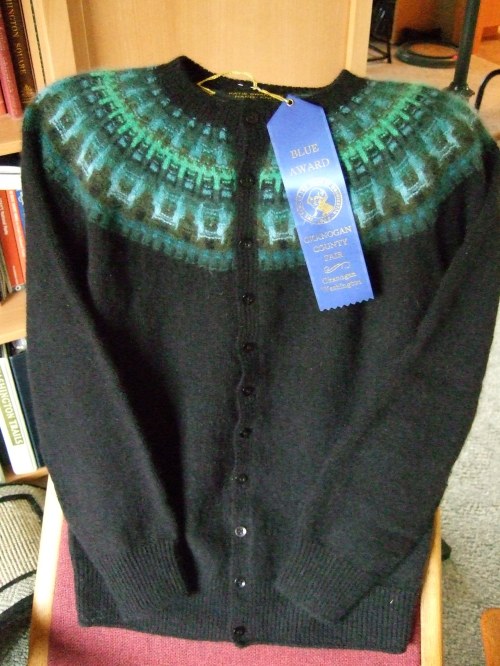
My “Bohus Forest Darkness” sweater, the knitting of which was chronicled on this blog earlier in the year, received a blue ribbon.  I find it ironic that this one wasn’t the G.C., since I know it required much more skill, experience and patience to knit than the coat.  The comment form said “Good looking sweater – good work – but looks like dog or cat hair on it.  Roller (sticky) would clean it off.”  Excuse me?  I carefully de-pilled and cleaned this sweater before entering it and I sure don’t see any cat hair on it.  I did tell them it was an angora blend yarn on the entry form – Rick thinks someone thought the angora halo was cat hair.  Who knows.

blue ribbon Bohus

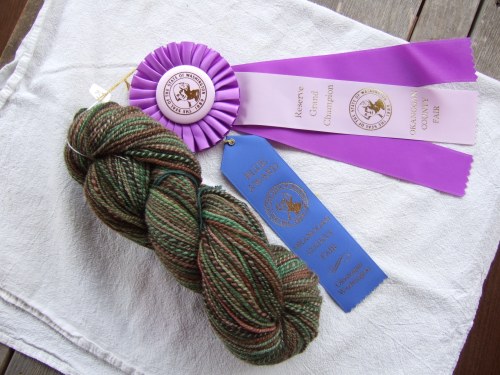
Over in the Arts & Crafts department, I entered a skein of handspun yarn in the Spinning class, and one of my overshot table mats and a rag rug in the Weaving class.  I got a blue ribbon and Reserve Champion award for my handspun (spun last fall from a dyed Corriedale pencil roving I bought from Crown Mountain Farms in Yelm, WA):

reserve champion handspun

I also got a blue ribbon for my table runner and a red ribbon on the rug – there was no comment form so I am not sure why but, oh well.

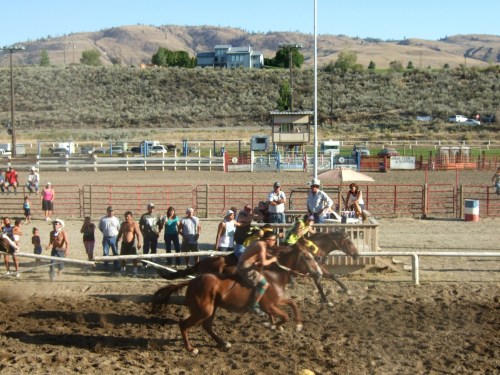
We also managed to catch the last 2 horse races of the day, the final one being the “Pony Express” race, which a friend here in the Methow had told me about last week.  There were 4 teams with one rider and 3 horses each.  And this is done bareback, too!  They have to change horses after each lap around the track, and if they don’t make the transition they are disqualified.  One guy was in this unfortunate position, he just didn’t manage to get on the second horse and it wound up making the lap without him.  They seemed like pretty high-strung horses, too.

Pony Express

Read Full Post »
I set up my Weck electric canner last week for the first time – in my case it is a Weck electric “dyepot”.  This thing is wonderful.  It is heavy gauge stainless steel, has temperature control and a drain spigot:

Weck dyepot

The project at hand was to overdye a woven shawl and a handknit shawl.  Both were originally made using a colorway in the New Zealand handpainted yarns I get from Fiber Trends, in a colorway not too many people besides me seem to like.  The company has changed dyers now, anyway, and I am not sure this color will be available anymore.  So anyway, I overdyed the two pieces, which were a yellow-green-grey-taupe mix, with about 60% blue and 40% violet at a DOS i.e. depth-of-shade of 0.75.   I was aiming not to completely obscure the color changes in the original yarn, but transform it to a blue green overall color.

The domino wrap, before and after:

domino wrap before dyeingoverdyed domino wrap

The woven shawl, before and after:

Sagebrush with wool handpaintoverdyed shawl

On the knitted wrap, I really like the way the mohair boucle and brushed mohair domino squares took up the dye a little differently from the plain wool squares.  It’s just a lot more interesting looking, besides being a better color.

As long as I am tooting my own horn, let me add that the knitted wrap is my own pattern which I call the Fats Domino Wrap.  I have been selling it with the yarns, which I get wholesale from Fiber Trends, as a knitting kit, mainly up at the Ashford Gallery in Winthrop, WA.  Fiber Trends is also promoting it as the Fats Domino Wrap/Shawl Kit with Pattern.  Fiber Trends is wholesale only, but you can order it through this link and it will be fulfilled by one of their participating retailers – the one nearest to you, I believe.  Fiber Trends provides a wide range of knitting and felting patterns under their own label, plus the full range of Naturally yarns from New Zealand, including the handpainted yarns I have used in the kit.

Read Full Post »
« Newer Posts - Older Posts »