Feeds:
Posts
Comments

Archive for the ‘fiberarts’ Category

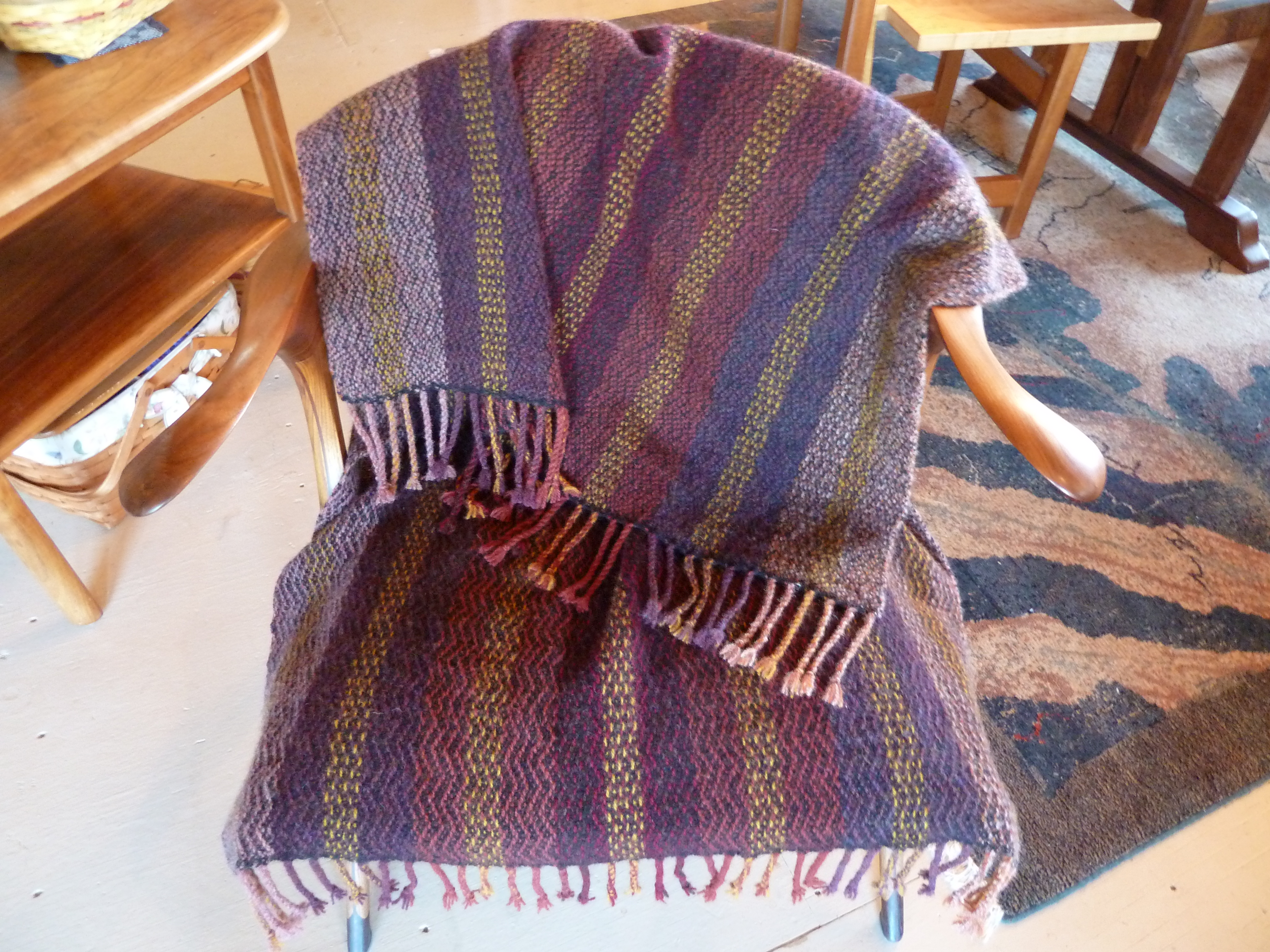
Lap Robe #5

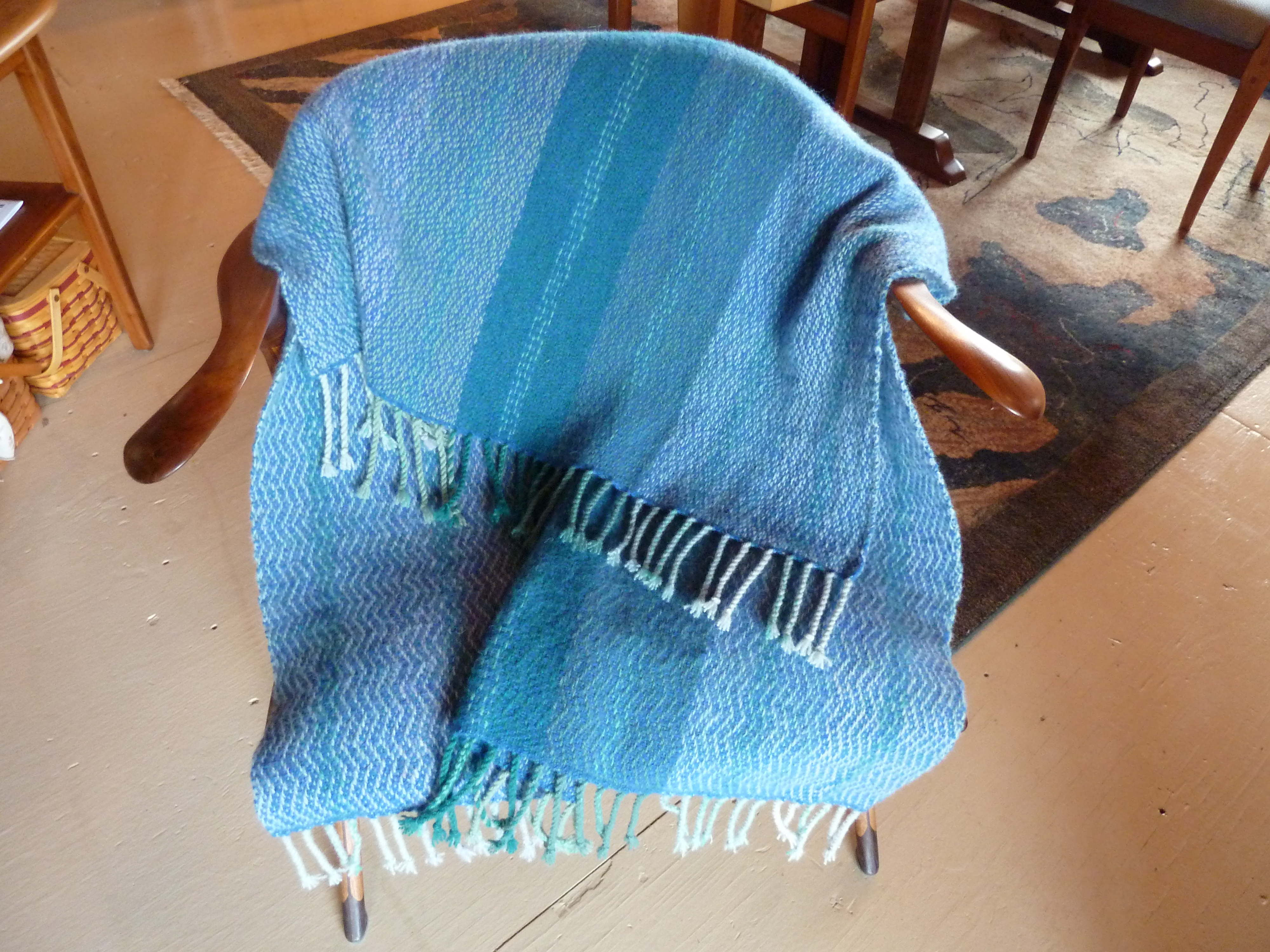
We’re in the final stages of preparing to leave on {gasp!} an actual vacation, so there don’t seem to be enough minutes in the day, these days.  But I did want to put up a picture of the blanket-of-the-week.  I really like the colors in this one, and it may be the one that goes to the ANWG 2011 Conference with me at the beginning of June.

Read Full Post »

Weaving along…

I finished the fourth fulled lap robe last week, this time in shades of green in the warp (Shetland wool) and a beautiful blue-green in Harrisville Shetland for the weft.  I think it may be my favorite so far:

off the loom but before fulling

the finished blue-green lap robe or throw

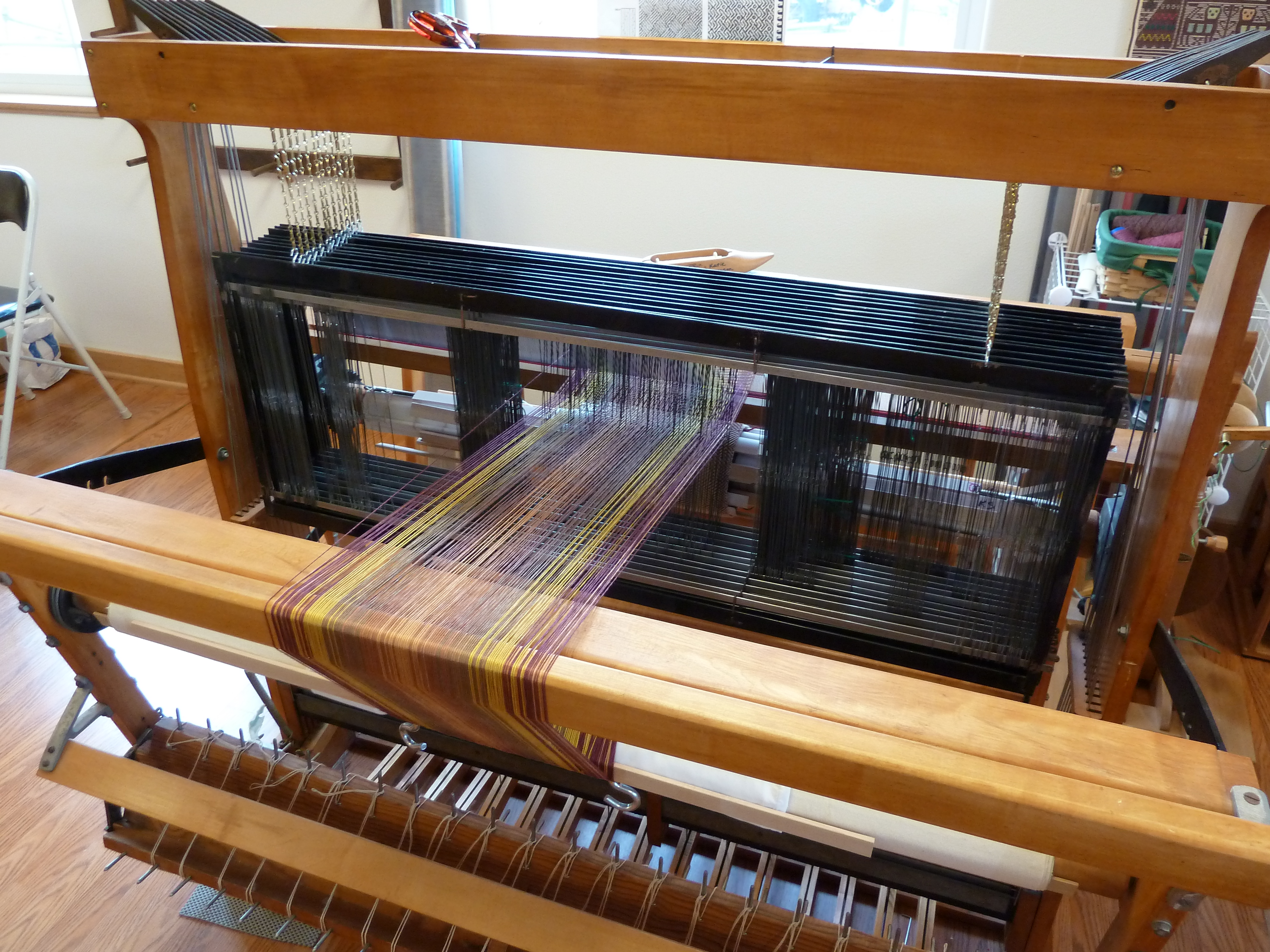
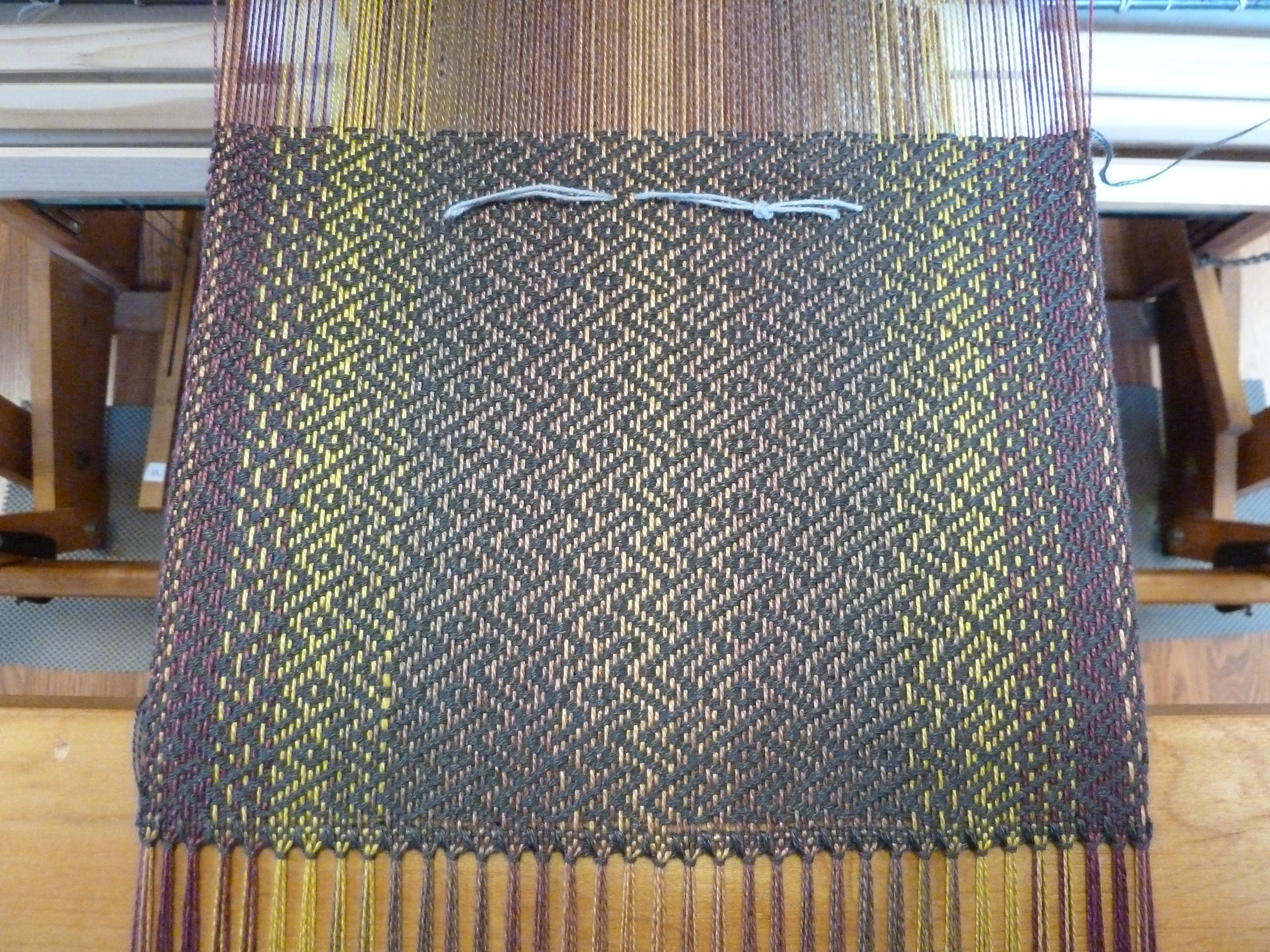
I moved my plaited twill scarf weaving down to the loom that I keep at the guild room.  This is “Mother Mary’s Loom” that we bought and restored 2 summers ago (blogged about here).  I am using 8 of the 12 harnesses, but the real bonus is in having 16 treadles.  Now I can reserve 2 treadles for true tabby or plain weave (which raises 1-2 on one treadle, and 3-4-5-6-7-8 on the other  – for the double 2-tie threading, same as with summer & winter – in other words, every other thread is on either harness 1 or harness 2).

I put on enough warp in my Autumn colorway to weave 5 scarves:

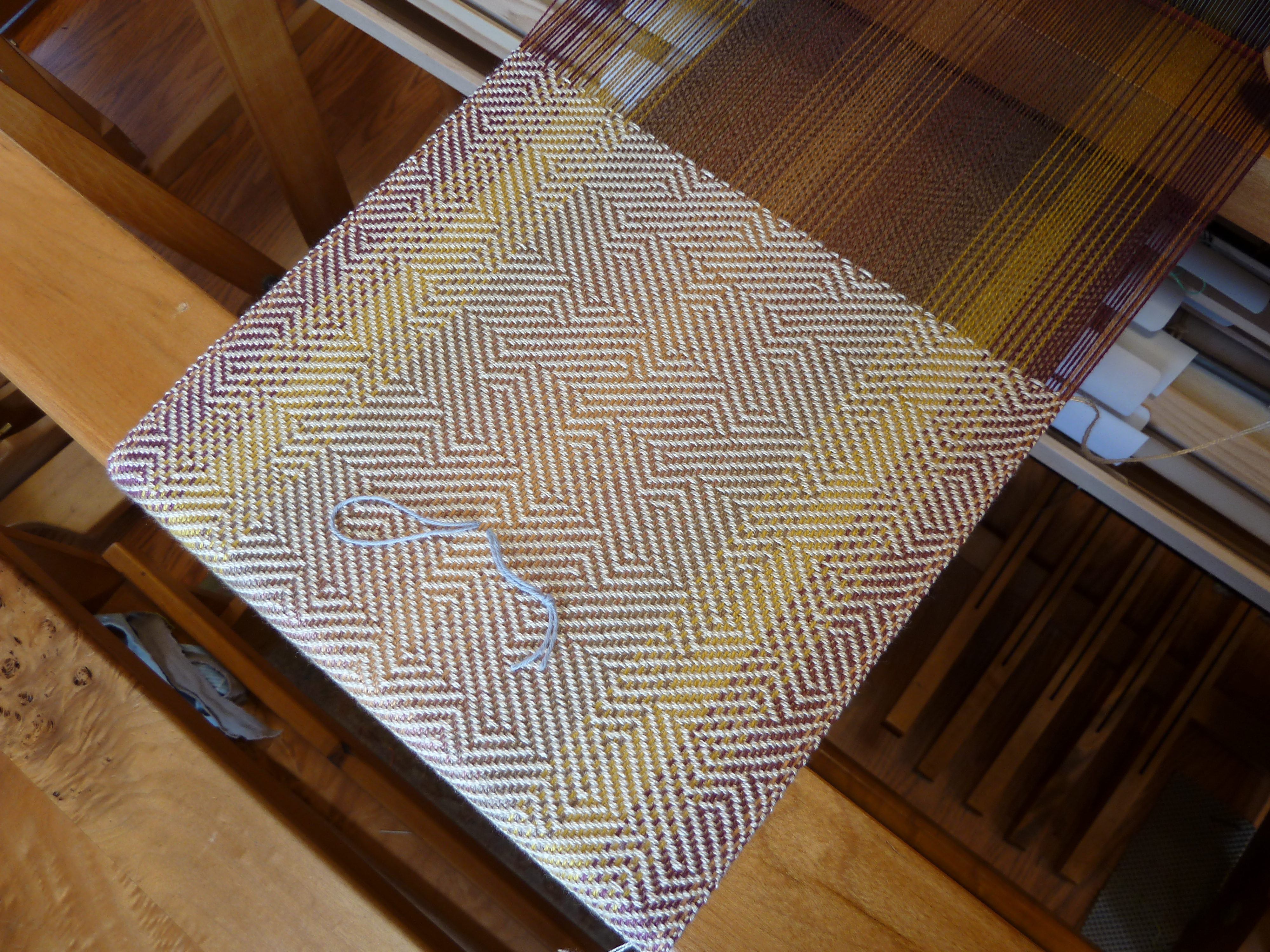
I got into the guild room several times this past week, and finished off the 5th scarf yesterday.  I have had some fun trying some new weft colors and a new pattern, too.

Here it is with a tencel weft in a color called Tussah:

Here is the new pattern.  It required 12 treadles and I only had 10 on the smaller workshop loom I was using at home for these scarves.  I used tencel in a color called Shale:

Now that I have enough treadles to do a complicated pattern plus tabby (plain weave) I am weaving a small header in plain weave at each end and doing hemstitching.  I think it will be a much nicer finish than going straight into the twisted braids (although I will still braid the ends as before).

Dare I speak it… Spring may be on the way!  It is supposed to be sunny and in the mid-60’s this coming week, for the most part.  We went for a lovely walk up Wolf Creek Road this morning, enjoying the sun and the bird songs.

Read Full Post »

Lap Robe #3

This one came off the loom before we left for California, but I didn’t finish it until this week (twisting the fringes, then fulling it in the washing machine).  I agitated it for 8 minutes this time, after the initial 4-hour soak, and it came out about 34″ x 57″ exclusive of fringe.  It is nice and soft and drapy.

The yarn was, once again, Shetland wool 2-ply knitting yarn – leftovers from previous knitting projects, plus yarn bought at a de-stashing sale at knitting retreat.  I had quite a bit of a heathered grey with mauve overtones, and not enough of the actual mauve colors to do all the warp, so I alternated the grey with the mauve colors every other thread in the warp.  The same grey was used to weave the blanket as the weft.  I used the broken twill treadling but it doesn’t show up as much as in blanket #1.  The use of the grey yarn in both the warp and the weft tended to mute the tones overall, but I do like it – just another variation, and a learning experience!

Read Full Post »

Lap Robe #2

Not a lot to report today, but I did finish the second fulled lap robe:

I agitated this one a little longer after the initial soak (11 minutes instead of 7), and it is definitely a little more dense, although not overly so (not felted).

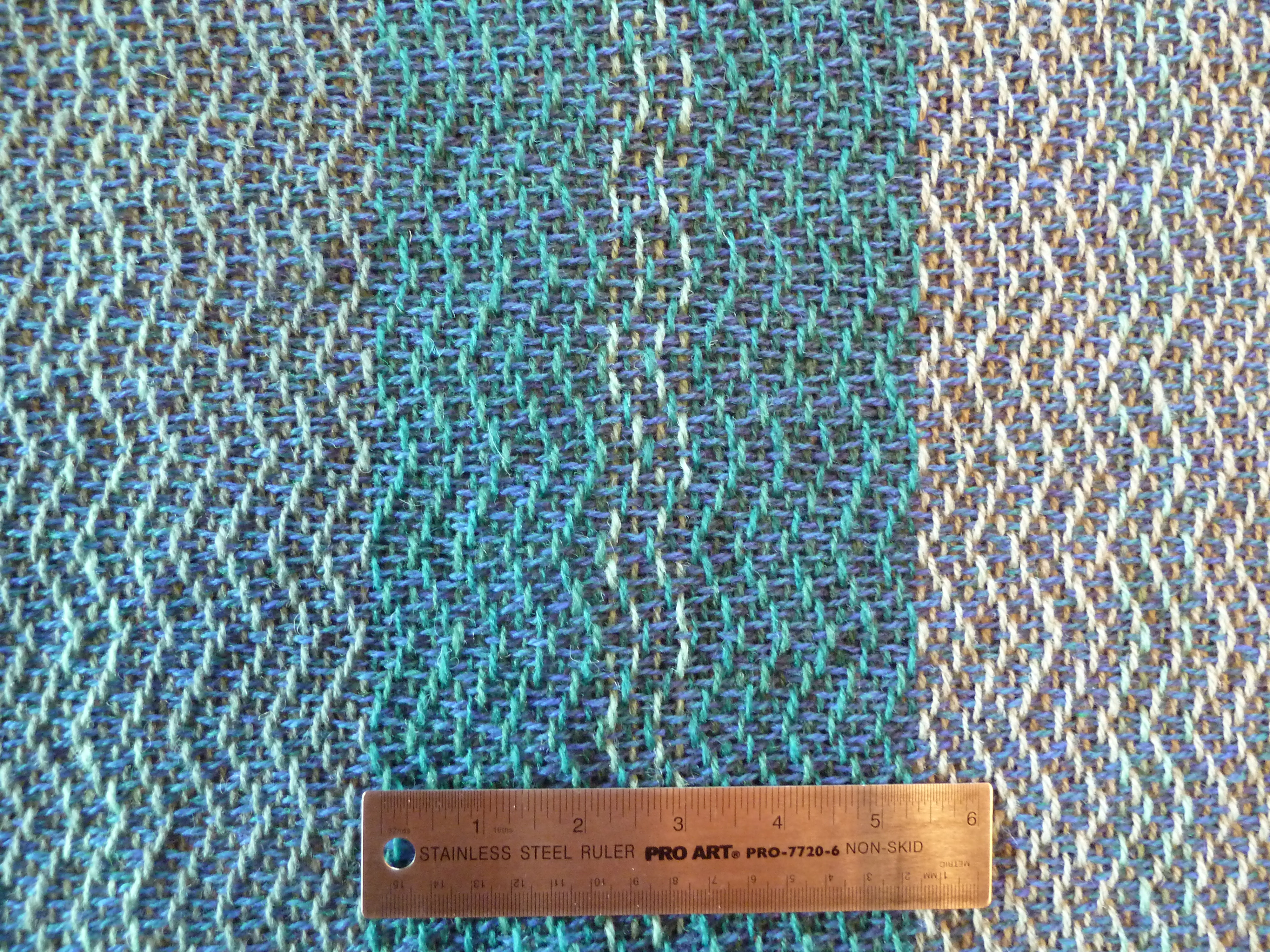
I am really pleased with the colors – seven shades of Shetland 2-ply across the warp, plus the red stripe down the middle of each of those.  I really had to work out the number of ends  in each stripe ahead of time, because not all the colors were a full skein.  A good scale is the weaver’s friend!  The weft was a heathered green with gold overtones.  I used a twill-and-tabby treadling this time.  You can see it better in the close-up of the fabric before fulling:

Lap robe 3 came off the loom last night and I should have it finished up sometime next week.

Read Full Post »

What, me wadmal?

The Methow Valley Spinners & Weavers Guild has an annual “challenge” project, due in April of each year.  Usually the challenge is to weave something in a particular weave structure (2 years ago it was “overshot”).  This year it is more of a fabric type – wadmal.  This is a woven fabric that has been felted so the weave structure is no longer apparent.  Often it is used for apparel (jackets etc) or it can be made into mitts or slippers.  Usually it is woven as yardage, loosely, in plain weave or twill and it is the color choice and final treatment of the fabric by machine felting that gives it the final appearance.

So I set out to make a small blanket using miscellaneous colors of 2-ply Shetland knitting yarn, because I also wanted to make a gift for some friends who have recently had their first child.  I got some of my ideas from a project in the Jan/Feb 1996 Handwoven Magazine:  Cloud-Light Lap Robe by Sharon Alderman.  I liked the braided fringe, and her instructions for machine fulling leave the fabric dense but still soft and drapey, not stiff as a board (soak in hot water with detergent for 4 hours, followed by only about 5 minutes of agitation plus a couple of gentle rinses and spinning out).

I used 5 colors of Shetland 2-ply for the warp (a total of 8 skeins at 150 yds each), but the weft was a New Zealand DK-weight wool I got in a fiber exchange a couple of years back.  It was sett at 8 epi (that’s ends-per-inch for the non-weavers out there).  I threaded it as a 2/2 twill and treadled it in a broken zig-zag pattern, trying to maintain 8 picks per inch.  To maintain the openness of the fabric, the weft needed to be nudged into position, not beaten, after changing sheds – another tip from Sharon Alderman.

Here’s the fabric before fulling:

After fulling:

It was 41″ wide on the loom and I wove about 2 yards, maybe a little more.  Off the loom before fulling it measured 37″ x 64″ (excluding fringe).  After fulling it measured 30″ x 57″.  I still need to trim the fuzzy ends of the braided fringe, but otherwise it is done:


I am really pleased with how this turned out.  Maybe it isn’t exactly “wadmal” (not felted to jacket fabric consistency) but I love the feel of it.  I am tieing on another warp already and will try a different treadling pattern on the same twill threading.

Hey, what’s that peeking out from under the blanket in that last picture?  I finished the Notre Dame de Grace Pullover designed by Veronik Avery!

Read Full Post »

The Twice-Knit Sweater

Warning! Knitting lingo-intensive-post ahead.

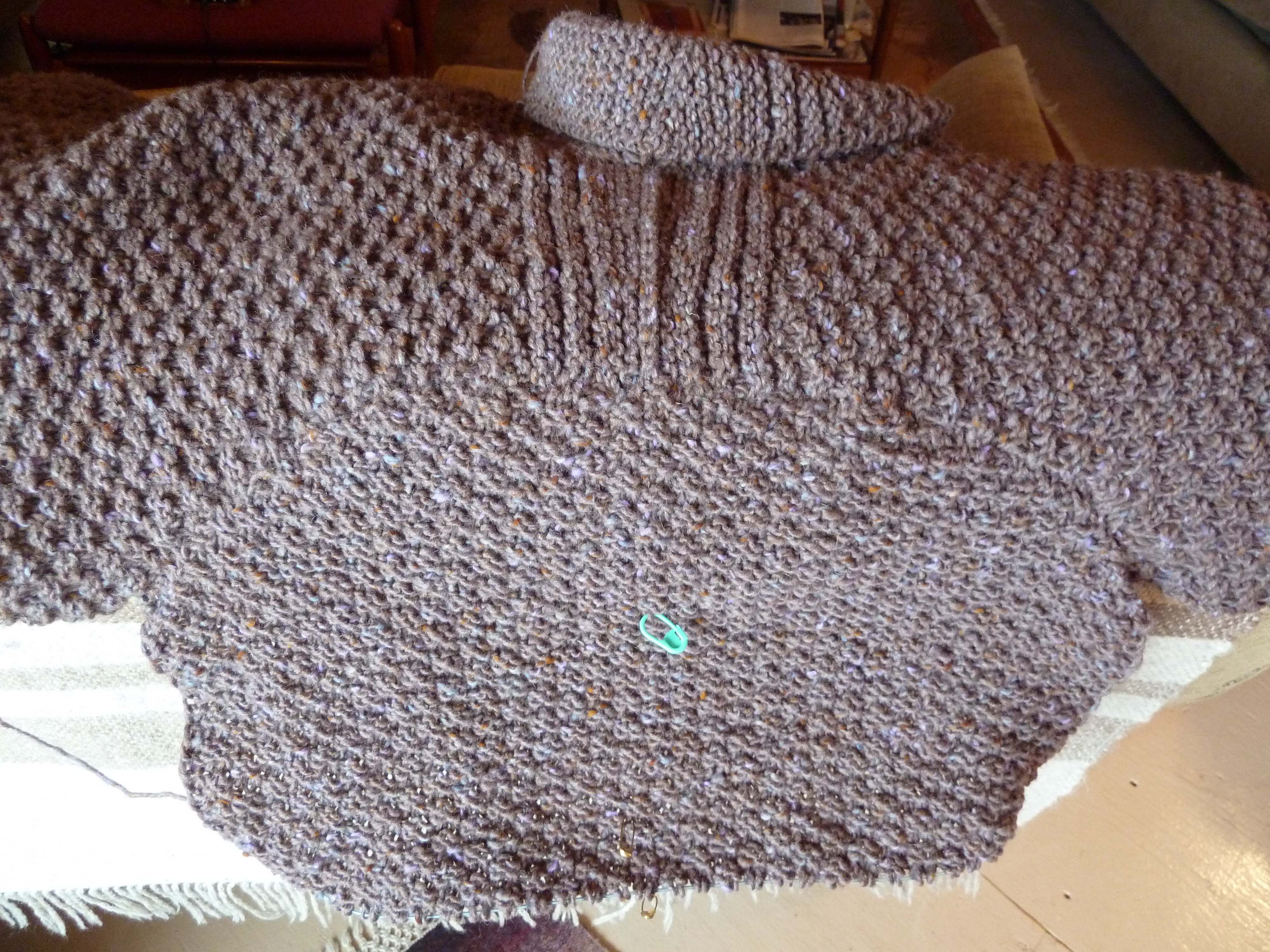
For several months now I have been working away on this sweater, “Notre Dame de Grace Pullover” by Veronik Avery.  It was originally published in the Summer 2007 Interweave Knits magazine.  I’m using Rowanspun Tweed in a color called Fig, which I have had in the stash for quite a while.

I don’t know why, but it has seemed like a star-crossed project.  First I decided to work the body in the round to the underarm, instead of 2 separate pieces worked flat and then sewn together as specified in the pattern.  I was well along before I took a good hard look at it and realized the fabric was biasing terribly.  I’m not sure if that was because of the stitch pattern (double seed, or moss stitch) or the yarn, which seems to be a bit twisty.  Or both!  Anyway, ripped it all out and started over.  Finished the back and started on the front.  Then I realized I hadn’t read the directions for the selvage stitches correctly, and the pattern was placed so it wasn’t centered in the middle of the front and back.  I had to finish to the underarm to make the side seams work out, but had to futz around with re-positioning the pattern for the center front placket.

But wait – I noticed I had cast on one too few stitches for the left front placket and now the edge of the placket was going to bother me.  So I ripped back to the beginning of the left placket and re-knit it.  Then I finished both sides of the collar and grafted them together in the back as directed, but wasn’t looking forward to sewing it onto the back neckline, which includes live stitches left on a holder.

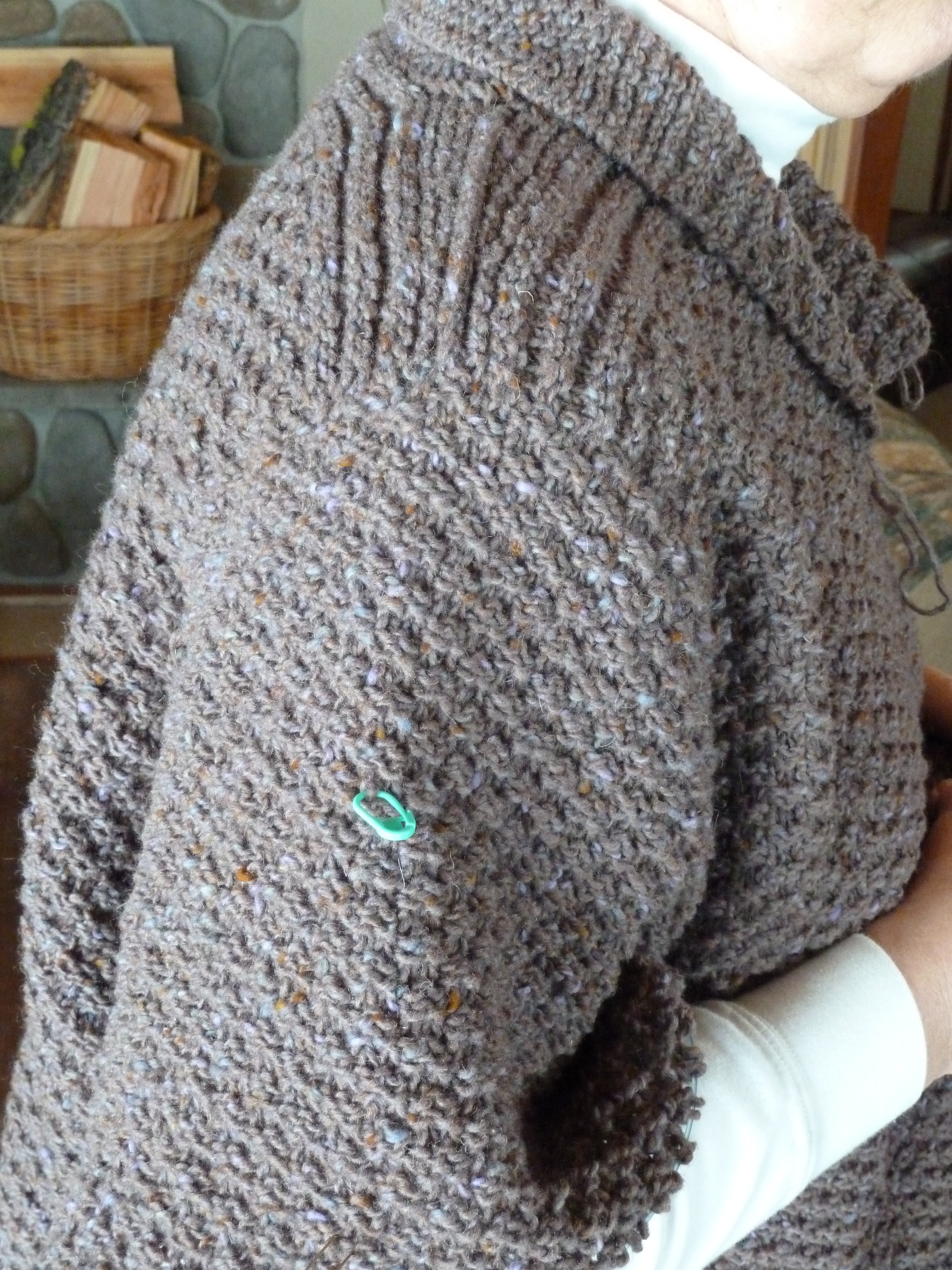
So then I decided to try a knit-in sleeve cap from the top down, instead of knitting the sleeves separately and then sewing them into the armhole.  I was using Karen Alfke’s directions from her Top-down Set-in-sleeve Pullover, except I planned the pickup of stitches around the armhole to match the sleeve cap shaping in my pattern.  I was marking off the sections with plastic markers when I realized with horror that when I re-knit the left placket I had used my notes for starting at the underarm level and knit the darn thing about  3 inches too long!  I mean, it was bizarre looking – how could I not have noticed it until now?  I had to take the collar apart in the back, rip out the left side of the collar and the whole placket and do it once again.

There was an upside to this turn of events, though.  I realized I could pick up stitches across the side of the back neck and put the live back neck stitches on the same needle, then attach the collar as I went (since I knew from the previous attempt how many rows there would be).  This was a much more satisfactory solution than sewing the darn thing on, so I ripped out the right side of the collar and re-did it as well.

I am happy with the knit-in sleeve cap:

This is worked with “increasing short rows” (isn’t this an oxymoron – that makes them “longer and longer” rows in actual fact).  I decided to use a traditional “wrap and turn” method at the end of each row.  When you reach that point on the next (longer) row you need to hide the wrap as you work past it, and that presented some challenges when working within the double seed pattern, but I think it looks OK.  The sleeve cap came out the exact height it was supposed to be and I am happy with the fit.

So onward!  I may actually finish this sweater in time to wear it before the weather turns warm.

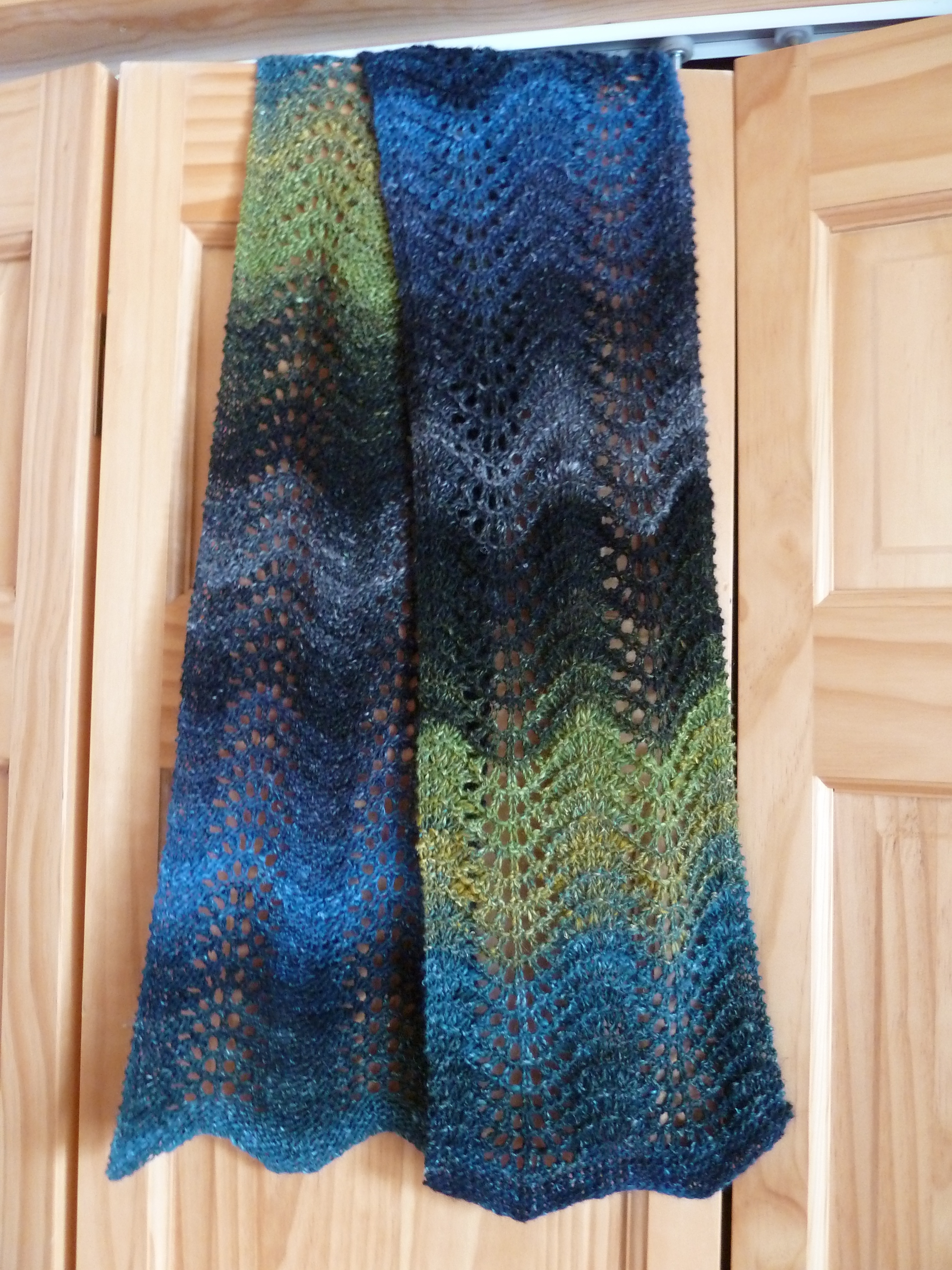
I also finished a little Feather & Fan pattern scarf using Noro Silk Garden Lite, which was started some time last year as a car-knitting project:

Read Full Post »

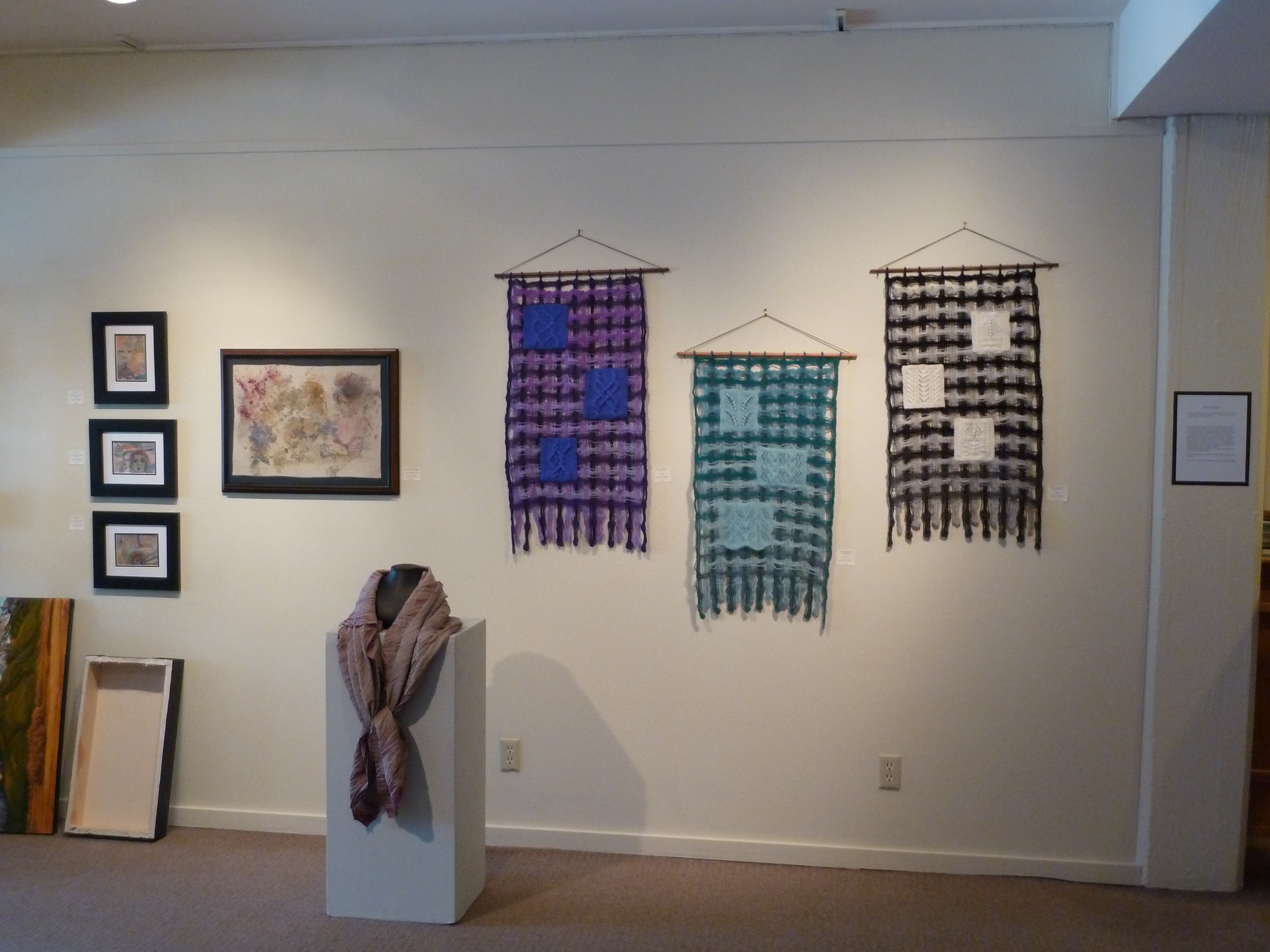
The show, titled “Lacunae – The art of gaps, holes and negative spaces”, at the Confluence Gallery in Twisp opened yesterday.  My friend Sara Ashford and I have our work displayed in what they call the Solo Gallery, which is now on either side as you walk on back to the main gallery space.  Sara owns (or owned) the Ashford Gallery in Winthrop and has been carrying my rugs, scarves, shawls and shawl pins on consignment for the last couple of years.  She does beautiful nature dyeing on silks and is also a weaver and member of our local guild.  She is closing the gallery in Winthrop to devote more time to her own artwork, and will hopefully have a new studio space at TwispWorks (on the site of the old Forest Service complex) in the near future.

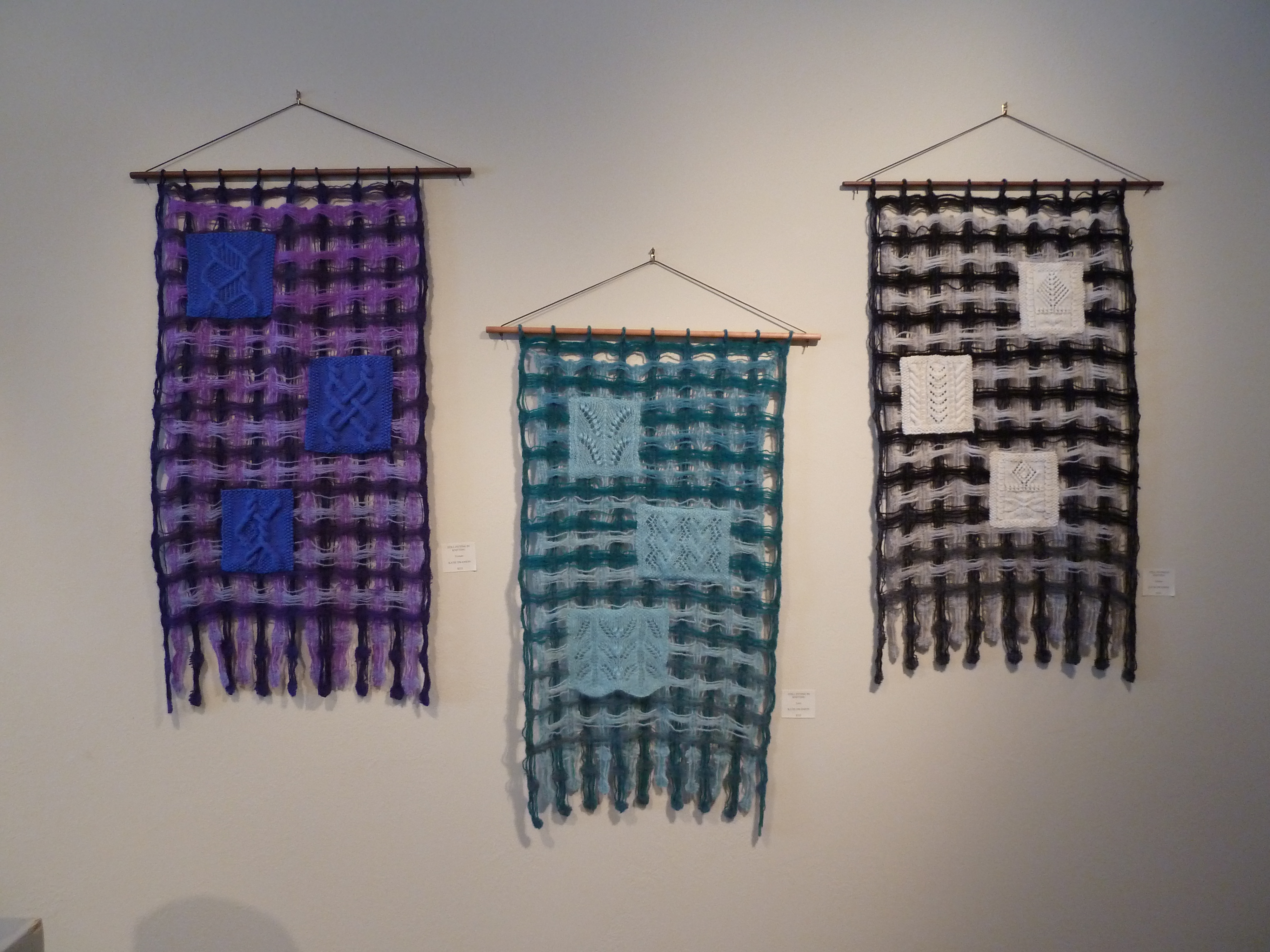
While up on Orcas Island, I was also knitting away feverishly on the embellishments for my woven and felted wall-hangings.  I wanted each one to have a theme, and wound up knitting Estonian lace panels in Rowan Kidsilk Haze for the blue/green wall-hanging, and patterns from the fishermen’s ganseys of Eriskay (in the Outer Hebrides) for the black & white one.  I have always loved the Eriskay ganseys and this got me excited about actually knitting one this year.  My idea for the purple wall-hanging was to do stranded colorwork (Fair Isle, Bohus, etc) but this wasn’t panning out too well, so when I got home I found a yarn that worked well color-wise, and wound up knitting some elaborate cable and texture patterns from my stitch pattern books.

The idea here came from some of my friends asking me if I still knit, in slightly puzzled tones, when they observe my new obsession with weaving.  It made me realize that for me, weaving is new, exciting, exploratory and offers a way to play with fiber and color and also get something completed relatively quickly.  Whereas knitting is more of a “slow fiber” craft, it can take 6 months or more to complete a finely knitted sweater, but that is always OK with me – I enjoy the process and enjoy knitting challenging and complex patterns.  So the wall-hangings are titled “Still Fitting in Knitting” – they are meant to be playful and whimsical, but also represent the place of the two crafts in my life at present.

They had to be in to the gallery by last Tuesday, and I was working on them right up to the end, but here they are hanging.  I also have a nice selection of my plaited twill scarves in the Confluence Gallery gift shop.

Still Fitting in Knitting – Texture
Still Fitting in Knitting – Lace
Still Fitting in Knitting – Eriskay

By the way, for you traditional knitters out there, I know of two sources for patterns for complete Eriskay ganseys:  Alice Starmore’s Fishermen’s Sweaters, and Madeline Weston’s Country Weekend Knits (originally published as Classic British Knits).

Read Full Post »

Orcas spinning camp

I spent last week up on Orcas Island at “spinning camp” with Judith MacKenzie – my 4th time at this event (I missed 2009).  This year’s theme was “Bringing Color into Your Spinning”.  They were set up to do a lot of dyeing outdoors (always a bit iffy in February in NW Washington).  Then it snowed.  And got really cold.  But our organizers managed to score an indoor space in an adjacent cabin to the meeting room, swathed it in tarps to protect the furnishings, and we pressed on!

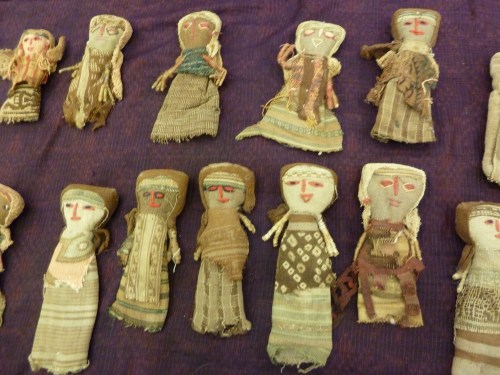
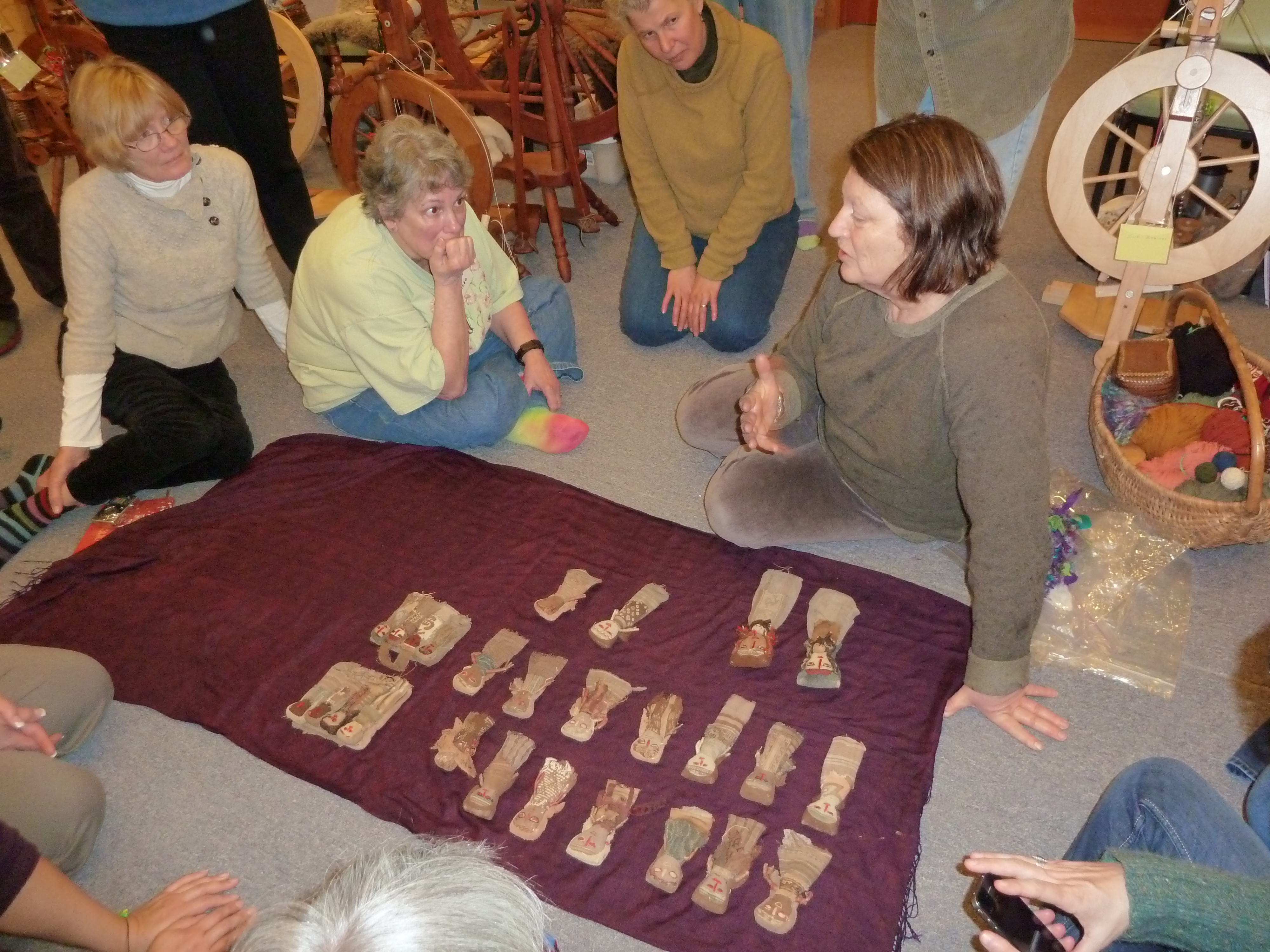
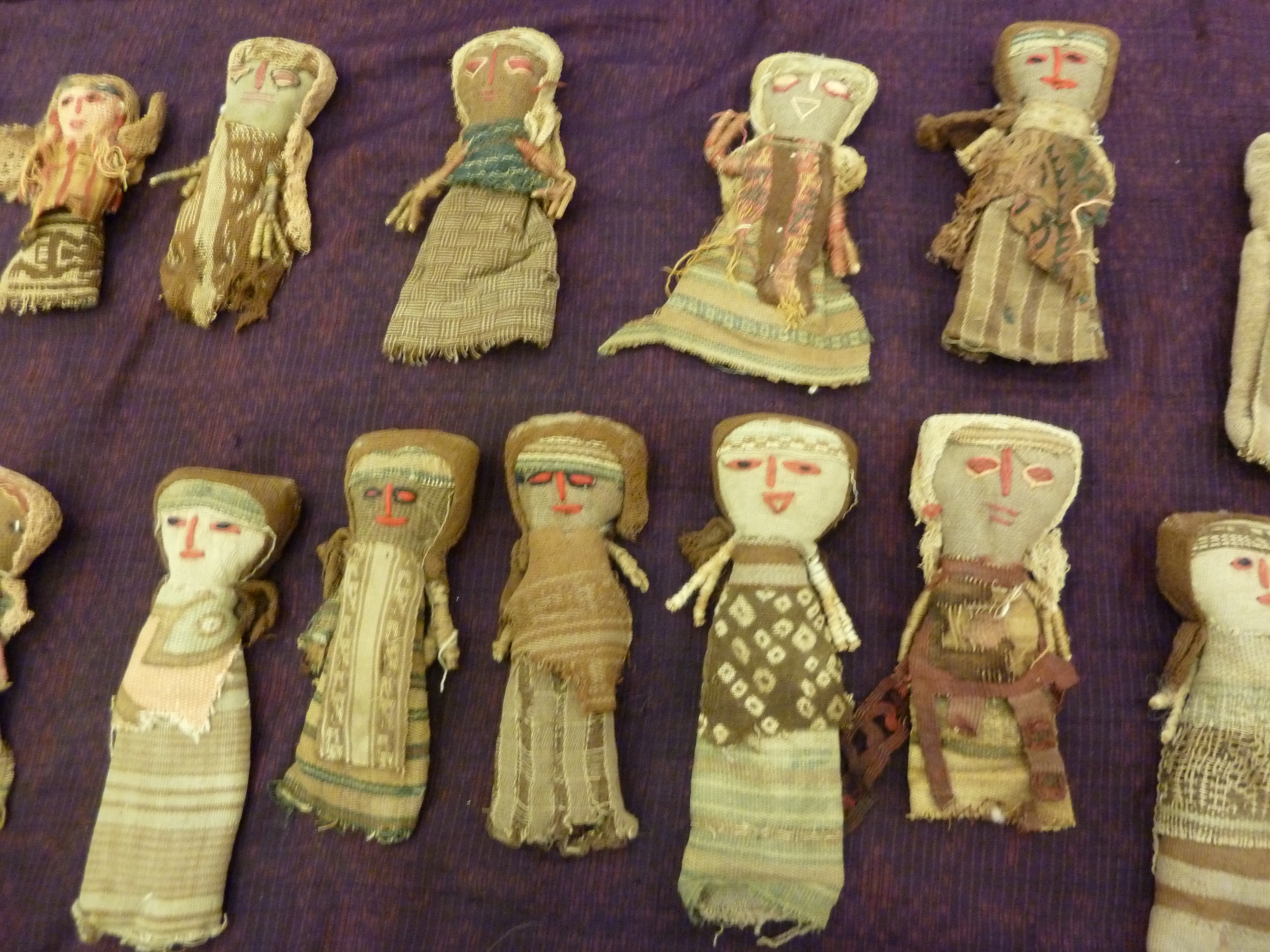
The first day Judith entertained us with stories of her trip to Peru in November 2010.  She was one of the speakers at Tinkuy de Tejedores (A Gathering of Weavers) near Cusco.  She brought back some beautiful textiles, all nature dyed handspun and woven on primitive backstrap looms.  She also shared a portion of her collection of Peruvian “burial dolls” – many of them very, very old.  They are not really dolls, but religious or ceremonial objects.  The clothes they wear are made from fragments of cloth that were originally on mummies, so in some cases the textile fragments could be thousands of years old.
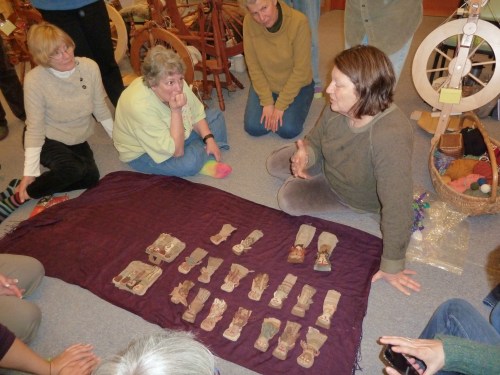
Judith with burial dolls
The first class project was to spin a boucle yarn using a rayon core and kid mohair locks that Judith had dyed.  I skipped this one, as I have tried it before, am really bad at it, and know I won’t be pursuing this one any time soon.

Next she had us spin up some Corriedale rovings in white and black (natural colors) and make a series of 3-ply yarns: 3 white plies, 1 white/2 black, 2 white/1 black, 3 black.  Then we overdyed the final skein(s) with a color of our choice to see how the color interacts with the underlying makeup of the yarn.  Or this would be a way to make a graduated color yarn as you transition from white to black.  Mine came out sort of “sea lettuce green”:

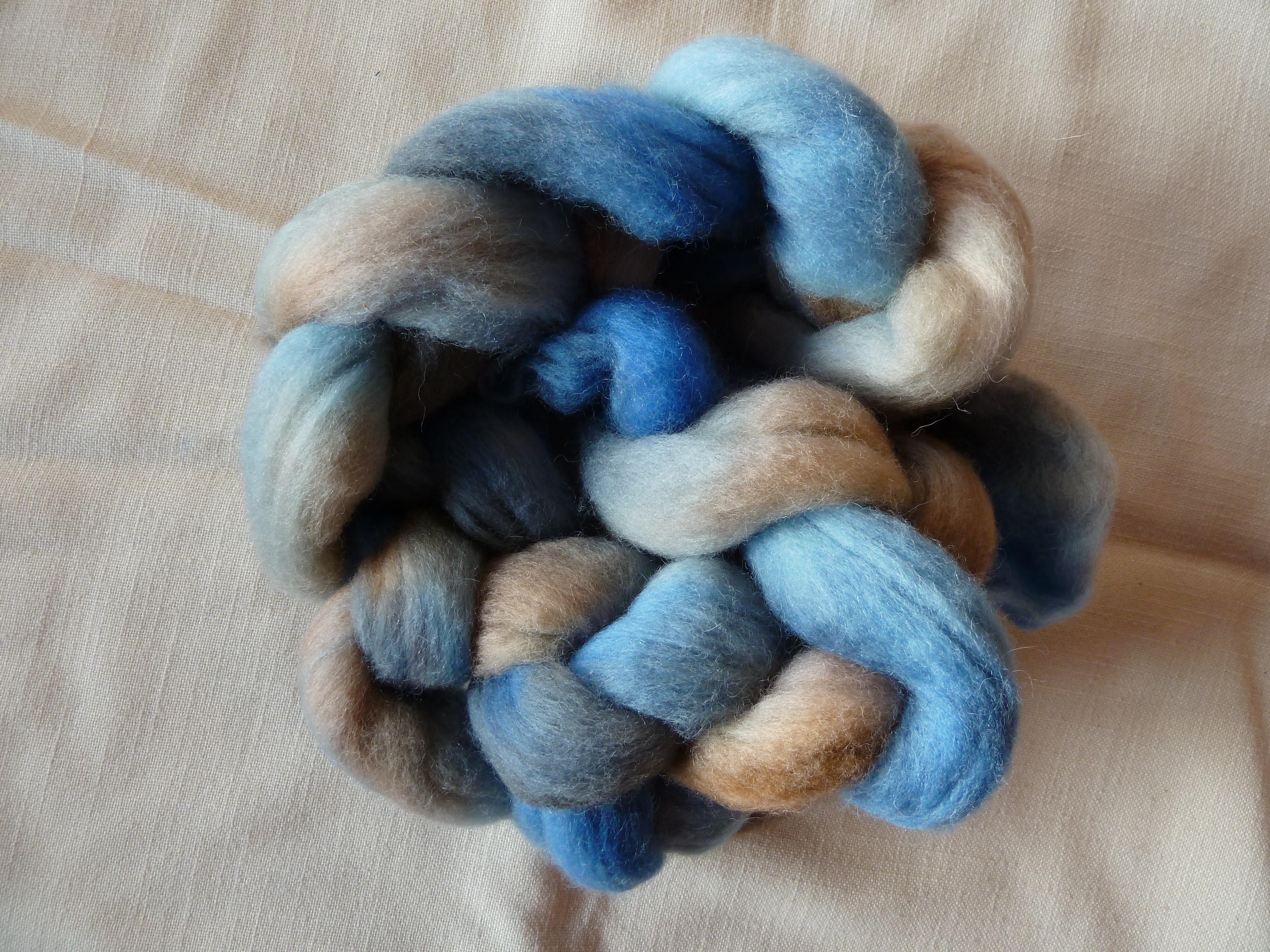
After they got the dye area set up, we were able to dye solid colors in big dye pots on the cabin front porch, or go inside where they had 4 electric roasters set up to dye variegated color rovings or yarn with a direct pour application.  Each of us were given 4 oz of Corriedale roving, chose a colorway, then Judith dyed it for us while we observed the technique.  After everyone had done one roving this way, we were able to do more on our own (with her help with the colors, “if needed” – ha ha, always needed…)

my first dyed roving

Another spinning exercise: we were given 4 oz of Corriedale roving that Judith had already dyed (variegated in color like the one above).  Then we were encouraged to “share and share alike” by getting small amounts of other colors from other folks in the room.  The idea was to introduce other colors into the spun singles, in either a random or semi-methodical way, to obtain a final plied yarn that is more complex in color than if you had spun up just the single colorway represented by your roving.  This was a lot of fun and I like the idea a lot.  I finished plying mine when I got back home but I don’t have a picture of the final yarn yet and here it is:
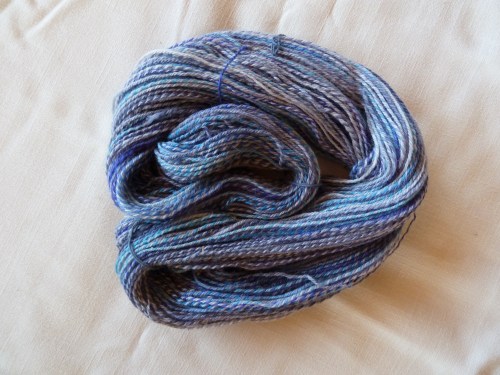
The basic roving was quite muted, cream through shades of greyish purple, but I introduced short sections from another roving from time to time: dark royal blue through purple, and a brighter turquoise color.  I spun all the singles, divided it into thirds by weight, and made a 3-ply yarn where all the colors just come and go randomly.  I am pleased with the result and will probably use this idea again.

I also spun up some Polwarth roving that I bought from Maxine of Island Fibers on Lopez Island, at the event.  I made about 150 yds of 3-ply and it is wonderful, springy and soft yarn.  I will definitely be spinning more of this fiber.  I dyed it in one of the roasters along with some merino/tencel roving I also bought from Maxine.  Can you say RED?
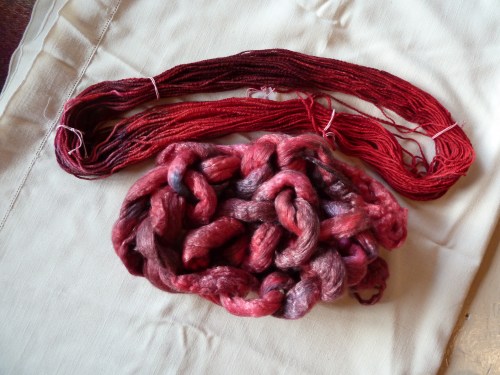
Here are two more batches of dyed merino/tencel roving:

The one on the left was supposed to have more purple tones in it, but as it turns out this was superwash merino and it takes up dye very quickly.  It all just sort of blended together.  But I can put it back in a dye bath at home and try to modify it some, and I will.

Read Full Post »
Weaving Marathon

Yesterday was a 12-hour weaving day – winding warps, tie on to the previous warp, wind on, weave weave weave the next piece for the wall-hangings I am doing for the show at Confluence Gallery.  I felted the first one on Wednesday and it turned out OK!  I was so uncertain it was even going to work.

These are actually a kind of double-weave, each color is woven separately but they interlace.  I am using Shetland 2-ply yarn (the kind you would knit a Fairisle sweater from) – I bought a big mixed bag of colors from a friend at the knitting retreat a couple of years ago at the stash reduction sale.  So I had a lot of colors to choose from and it wasn’t expensive, so risking completely ruining it in an experiment seemed OK.

Encouraged by the way the first one turned out (about 30-40% shrinkage) I went ahead and wove 2 more.  One is blue/green and the other is black & white (with some greys).

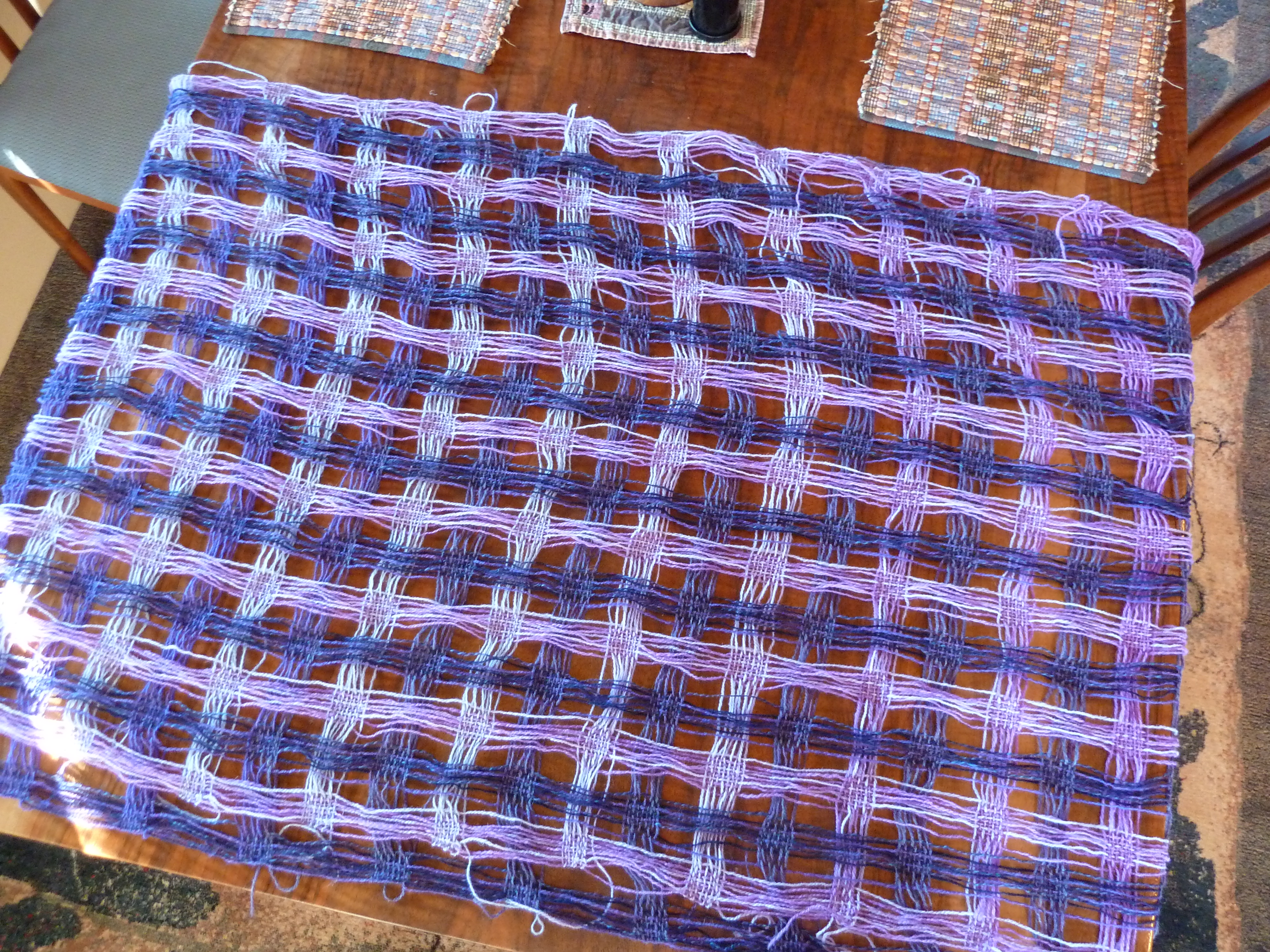
Here’s the Black & White before felting:

These are so open and delicate I have to start off with just a soak and then a careful swish in hot water and detergent, using some plastic spoons I use for dyeing:

After about 15 minutes I shocked it with cold water, then back to hot tap water and detergent and using my hands in rubber gloves.  Once they started holding together I transferred them to a table and the setup I used years ago for a nuno felting class:

The blue mat is spa cover material and has a waffle texture on one side, which provides just the right amount of rubbing and friction to continue the felting.  Then you use a “water noodle” (flotation device) to roll the package around.  Sprinkle on some hot soapy water and roll – and roll – and roll.  Take it out, rinse, check, roll some more.  It took a total of 2-3 hours to get these down to where I wanted them (from initial soak to final rolling and rinsing).

But I needed to get the weaving and felting done this week before I leave for Orcas Island and spinning camp with the fabulous Judith MacKenzie – bright and early tomorrow morning.  I am not done with these pieces yet, they are going to be embellished.  I will be working on that part while gone next week, then do the final assembly when I get home.

The show opens March 5 and here’s an article from the Methow Arts website about the show, with a wee small blurb about me and my friend Sara Ashford.

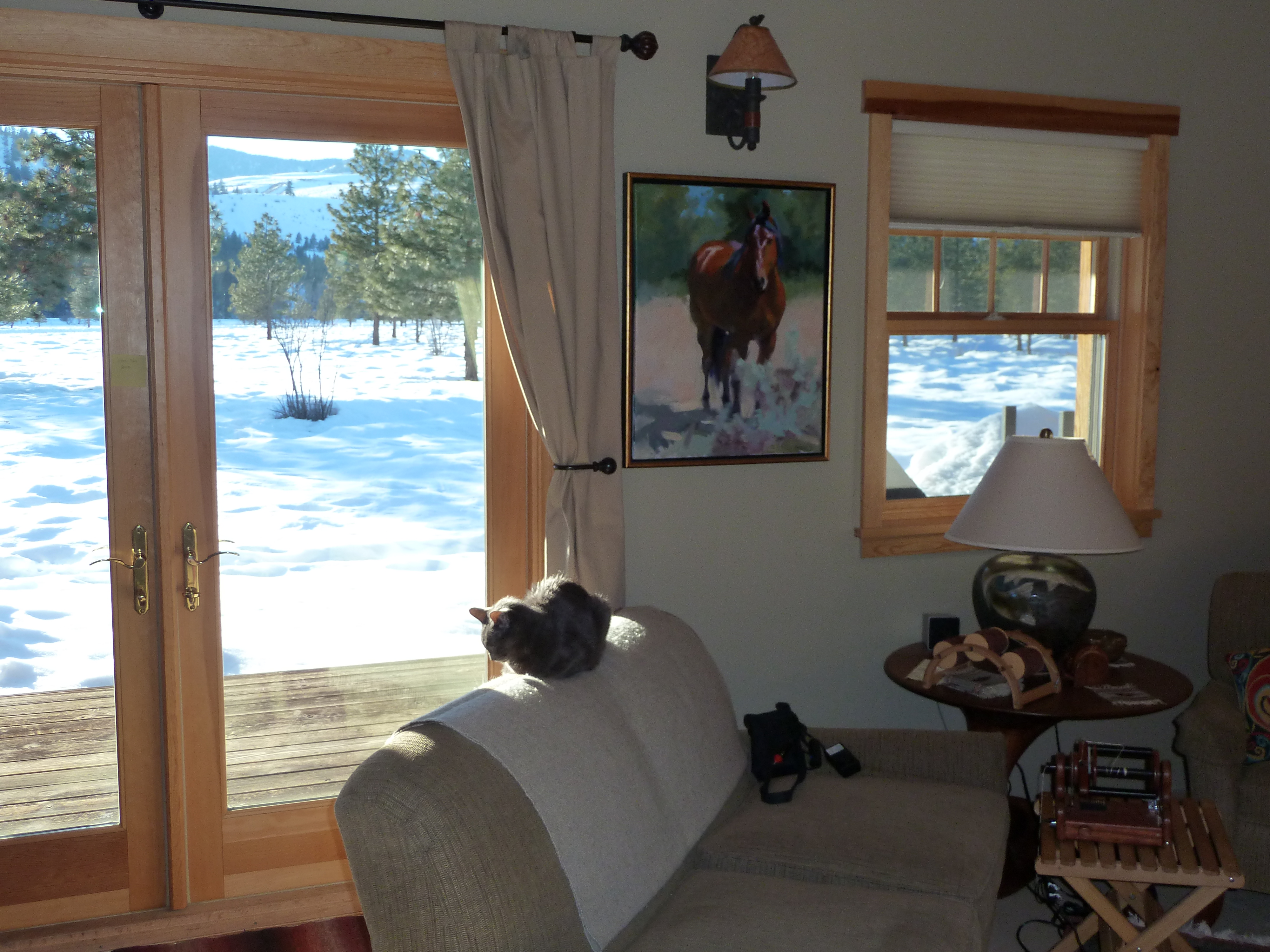
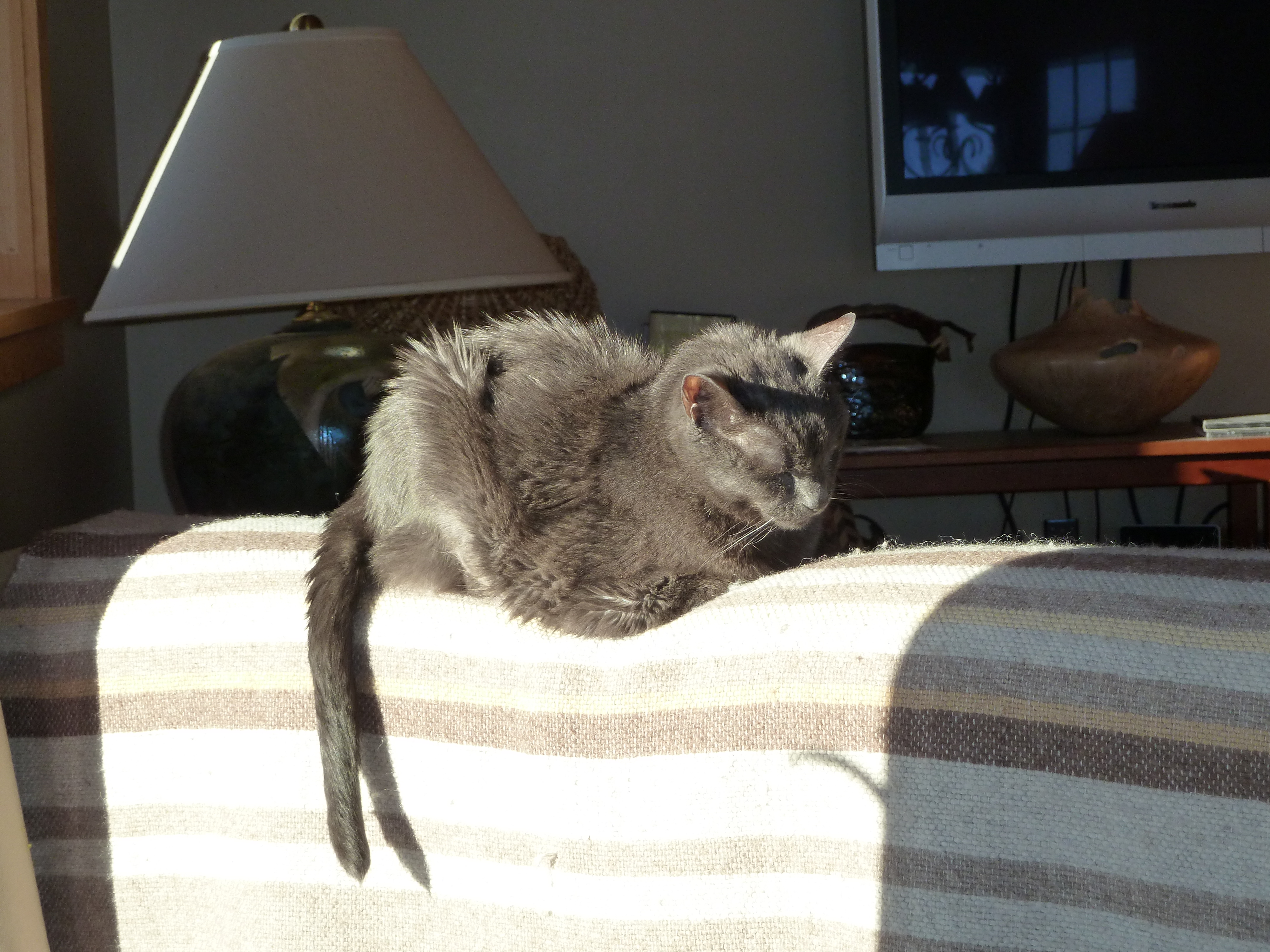
It was an absolutely gorgeous Methow day today – sunny and clear, with many skiers out on the trail across the fields.  Sadly, we were not among them.  But Pushkin came downstairs and grabbed some sun on the back of the sofa:

Read Full Post »
Last weekend we made a trip to the Coast to pick up materials for one of Rick’s cabinet jobs, and visit with friends and family.  On the way to and from Anacortes, in the Skagit Valley, we saw large flocks of snow geese out in the fields.  They are quite a sight!  Then when we arrived home, it was obvious that rain and/or thaw had set in.  We still have snow on the ground, but it is soggy during the day, becoming icy at night.  Yech!  Navigating our driveway on foot from house to carport is a bit treacherous.  Although now, in the late afternoon, I look outside and it is…. snowing!!

Having dropped the ball entirely on blogging the last couple of weeks, I will attempt a bit of a catch-up.

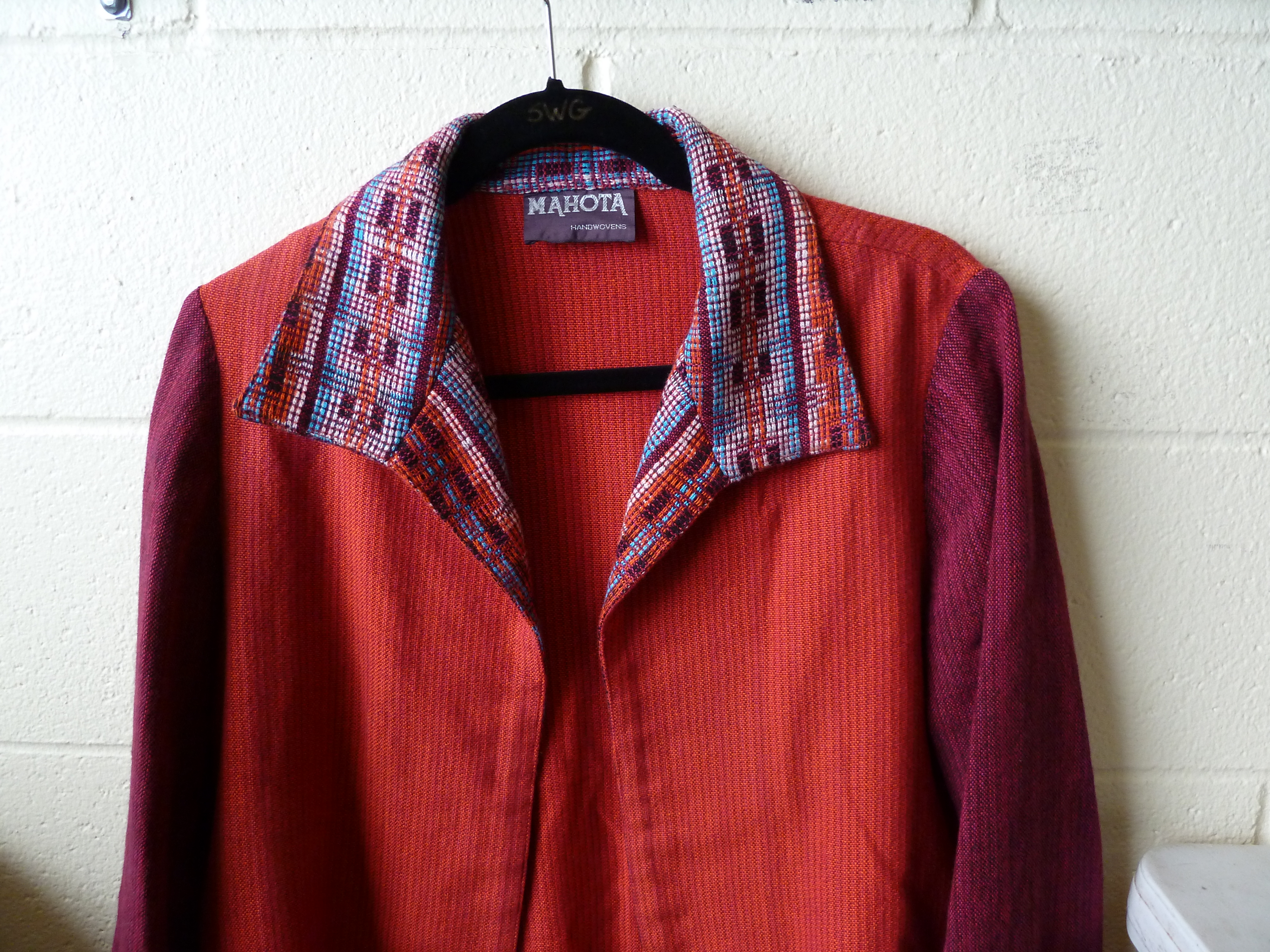
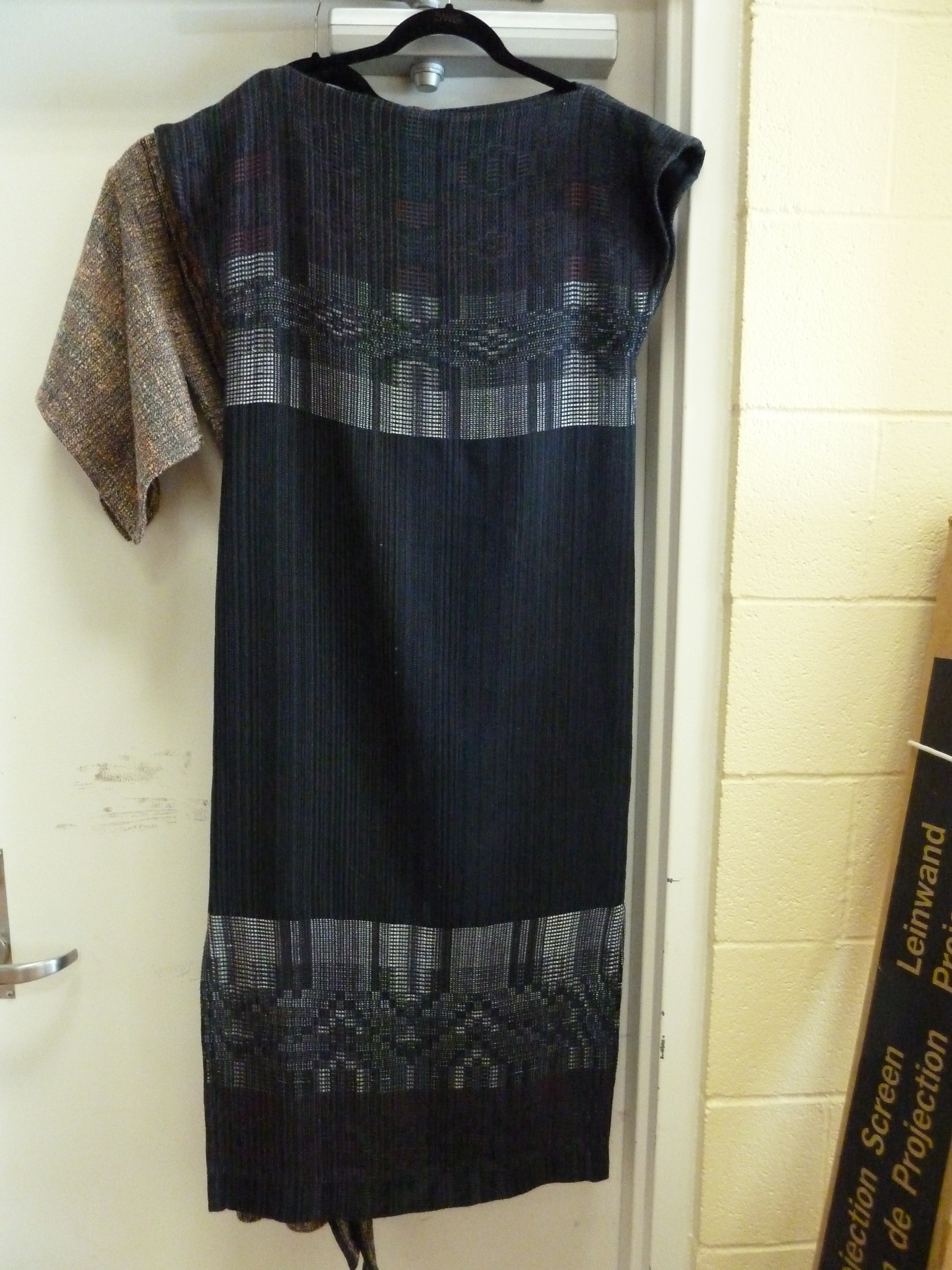
My weaving workshop a couple of weeks ago in Seattle, with Margaret Roach Wheeler, was marvelous.  Her website is Mahota Handwovens – the type of weaving we were learning is shown in her clothing line.  She uses the summer-and-winter weave structure to weave decorative bands that emulate Native American beadwork and quillwork.  Here are a few pictures from the 2-day workshop:

Margaret discussing a finished sampler

A shirt with decorative work on collar and facings

A beautiful dress - note subtle colorwork at the very top

Our samplers were worked in 10/2 perle cotton.  She gave color value and contrast guidelines, but every warp was different and the colors chosen for wefts were up to the student.  There is a lot to explore and learn there – what works and what doesn’t!  But I am pleased with my sampler and will use it both as a guide for future work, and as a wall hanging in my studio:

My washed sampler from the Wheeler workshop

Meanwhile, the last few weeks I have written up the pattern for the “Mosaic Mojo Hat” and have taught 2 groups of intrepid knitters the techniques used there – short rows (including hiding the wraps in garter stitch), garter stitch grafting and mosaic knitting.  No-one left crying so it must have been OK.  I taught it as two 2-hour sessions with a week in between to get some knitting done, and will be teaching it again in March down at Uptown Woolery in Chelan.  Inevitably, some errors in the pattern were found and I still need to tweak it a bit.  Eventually I will offer it as a PDF download from my Ravelry page and will put a link here on the blog.

I made a commitment to have some woven pieces for the next show at Confluence Gallery in Twisp – the theme is “Lacuna”, which they said “can be described as a gap, an absence or a void, but the meaning is much more nuanced and evocative”.  It has different meanings depending on the application.  The show opens the first weekend on March so time is running out, especially as I will be gone to spinning camp on Orcas Island all of next week!

So this week I am trying to bring an idea along and I am not sure it is going to work.   The basis will be some woven and felted wall-hangings, which I plan to embellish further.  So here is what I was doing the last couple of days:

Sleying the reed off the loom -first time I have tried this, and I like it.  Much more comfortable.

I discovered the Hans Wegner “Wishbone” chair is perfect for sitting over the sectional warp beam to thread from the back.  [As an aside, we were thrilled to find the set of 4 chairs at a used-furniture store in Ballard a couple of years ago, for a very reasonable price.  Hans Wegner is one of Rick’s heroes, a famous Danish furniture designer.  We had them down at Benson Creek but now they are in my studio along with the smaller oak dining table]

Here is the first piece almost done:

What will this odd-looking blob become?  Stay tuned!

Read Full Post »
« Newer Posts - Older Posts »