I set up my Weck electric canner last week for the first time – in my case it is a Weck electric “dyepot”. This thing is wonderful. It is heavy gauge stainless steel, has temperature control and a drain spigot:

The project at hand was to overdye a woven shawl and a handknit shawl. Both were originally made using a colorway in the New Zealand handpainted yarns I get from Fiber Trends, in a colorway not too many people besides me seem to like. The company has changed dyers now, anyway, and I am not sure this color will be available anymore. So anyway, I overdyed the two pieces, which were a yellow-green-grey-taupe mix, with about 60% blue and 40% violet at a DOS i.e. depth-of-shade of 0.75. I was aiming not to completely obscure the color changes in the original yarn, but transform it to a blue green overall color.
The domino wrap, before and after:


The woven shawl, before and after:


On the knitted wrap, I really like the way the mohair boucle and brushed mohair domino squares took up the dye a little differently from the plain wool squares. It’s just a lot more interesting looking, besides being a better color.
As long as I am tooting my own horn, let me add that the knitted wrap is my own pattern which I call the Fats Domino Wrap. I have been selling it with the yarns, which I get wholesale from Fiber Trends, as a knitting kit, mainly up at the Ashford Gallery in Winthrop, WA. Fiber Trends is also promoting it as the Fats Domino Wrap/Shawl Kit with Pattern. Fiber Trends is wholesale only, but you can order it through this link and it will be fulfilled by one of their participating retailers – the one nearest to you, I believe. Fiber Trends provides a wide range of knitting and felting patterns under their own label, plus the full range of Naturally yarns from New Zealand, including the handpainted yarns I have used in the kit.
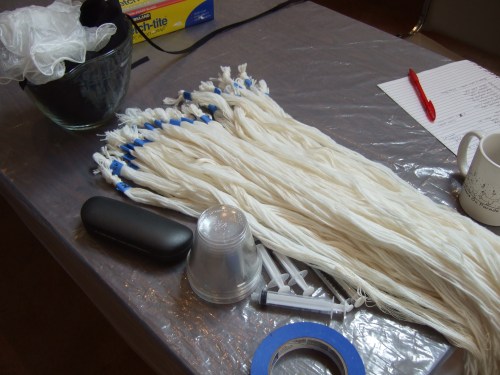 The fiber bundles contained 12 strands each of Cascade 220 (a basic wool knitting yarn), a laceweight wool/silk and a fine spun silk. Each type of fiber takes up the dye a little differently.
 After the bundles were steamed and cooled, we had to unwrap them and rinse them 3 times, then hang them to dry.
 You think that was a repetitive task? But wait, there’s more! The next day we spent taking apart each bundle and tying 3 strands (one wool, one silk/wool and one spun silk) of each color onto 10 pre-printed cards.
 This was a task that did not get finished. I have some here at home that I am still working on, but eventually we will all get the finished cards with everyone’s samples.
 Twisp of Fate